Tuesday, May 1, 2018

MUSICAL MASH-UP


MUSICAL MASH-UP

All musicals! A spelling bee, tapping feet, conjoined twins, Victorian orphans, and singing and dancing kitty cats. It's all here! This is a longish post, so get some coffee, get comfortable, and let's begin.

THE 25TH ANNUAL PUTNAM COUNTY SPELLING BEE – Circle in the Square, New York
June, 2005. With over 1100 performances on Broadway and thousands of amateur and professional productions, making its creators and licensor MTI lots of coin, it's obvious many people like The 25th Annual Putnam County Spelling Bee. I am not among them. Rather than the charming, feel-good show that I was eagerly anticipating based on the rave reviews I'd read, I found Spelling Bee to be a predictable, stereotype-laden show, skillful in concept and execution, but with too little heart and too much quirky-for-quirkiness' sake and a underlying smugness shouting "look how cute and clever we are!" that was present throughout the show. The audience participation segment was poorly handled, with the cast clearly rattled by a really good volunteer. That whole thing became awkward and uncomfortable. When the adult actor playing a middle-school-aged boy sang about his "unfortunate erection," it came off as smarmy and creepy rather than funny or fondly reminiscent of the perils of male pubescence. Earlier dialogue established the character's "problem," and that was funny, and the joke was made. Singing about it was too much. The obnoxious character, Barfee, won the Bee, and if that surprised anyone in the audience, they simply weren't paying even the most cursory of attention. Where You're a Good Man, Charlie Brown is charm from beginning to end, Spelling Bee had an almost total lack of it. Perhaps it was because of the lukewarm reaction from the audience, especially after the botched audience participation segment that resulted in some walkouts, but the cast often appeared to be pushing it, trying too hard to win over the sell-out crowd. A lot seemed forced, little seemed natural. The cast did what was asked of them. They were competent and professional, if not especially memorable. I did really like Jesse Tyler Ferguson, who gave Leaf Coneybear a goofy lovability. I also admired Celia Keenan-Bolger's ability to overcome the stereotype she was given and make Olive Ostrovsky a real person. Tony-winner Dan Fogler as William Barfee did his bit and was fine, but it didn't feel like a Tony-winning performance. I realize that I am in the minority with my opinion of the show, but that opinion is based on what I saw onstage at the Circle in the Square on June 17, 2005. I believe the show could be improved by eliminating the audience participation, changing the Bee participants from middle schoolers to high schoolers, and, most of all, have multiple endings a la Edwin Drood. Don't let the obnoxious Barfee win all the time. (For the record I wanted Leaf Coneybear to win.) Furthermore, I feel Spelling Bee needs to decide if it's a family-friendly show or a "kids" show for adults. (I wouldn't take my 8-year-old granddaughter to a musical where a song about penile erection is sung. I'll leave that conversation to her parents.) I really wanted to like it. Sadly, I didn't. – at the Circle in the Square, New York
Sidebar: Spelling Bee alumni Jesse Tyler Ferguson, Lisa Howard, Jose Llana, and Celia Keenan-Bolger would go on to other Broadway shows, and Ferguson would become a household name in the groundbreaking television series, Modern Family. Kate Wetherhead, an understudy in the production, would co-create, write, direct, and star in the not-to-be-missed web series, Submissions Only. Dan Fogler took his Tony Award and left Broadway to have a successful career in television, film, and stand-up.

SIDE SHOW – Stage 773 (Porchlight), Chicago
September, 2015. Preview performance. The men fared better than the ladies in Porchlight Music Theatre's Side Show, and considering this is the story of the Hilton sisters, conjoined twins Daisy and Violet, the women should have been our focal point. But they weren't, and I suspect that is because the two leading performances just didn't land. Oh, Colleen Fee and Britt-Marie Sivertsen sang the fabulous score well, but there was a lack of chemistry between the two actresses. Overall, however, this production was worth seeing. Ignore the occasional, well, more than occasional creaks in the show's construction and relish in the remarkable score that was sung well by the cast and professionally played by the small, but adroit, orchestra. Great-looking set; the less said about the wigs and costumes, the better. The young cast lacked credibility in the older roles and the show could have been enhanced by casting a few more seasoned performers, especially in the more mature roles. I'm not a huge fan of Porchlight, but this was one of their better shows, a commendable production of a difficult show. – at Stage 773, Chicago

42ND STREET
– Winter Garden Theatre, New York
 42nd Street did not stay long at its original home, the Winter Garden. The marquee is still up, but a banner tells customers the show is now playing at the Majestic.
 The front of the Winter Garden. I love this theatre.
The iconic nearly block-long Winter Garden billboard.
October, 1980. The ultimate valentine to Broadway and the enduring dream of becoming a star. This, the
original production, remains Gower Champion's legacy to the theatre and the world. It arrived on Broadway on August 25, 1980, with the roar of a prolonged audience ovation and the devastating announcement delivered from the stage by producer David Merrick that Champion had died earlier that day, leaving the cast, the audience, and the world stunned. Perhaps not the time or the place for such an announcement, but it all but guaranteed favorable press and lines at the box office. Both occurred, and with good reason, for 42nd Street was a triumph, exuberant in its spectacular dances, joyful when singing the timeless songs from Harry Warren and Al Dubin, and period-stylish as acted by a cast of seasoned veterans and a spectacularly talented ensemble. Who wouldn't thrill to the now legendary opening? The overture ended as the curtain rose just enough to reveal a stage full of feet furiously tapping away. Then the curtain rose completely, and we saw the ensemble, all thirty-six of them, yes, that's right, thirty-six, dancing their collective hearts out. Thrilling. Breathtaking. The very definition of show business. The book, oddly billed here as "Lead Ins and Crossovers," by Michael Stewart and Mark Bramble, based on Bradford Ropes' novel, got us from one number to the next with little fuss. The plot about the fresh-off-the-boat, or, in this case, fresh-off-the-bus, chorus girl who fills in for the established star and becomes an overnight sensation is complete nonsense, of course, but, 42nd Street is a fairy tale of show business, and who doesn't like a great fairy tale? And what about that original cast? Tammy Grimes as diva Dorothy Brock was simply delicious…all haughty attitude and star presence with her signature and inimitable voice. Jerry Orbach, one of the theatre's treasures, played director Julian Marsh with a twinkle in his eye and made everything look effortless. Lee Roy Reams danced his heart out as Billy Lawlor. Joseph Nova and Carole Cook were perfection as the show-within-a-show's authors, all delightfully piss and vinegar. Danny Carroll, James Congdon, Don Crabtree, and Karen Prunczik rounded out the supporting players. Wanda Richert, making her Broadway debut, was appropriately demure, sweet, and fresh out of Allentown, Pennsylvania, and knocked the part out of the park with her dancing. And big kudos to the design team of Robin Wagner (scenic), Theoni V. Aldredge (costumes), and Tharon Musser (lighting) for giving 42nd Street a lush, lavish look…legendary designers at their best. The show would play an astounding 3486 performances at three theatres (the Winter Garden, the Majestic, the St. James), winning the 1981 Tonys for Best Musical and Best Choreography. It is currently the 14th longest-running Broadway show. I loved every minute. – at the Winter Garden Theatre, New York
Beware of Boxes: The only seat I could get at the last minute for 42nd Street was a lower stage left box. While it was perfect for being up close and personal when the action was center, much of what was happening upstage and stage left was unseen. I could hear stuff going on, but couldn't see it. When the touring company came to Chicago for the first time and I was sitting in a center orchestra seat, I gasped, "My God, there is scenery!" Moral of story: box seats suck.
More Than Just Broadway Babies: Karen Prunczik made her Broadway debut as Annie. She was also having an affair with producer David Merrick, forty-five years her senior, would become wife number 5, and be divorced a short time later in a bitter divorce with allegations that Prunczik in real-life was playing the golddigger role that she did eight times a week in 42nd Street. She has since dropped the "C" and as Karen Prunzik made her last appearance to date in 1995 as Dorothy Shaw in a critically-trashed revival of Gentlemen Prefer Blondes. She currently runs a dance studio in her native Pennsylvania. Wanda Richert, aka Peggy Sawyer, was Gower Champion's lover at the time of his death. Champion was still married, though separated, to his second wife, Karla, a fact Richert claims not to have known at the time. She was Chicago's Cassie in A Chorus Line, and was very good, if, at 20, far too young for the role. In a curious twist, she would have health issues and was fired from the tour by Michael Bennett. She would last appear on Broadway in the mid 80s and would, ironically, reprise her performance as Cassie in a tour of A Chorus Line in the early 90s. She is currently an interfaith reverend, and, according to her LinkedIn profile, a "Broadway legend." Uh…Legend? Nah. Don't think so. And here's a fun fact: Prunczik and Richert were roommates during the early days of 42nd Street.

– Civic Opera House, Chicago
January, 1983. Launching its tour at the Art Deco beauty known as the Civic Opera House, the First National Tour of 42nd Street looked and sounded mighty fine in its snazzy digs. And with scenery! (see above) Personal favorite Elizabeth Allen was a tart-tongued, smooth-singing Dorothy Brock and Tony-winner Ron Holgate (1776-Best Featured Actor in a Musical) lent his booming voice and comedic talents to Julian Marsh, and pert Nancy Sinclair, Wanda Richert's understudy in New York, was a dynamic Peggy Sawyer. As a bonus, Broadway stalwart and Dolly standby for seven years, Bibi Osterwald gave a supporting role star treatment as Maggie Jones. Top drawer production, first class cast.  – at the Civic Opera House, Chicago

Exeunt "Lead Ins and Crossovers"; Enter "Book": It's been suggested that David Merrick's decision to initially refer to Michael Stewart and Mark Bramble's libretto as "Lead Ins and Crossovers" rather than "Book" cost them the Tony Award for Best Book that season. By the time the show reached Chicago, the billing had long been changed back to "Book." For the record, Peter Stone won that year for Women of the Year, which was an inferior show, but with a stronger book.
From the Trouble in Paradise Files: Karen Prunczik, the original Annie on Broadway and now Mrs. David Merrick, was listed in the Chicago Playbill as Annie, and was in the cast on opening night, but, in late January, an insert told us  that "the role of Annie is now being played by Cathleen McGowen." According to sources, Prunczik was fired days after the show opened in Chicago. A few weeks after that, Merrick suffered a debilitating stroke, and shortly after that, divorce papers were served to Prunczik, and bitter, acrimonious divorce proceedings ensued. Well, all right then! You just can't make this stuff up!

– Shubert Theatre, Chicago
 Not sure why David Merrick decided on a new graphic for the show. I think it's kinda cheesy.
January, 1985. 42nd Street returned to Chicago two years later when the Second National Tour made a stop at the Shubert for a six-week engagement.  This time around Dolores Gray and Barry Nelson played Dorothy Brock and Julian Marsh. Gray lent the part some old-fashioned glamour, and Nelson, definitely not much of a singer, was a gentler Marsh than either Orbach or Holgate. Gail Benedict, a 42nd Street veteran, tapped and sang Peggy Sawyer with skill. Singer and television personality (a regular on The Gary Moore Show) Denise Lor played wise-cracking Maggie Jones. Producer David Merrick was notorious for being, well, a nasty piece of work. He was also notorious for making sure his touring productions looked just as good as their Broadway counterparts, and cast his tours with both an eye to the box office and an eye to talent. In the smaller confines of the Shubert Theatre, this edition of 42nd Street looked big, bold, and sumptuous. But, I must confess, I liked the Opera House production better. – at the Shubert Theatre, Chicago
Critic Fail: In his review, Chicago Tribune critic Richard Christiansen called Gail Benedict "a little too old, but a terrific singer and dancer." Excuse me? Bit cheeky, don't you think? He also referred to James Mellon, who played romantic lead Billy Lawlor, as "pearly-toothed." Richard, Richard, Richard!
 The "pearly-toothed" James Mellon demonstrates his dancing chops.
"A bit too old" Nancy Sinclair kicks like a youngster.Stars and old pros Dolores Gray and Barry Nelson.


– Ford Center for the Performing Arts, New York

June, 2001. The first, and to date only, revival of 42nd Street won 2001 Tony Awards for Best Musical Revival and Best Performance by a Leading Actress in a Musical. In both cases, these are best-of-an-indifferent-lot wins, although I will argue strenuously that Blythe Danner should have won the Tony for a razor-sharp performance as Phyllis in a muddled revival of Follies. We saw this ten days after the Tonys. The show should still have been on a high after their wins. Instead, what we saw was a professional, thoroughly solid production with precision dancing, but little heart. We saw a product, not a show, which was disappointing because I really like this old chestnut of a show. For the revival, a new scene and song ("I Only Have Eyes for You") was added for star Christine Ebersole and cabaret maestro Billy Stritch that added nothing to the show, and, in fact, ground everything to a screeching halt. All the performers (Michael Cumpsty, Mary Testa, Jonathan Freeman, David Elder, Billy Stritch, and Kate Levering) were fine, with one notable exception, Tony Award winner Christine Ebersole, who phoned in her performance. She did what she had to do, and that, my friends, was that. In true David Merrick style, the show once again had a huge 36-person ensemble, remarkable for the economics of 2001, lots of glitz, and nice big sound from the pit. The audience clearly grooved on it, and despite a mixed critical reception, including a very negative one from the New York Times, the show went on to a profitable run of over 1500 performances. The songs and dances still shone brightly, but I missed the original. – at the Ford Center for the Performing Arts, New York
Casting Notes: The wonderful Beth Leavel, who would win her own Tony a few years down the road, was the standby for Dorothy Brock and Maggie Jones (Christine Ebersole and Mary Testa). Richard Muenz, who played Ebersole's former partner and romantic interest in this production, played Lancelot to her Guenevere in a revival of Camelot. Megan Sikora, who we loved in Paper Mill's Can-Can, was in the ensemble.

– Ford Center for the Performing Arts, New York

August, 2003. Jump ahead two years. When I was flying, whenever I had a NYC layover, I would try to go into Manhattan and see a show. On this trip, my captain asked if he could tag along because he'd never seen a Broadway show. Well, I'm always delighted to introduce the wonders of Broadway to someone, so off we went to the TKTS booth. While on line, he mentioned that he and his wife were into ballroom dancing, and I knew right then the perfect show for both a Broadway neophyte and a dance aficionado…naughty, bawdy, gaudy, sporty 42nd Street. Even though my previous experience with the current revival was less than satisfying, I knew that two years had passed and the show now had a different cast, plus, the show itself is great fun with the timeless tunes, the terrific dancing, and all the accompanying glitz and pizzazz. And all I can say is what a difference two years made! Original cast member David Elder was still dancing his feet off as Billy Lawlor, but overall this was a completely new cast. Patrick Ryan Sullivan was a better fit for Julian Marsh than Michael Cumpsty and gave off a understated sexiness, but also gave a hint of ruthlessness. The real revelation, however, was just how absolutely wonderful Beth Leavel was as Dorothy Brock. Night and day from Christine "I'll Phone It In" Ebersole. She was bitchy, she was funny; she was glamorous; she was imperious; she was every inch the past-her-use-by-date diva trying to hold on to whatever fame she still had. She sang like a dream. She was divine! The show, with its August, 2003 cast, seemed brighter, more fun, crisper, and a better show all around. For the record, my captain loved it. So did I. – at the Ford Center for the Performing Arts, New York

– Cadillac Palace Theatre, Chicago
March, 2016. The VERY young non-Equity cast worked hard, often very hard, to keep us entertained, and I was entertained more often than not. The orchestra sounded terrific and the costumes sparkled, but the sets sometimes looked cheap, and at times the stage was so crowded, it made the dancing unfocused and muddy. Almost all of the principals were too young, resulting in competent, but unexciting performances. The lack of both stage experience and life experience was most glaringly apparent in the performance of Kaitlin Lawrence as Dorothy Brock. Too young by at least two decades for the part to have any resonance, she sang well and did her best, but she lacked the sophistication of a Tammy Grimes, an Elizabeth Allen, a Dolores Gray, a Beth Leavel. Matthew J. Taylor's performance as Julian Marsh, however, belied his young age. He was terrific. Well worth the 1/2 price ticket, but it will never be confused with an Equity company. - at the Cadillac Palace Theatre, Chicago

OLIVER! – Walnut Street Theatre, Philadelphia
 The venerable Walnut Street Theatre, Philadelphia

 Hugh Panaro is a total babe. Not, however, as Fagin.
You can see the attempts at dirtying up Nancy. From the audience, though, she looked spotless.

December, 2009. Lionel Bart's masterpiece, Oliver!, was the 2009 holiday offering at Philadelphia's venerable Walnut Street Theatre. The Philadelphia Inquirer was rhapsodic about the production gushing over the "adorable" kids and the "charming" adults and, with that, joining the ranks of millions who think Oliver! is an almost perfect family-friendly show. I don't get it. Seriously, I don't. In "Walking in a West End Wonderland – Part 3," I wrote in detail about my conflicted feelings toward this musical. It's score is admittedly glorious, but the light-hearted and jolly treatment most productions give to this dark Dickensian tale all but completely ignore what are, in my opinion, the two biggest elephants in the room: 1) the fact that the leading lady is brutally murdered onstage shortly after warbling the big hit tune; and 2) the fact that the leading man is, at best, a creepy, but innocuous perv who craves the company of little boys or, at worst, is a full-out pedophile. Mr. Dickens never overtly states in his novel that Nancy is a prostitute or that Fagin is a pedophile, but the subtext for both is in both novel and, if you exam the material closely, the musical. (Big Hint: Nancy wears the de rigueur red dress! Fagin is just a little too "my dears" with the boys.) I long for a darker version of this show, but it was not to be at the Walnut Street Theatre. Onstage was lots of color, lots of energy, a cast of fifty-one (!!) including twenty cute-as-a-button children, a peppy orchestra, and all the bells and whistles one associates with Oliver! For me, the character of Oliver is a plot point. Yes, he sings the poignant "Where is Love?" and starts off the lovely "Who Will Buy?," but he's really secondary to the two leads, Nancy and Fagin. Janine Divita made for a fine Nancy, bringing a buoyant attitude and a nice vulnerability to the part, and sang the dickens, pun intended, out of "As Long As He Needs Me." Note to Costumer and Make-Up Folks: Nancy should look like she's from the streets. There wasn't a speck of dirt or even dust on her, and her dress looked like it came straight from the cleaners. Overall, she was just a little too well-scrubbed. The revelation in this production, though, was Hugh Panaro's magnetic Fagin. The Philadelphia Inquirer thought his portrayal brought a much-needed dimension to a character often played as somewhat of a cartoon. True, Panaro brought an added dimension to the role, but where Howard Shapiro of the Inquirer saw a Fagin with a heart, I saw a subtle, but unmistakable malevolence lurking just below the surface of his outwardly criminal geniality. A look here, a way with a word or phrase there, the smile disguising the rot. It was a magnificent performance. Director Mark Clements is currently the Artistic Director of the Milwaukee Rep and has helmed many excellent productions there. The wonderful Rob McClure played Noah Claypool in this production. – at the Walnut Street Theatre, Philadelphia
Sidebar: The two-hundred-year-old, as of 2009, Walnut Street Theatre in Philadelphia was just as big a draw as the production on its stage and its star, the magnetic Hugh Panaro. Comfortable with all mod cons, the Walnut Street didn't feel like a 200-year-old playhouse. It was all rather contemporary, which was a bit disappointing. I was looking for a bit more elegance and old-school theatre. But, still and all, the Walnut Street is America's oldest theatre, so attention must be paid.

CATS – Elgin Theatre, Toronto
 The glorious Elgin and Winter Garden Theatres.
Not "now and forever" perhaps, but it did score a very respectable two-year run before embarking on a Canadian tour.
September, 1985. This all-Canadian version of the Andrew Lloyd Webber homage to felines playing in a big litter box is largely credited with jump-starting Canada's musical theatre scene. Steve and I saw this about six months into its two-year run at Toronto's Elgin Theatre. "Jellicle Songs for Jellicle Cats" started the evening off in grand style and I was thinking to myself, "Why all the negativity and bad-mouthing of this show? This is terrific!" But then, the show progressed, and, unfortunately I went, "Oh. Now I get it!" Some songs were better than others, "Macavity" was really quite fun, but in the second act, "Gus: the Theatre Cat/Growltiger's Last Stand" played out for nearly twenty agonizing minutes, and I thought I would slit my wrists I was so bored. Cats' big takeaway tune, "Memory," was given a star diva rendition by Kathy Michael McGlynn, who basically eschewed all attempts at characterization and just belted out that puppy. It was, truthfully, freaking amazing. Had nothing to do with the show, but wowzer! I've seen far worse; I've seen far better. Mediocre show; entertaining pablum. – at the Elgin Theatre, Toronto
Sidebar: The Elgin/Winter Garden Theatres in Toronto are the last surviving Edwardian stacked theatres in the world, i.e. the theatres are on top of one another. They are, deservedly so, a National Historic Site of Canada. Bob and I have taken the tour of the theatres twice and will probably do it again on our next visit to Toronto.

And with that…until later! TTFN!
© 2018 Jeffrey Geddes

Friday, April 13, 2018

ALPHABET SOUP (13): FEATURING A RANDOM LETTER OF THE ALPHABET AND SOME SHOWS THAT BEGIN WITH THAT LETTER

  ALPHABET SOUP (13):
FEATURING A RANDOM LETTER OF THE ALPHABET AND SOME SHOWS THAT BEGIN WITH THAT LETTER

B
Today, the blue London mug gave me the letter "B" … a classic Inge, a hit revue featuring music of the Harlem Renaissance era (1920-1940) written by African-American song masters, a one-woman show starring the dazzling Caroline O'Connor, a Lerner and Loewe masterpiece, a Sondheim show that has never really landed, a quintessential Ayckbourn farce, and Peter Allen's life, Broadway style, that featured one of the most breathtaking performances I've seen.

BUS STOP – Ivanhoe Theatre, Chicago


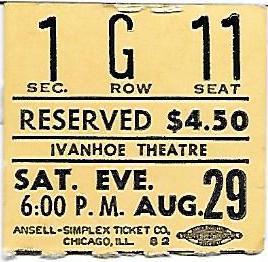
August, 1970. Even though only fifteen years had passed since Bus Stop opened on Broadway, Chicago reviewers praised the actors, but found the play itself to be coy, a little too twee. A lot happened in those fifteen years: three gut-wrenching assassinations, the escalation of an unpopular and doomed war resulting in riots and protests, Stonewall, Hair on Broadway featuring a glimpse of full-frontal nudity, Oh, Calcutta! on Broadway, a musical revue featuring sketches by some leading talent of the time, that featured lots of nudity, the Sharon Tate/Manson murders, the rise of the counterculture and the younger generation questioning the status quo and the politics of power, the Democratic convention in Chicago in 1968, the moon landing. Given all that, it's not surprising that a gentle, unprepossessing show about a group of people stranded in a Kansas diner in a blizzard would seem a bit dated and quaint. But this production, expertly directed by the remarkable George Keathley, had a cast, including Chicago vets George Womack, Marrian Walters, and Bob Thompson, that enchanted the audience. No matter how good the supporting players, if the leading roles of would-be chanteuse Cherie and her cowboy would-be mate Bo Decker aren't played well, the play sinks. This production was blessed with the handsome and versatile Ben Piazza as Bo and the quirky, always fascinating Sandy Dennis as Cherie. Piazza would soon play the macho Nick in Ivanhoe's Who's Afraid of Virginia Woolf? and Dennis made a career out of playing wounded, flawed characters in both comedies and dramas, as witnessed in Ivanhoe's A Streetcar Named Desire in which she played Blanche (!!) and the national tour of And Miss Reardon Drinks a Little at the Civic. Both Piazza and Dennis played their characters with affection and conviction and, as a result, the play had an unshakeable charm that almost hid the just-under-the-surface creakiness. A fine production all around. I thoroughly enjoyed it. – at the Ivanhoe Theatre, Chicago
Sidebar: In Bus Stop's Broadway production, Elaine Stritch originated the part of Grace, the diner proprietress, and Kim Stanley originated the role of Cherie.
William Inge Sidebar: Repressed sexuality plays an important part in William Inge's four plays that are considered American classics: Come Back, Little Sheba, Picnic, Bus Stop, and The Dark at the Top of the Stairs. A closeted homosexual from very conservative Kansas, Inge only overtly referenced gay characters in a couple of works, but it's been suggested that Inge's conflicted sexuality infused the sexual conflicts in his plays. A 2015 Chicago production of Picnic with gender-bending casting was more admired than liked and, for some reviewers, brought Inge's sexual insecurities to the forefront. Inge committed suicide in 1973, ending a lifelong struggle with alcoholism and his sense of failure. While perhaps a bit racy in the 1950s with their sexual energy, Inge's plays are tame by today's standards.

BUBBLING BROWN SUGAR – Blackstone Theatre, Chicago


November, 1975. My research on the show tells me that there was a plot, of sorts, a sort of stroll down Harlem's memory lane with show biz old-timers sharing stories and songs with some youngsters as they walk through mid-1970s Harlem. If you say so. I vaguely remember "back in my day" moments, so I guess there was a storyline. What I do remember, however, is how this show sizzled with drop-dead outstanding performers, dazzling choreography and musical staging by Billy Wilson, a simply sensational onstage orchestra, and terrific songs, both especially written for the show and songs from the heyday of Harlem (1920-1940). Old pros Avon Long, Joseph Attles, and Thelma Carpenter were in fine form, but for me, the highlight of the show was Vivian Reed, a sultry seductress with a voice that simply caressed you. Any doubts, there's a clip of her from the 1976 Tony Awards on YouTube. There wasn't a weak link in the show and when the show arrived on Broadway a few months later, it would enjoy a profitable run of 766 performances. This musical revue did more than simply "bubble." It boiled over with talent and entertainment. – at the Blackstone Theatre, Chicago
Sidebar: Avon Long originated the role of Sportin' Life in several revivals of Porgy and Bess in the 1940s. Joseph Attles' career began in 1928, that's right, 1928, as a performer in Blackbirds of 1928. Vivian Reed, a Julliard graduate, would appear on Broadway only sporadically, but had a successful career as a singer and nightclub performer. (I think I may still have her 1976 album Brown Sugar.) Thelma Carpenter was a familiar name to me from her stint as Pearl Bailey's standby in Hello, Dolly!, going on as Dolly at least 100 times, and later becoming the publicized and fully-billed matinee star. She had a roller-coaster career and was replaced before the Broadway opening with Josephine Premice. Carpenter played Miss One in the god-awful film version of The Wiz.
Filling in for Pearlie Mae: As mentioned above, Thelma Carpenter filled in for Pearl Bailey at least 100 hundred times before being named the matinee Dolly. At eight performances per week, that means Carpenter replaced Pearlie Mae for, at minimum, 12 ½ weeks, or roughly 3 ½ months. That's a lot of filling in!

BOMBSHELLS – Quadracci Playhouse (Milwaukee Rep), Milwaukee


December, 2010. Dizzying, dazzling, dynamic portrayals of six completely different women all performed by the indomitable Caroline O'Connor made for a singular theatrical treat. In its U.S. premiere, and written for O'Connor, this was a one-woman show on steroids. Director Mark Clements wisely knew that all he had to do was give his star the framework and she would flawlessly fill in the details. Effective scenic, costume, and lighting designs put the icing on this multi-faceted cake. In rapid two hours, O'Connor played an Australian suburban housewife, an English abandoned wife, an Irish teenager, an Australian bride-to-be, an English widow, and a faded American diva. Each was individual, totally unique. The Milwaukee Journal Sentinel put it this way: "O'Connor consistently remakes the deliberately bare stage in the image of each woman's careening fears and desires." In my book, O'Connor can pretty much do no wrong. This was simply astounding. – at the Quadracci Playhouse (Milwaukee Rep), Milwaukee

BRIGADOON – Majestic Theatre, New York


October, 1980. Brigadoon holds a special place in my heart. When I was eleven or twelve, my grandmother took me to see a performance of Brigadoon produced by Waukegan Community Players in association with the Waukegan Symphony Orchestra. It was my very first stage production, and I was enraptured with the orchestra, the music, the actors, and the story of a village which appears once every hundred years. It has remained a favorite ever since. This production was the first major New York revival of the Lerner and Loewe classic, not counting limited run City Center productions. Featuring the original iconic Agnes deMille choreography, still divine, the show starred a radiant Meg Bussert as Fiona and a virile Martin Vidnovic as Tommy, a role completely opposite of his gripping performance as the brooding Jud in the previous season's Oklahoma! Together and individually, they were magic. UK Olympic figure skating gold medal winner John Curry and dancer Marina Eglevsky played the doomed Harry and Maggie, and were the principals in Brigadoon's two deMille masterpieces, "Sword Dance" and "Funeral Dance," respectively. Broadway vets Frank Hamilton, Jack Dabdoub, and Casper Roos played the older folks, Stephen Lehew, seen as Henrik in the tour of A Little Night Music, played the lovestruck Charlie, Mollie Smith played the thankless role of Jean, and Elaine Hausman did what she could with the annoying role of Meg. Brigadoon is a quintessential 40s musical, and as such, sometimes creaks a little. Personally, I'd eliminate most of Meg's part and especially her two songs, which are nothing but endless list songs that contribute absolutely nothing to the plot, and what may have been seen as slightly naughty and risqué in 1947, in 1980 was cloying. But, director Vivian Matalon knew if he treated the show honestly and with respect, the glories of it would shine through and make the occasional clunkiness irrelevant. I, and the audience of jaded New Yorkers who filled the Majestic Theatre, were enchanted. It was a thrill to see Brigadoon so magnificently produced, sung, and danced. I may have even gotten a little weepy at the end. – at the Majestic Theatre, New York
Fun Fact: Martin Vidnovic is Laura Benanti's father!
Sad Fact: Brigadoon would be John Curry's only Broadway musical and his second and last appearance on Broadway. (His first was a special limited engagement booking called Icedancing.) Curry would die in 1994 at the age of 44, a victim of AIDS, like far too many of my generation.
Sidebar: While I loved this production, I pretty much hated a 2014 "reimagined" production at Chicago's Goodman Theatre. Director/choreographer Rachel Rockwell just destroyed this lovely, gentle show. Not one of Goodman's finer moments. (See SUMMER SNAPSHOTS: NYC, WASHINGTON, MINNEAPOLIS, STORRS (WHERE?) AND CHICAGO - Summer, 2014 - Part 2 post.)

BOUNCE – Goodman Theatre, Chicago

August, 2003. Poor Bounce. It's been bounced around more than any well-intentioned musical should, pun definitely intended, with multiple name changes, revisions, songs added, songs dropped. And even with all that, the show, now called Road Show, has never received the type of critical love and/or respect usually given to a show by Stephen Sondheim. When Bounce began its world premiere run at the Goodman, the press gave it a rousing thumbs-down, with grudging respect for the score. But, instead of being the disaster I expected, the evening turned out to be entertaining, often somewhat of a hot mess, but entertaining. The story of the Mizner brothers, one a con artist and one the architect who put Boca Raton, Florida, on the rich and famous map, was told in big, broad strokes, so we never really got to know the brothers. The dramatic arc of the story was literally all over the place, and sometimes it was hard to follow what was going on. The cast tried mightily to put their flawed material over. Film legend Jane Powell played Mama Mizner with a film legend authority, though, and this is really unfair to Ms. Powell, it kind of seemed like box-office casting, rather than character-driven casting. No matter, she did well in an underwritten part, and when she wasn't onstage for Act Two, you didn't miss her. Tony-winner Michele Pawk brought strength to her role as Wilson Mizner's wife. Gavin Creel was earnest as Addison Mizner's lover. Howard McGillin played con man Wilson Mizner in fine voice, and Richard Kind played the closeted Addison with a nebbishy loveableness. Kind fared best of all the characters. It was directed by Harold Prince with a surprising lack of focus. Is this a vaudeville? Is it a musical drama? No one seemed to know. John Weidman's book was scattered, and Sondheim's score had a little bit of this, a little bit of that, some good, some not so good, but, let's face it, imperfect Sondheim is usually better than someone else's perfect. To date, it has never made it to Broadway. I suspect it never will. Flawed, but noble, I'm definitely glad I saw it. – at the Goodman Theatre, Chicago


What's In a Name?: When Bounce workshopped in 1999, it was called Wise Guys. Then, briefly, it became Gold! Then Bounce for the Chicago premiere and a subsequent engagement at the Kennedy Center. Revised and without an intermission, and with a downgraded Michele Pawk character, Bounce became Road Show and that's how it's licensed today. Making the show darker seemed to please the critics more, though that's relative, and this version has enjoyed runs at the Public in New York, the Donmar Warehouse in London, the Chicago Shakespeare, and regional theatres nationwide.
Fun Fact: Irving Berlin, you know, Annie Get Your Gun Irving Berlin, tried his hand at musicalizing the Mizner brothers with a show called, wait for it, Wise Guy. Wise Guy also had lots of other names: The Last Resorts, Palm Beach, The Mizner Story, and Sentimental Guy. The project never came to fruition. Berlin was a friend of Addison Mizner and even invested in Mizner's Boca Raton project, which ultimately tanked. Fascinating to think how different a Berlin Mizner musical would sound as opposed to the Sondheim one.

BEDROOM FARCE – Brooks Atkinson Theatre, New York


Judy Ivey? Judy? Look how young Lithgow, Ivey, Schramm and Cuervo look! Lithgow was a muffin in his younger days.

August, 1979. Playwright Alan Ayckbourn is one of Britain's most prolific and successful playwrights. He achieved his greatest fame writing about marriage and the British middle classes with such works as Absurd Person Singular, The Norman Conquests, How the Other Half Loves, and Bedroom Farce. The reason I saw this was to see Mildred Natwick, so indelibly unforgettable as the mother in Barefoot in the Park and who was luminous on the cast recording of 70, Girls, 70, a truly underrated Kander and Ebb musical. The play focuses on themes of marriage and relationships, young and old, and the effect adultery and lying have on relationships. The action, under the direction of playwright Ayckbourn and Peter Hall, was fast and furious as it bounced from bedroom to bedroom to bedroom. Although often quite funny, it wasn't the madcap farce I was expecting, and I was a bit disappointed. I wasn't disappointed, however, by Mildred Natwick. She was every bit as wonderful as I had hoped, with precision comic timing and a warmth that enveloped the theatre. Every bit her equal was Robert Coote, the original Colonel Pickering in My Fair Lady and the original King Pellinore in Camelot. Rounding out the cast were such talents as John Lithgow, Alma Cuervo, John Horton, Lynn Milgrim, David Schramm (in the 90s, a regular on Wings), and, in her Broadway debut, Judith Ivey. If, at the end of the evening, it all felt a bit flat, seeing Mildred Natwick more than made up for any reservations I may have had. – at the Brooks Atkinson Theatre, New York

Sidebar: When the play debuted on Broadway in March, 1979, it featured its original London cast. When this cast took over, the New York Times remarked that the American cast worked better as an ensemble and focused more on the funnier sitcom elements of the play. Bedroom Farce would close a financial failure after only 276 performances. Alan Ayckbourn is also the author of the nifty thriller Haunting Julia, which we saw in Edinburgh a few years back (see HAVE PASSPORT, WILL GO TO THEATRE - Part 2 post.)

THE BOY FROM OZ – Imperial Theatre


December, 2003. New Year's Eve, 2003. Police barricades blocked off 45th Street between 7th and 8th, and bags and theatre tickets were checked by the NYPD to make sure you had a reason to be on 45th Street. Uber security? Perhaps, but I felt safer on a New York street than I ever had before or since, for that matter. What this all meant, though, was that getting to the Imperial was slow-going, and as a result, when the 7:00 PM curtain time rolled around, there were many empty seats for the sold-out performance. Promptly at 7:00, the house lights went to half, and then Hugh Jackman came out and announced that the curtain would be held for twenty minutes to allow folks to get through the enhanced security so everyone could see the show from the start. What a guy! And with that, we all applauded like mad, and, well, could we possibly love him more? As it turned out, we could. In fact, we loved Hugh Jackman so much we all were perfectly willing to ignore the fact that his show was, well, rubbish. Entertaining rubbish, very entertaining rubbish, but rubbish nonetheless. Certainly no one could fault the terrific Peter Allen songs, but Martin Sherman's book, based on the original book by the late Nick Enright, was a series of bits rather than an actual story where we got to know The Boy from Oz, Peter Allen. There were early Peter bits, Mom Marion bits, Liza bits (Allen was Liza's first husband), Judy bits (Allen was Judy's son-in-law), long-time lover bits, lover dying bits, ghost bits, concert bits, but nothing with anything resembling depth or nuance. Production-wise, it was often glitzy and flashy. Philip Wm. McKinley's direction and Joey McKneely's choregraphy got the job done with neither embarrassment nor distinction. Leslie Alexander filled in for Beth Fowler as mom Marion as was appropriately warm and matronly and sang the oddly-placed "Don't Cry Out Loud" with verve. P.J. Verhoest was playing Young Peter that night and was appropriately endearing. Tony-winner (Damn Yankees) Jarrod Emick was appropriately moving as long-time lover Greg Connell, and the "Love Don't Need a Reason" duet with Jackson was especially touching. Isabel Keating as Judy Garland was just eerily, almost creepily, like the late icon and for the brief time she was onstage, gave the show a stunning verisimilitude. And there was something pretty damn wonderful when Keating and Jackman sang "Quiet Please. There's a Lady on Stage."  I, frankly, hated Stephanie J. Block's Liza Minnelli. Her Liza just seemed off, especially went placed side-by-side with Keating's spot-on interp. She wasn't bad, mind you; I just wasn’t a fan. But when all is said and done, The Boy from Oz was all about Hugh Jackman. Jackman sang; Jackman danced; Jackman flirted outrageously with the audience. Well before the final curtain fell, I don't think there was a man or woman in the audience who didn't want to be Jackman's friend, lover, or somewhere in-between. It all seemed effortless on his part, and best of all, Jackman appeared to be having a blast. High energy that never flagged, he gave his audience one hundred percent and then some. What was onstage at the Imperial was perhaps more Hugh Jackman and less Peter Allen, but Hugh Jackman's performance was, and remains, one of the most flat-out amazing performances that I've seen. Single-handedly, he took a mediocre property and elevated it to show biz magic. And I loved practically every minute! – at the Imperial Theatre, New York
Sidebar: I saw Peter Allen live once at a star-studded AIDS benefit at the Chicago Theatre in the mid 1980s. I believe he opened the second half with a two or three song set. Flamboyant, charismatic, and always eager to please, qualities he shared with the man who would portray him in 2003, he was one-of-a-kind. His death from AIDS in 1992 was a major loss.
Another Sidebar: A major hit in its native Australia, The Boy from Oz was the first Australian musical to be presented on Broadway. Hugh Jackman didn't miss a scheduled performance during its 396-performance run, including previews, and despite mediocre reviews for the show, his presence would propel the show to profitability. He would also win the 2004 Tony for Best Actor in a Musical for his sensational Broadway debut.
Yet Another Sidebar: Trying to insert a song catalog into a book show is tricky business. Sometimes it works; sometimes it's less successful. Jersey Boys probably did it best, followed closely by Mamma Mia!'s surprisingly successful shoehorning of ABBA's hit tunes into the silly plot. Another Aussie import, Priscilla Queen of the Desert, struggled with its score and that hurt the show overall. The Boy from Oz wasn't as good as the ABBA and not as unsuccessful as Priscilla, which could have hugely benefited from some original songs.
Final Sidebar: Just how much The Boy from Oz benefitted from Hugh Jackman's participation was evident when a local Chicago production was mounted a few years back. The show's many flaws were on full display and no matter how mightily the cast tried, they just couldn't surmount them. A cheesy physical production and a lame ensemble didn't help matters.  Valiant effort, but without all the bells and whistles and a charismatic star, it often just sort of sat there.   

And with that…until later! TTFN!
© 2018 Jeffrey Geddes

CONCERTS AND TUNERS AND PLAYS…OH, MY! - vol. 1

  CONCERTS AND TUNERS AND PLAYS…OH, MY! vol. 1 Spring is finally here. And what better way to celebrate than by strolling down theatrical ...