Showing posts with label Raul Esparza. Show all posts

Friday, September 8, 2017

MUSICAL MAYHEM: MY TOP TWENTY-FIVE MUSICALS – Part 13b: THE TOP TEN – #6

MUSICAL MAYHEM: MY TOP TWENTY-FIVE MUSICALS – Part 13b
THE TOP TEN – #6

NOTE: Due to the length of this entry, I'm dividing it into two parts. This is part two of two.


And picking up where I left off in Part One...more Company!


10:30 PM? Say what?


Interesting billing for Melissa Hart. Although listed second, the font size is the same as most of the cast except for Davis and Dailey. One could argue, with justification, that as far as Chicago audiences were concerned, she was equal to Irene Dailey and Michael Davis as far as star power.


Melissa Hart was hugely popular in Chicago, playing both Sally Bowles in Cabaret and Fran Kubelik in Promises, Promises in lengthy runs at the Shubert. She won a Jefferson Award for her portrayal of Amy. She would pretty much retire from performing in the 70s, get her MFA, now teaches in St. Paul, and continues to act. A few years ago we saw her as Mrs. Higgins in My Fair Lady at the Guthrie. 

September, 1972. A present to me from me on my 22nd birthday. This locally-mounted Company was the first musical produced at the Forum Theatre in suburban Summit, a newly-opened 425-seat proscenium house next door to its older, very successful in-the-round sibling, the superlative Candlelight Dinner Playhouse. With a cast of Chicago and New York actors and starring Michael Davis, Irene Dailey, and Melissa Hart, this was the Chicago premiere of the Tony-winning musical. The touring company slated to play the Shubert earlier in the year had cancelled its engagement due to unexpected poor box office sales. Seriously? Wow. Everything about this production was first-rate, yet I felt the production didn't quite work. Melissa Hart, a favorite of mine from the Chicago tours of Cabaret and Promises, Promises, was terrific as Amy. Michael Davis, the full-throated Rutledge of Chicago's 1776, was a handsome, suitably remote Robert, and he sang the crap out of the songs. Irene Dailey, while certainly an accomplished actress, didn't do it for me as Joanne, however. Now, that could very well be because the only Joannes I had seen up to that point had been Elaine Stritch and Jane Russell, both formidable ladies whose performances were a combination of powerful personalities, talent, and an abundance of star power, and compared to them, Ms. Dailey's performance, though assured, didn't quite cut it. Now please understand, I didn't dislike this production because I did like it. Quite a lot. I just wasn't in love with it. – at the Forum Theatre, Summit, IL
Sidebar: According to the program, the orchestra for this production numbered three musicians who played over a dozen instruments. I remember a full sound, so bravo, ladies and gentlemen of the orchestra. Cast as Jenny, Ami Silvestre would sizzle as Phyllis in a widely-acclaimed production of Follies a year or so later at Candlelight. Iris Lieberman, Marta in this production, would become a staple on the Chicago theatre scene and is still active today. Sadly both the Forum and Candlelight would close debt-ridden in 1997.
Holy Second Show, Batman!: On Saturdays, the Forum's performances were at 7:00 PM and a mind-boggling 10:30 PM. What this means is that Company's second show didn't come down until after 1:00 AM! And they had a show at 3:30 the following afternoon! No. Just no.


November, 1972. Just because I had mixed feelings about this production didn't mean I didn't want to see it again. Melissa Hart had withdrawn due to illness and was replaced by a very capable Judy Rice. Now a few months into its run, this was a tighter performance than the one I'd seen that September, but I was still underwhelmed with Irene Dailey. – at the Forum Theatre, Summit, IL


 October, 1995. It would be twenty-three years before I would once again visit Robert and those "good and crazy people," his married friends in Company. This was my first encounter with the superb Roundabout Theatre Company, a company that consistently turns out quality work. This was also the first Broadway revival since Company's premiere twenty-five years earlier. Scott Ellis' sparkling production, aided by Rob Marshall's choreography, didn't necessarily offer any new insights, despite the addition of "Marry Me a Little," cut from the original production, and revisions to the Robert/Peter/Susan scene that implies at least one homosexual liaison between Robert and Peter, but, then again, it didn't have to blaze new trails. Another interesting change was lyrically in "You Could Drive a Person Crazy" which replaced "I could understand a person if it's not a person's bag/I could understand a person if a person was a fag." with "I could understand a person if he said to go away/I could understand a person if he happened to be gay." Doesn't have the same pop, perhaps, but is far less offensive. And look at that cast, among them Danny Burstein, Kate Burton, Diana Canova, Veanne Cox, Charlotte d'Amboise (Kathy…danced up a storm), Jane Krakowski (April…terrific!), La Chanza (Marta…OMG!), and Debra Monk. Boyd Gaines opened the show as Robert, but experienced health issues early in the run and was replaced for most of it by understudy James Clow, who was terrific. This was the first time I saw Debra Monk, and I became an instant fan. She had the unenviable job of tackling a role so irrevocably identified with its originator, and making that role her own. Let's face it. It isn't easy following Elaine Stritch, even twenty-five years later, but Monk did it and did it extremely well. I liked her a lot. But the standout performance of this production was Veanne Cox, whose performance as Amy was breathtakingly funny and heartbreakingly touching at the same time. She stopped the show dead cold. A class production all around. It's always good to visit an old friend. – at Criterion Center Stage Right (Roundabout), New York


December, 2006. In 2005, director John Boyle brought a critically-praised production of Sweeney Todd, starring Patti LuPone and Michael Cerveris, to Broadway in which the actors doubled as the show's musicians. It was an interesting concept, one I felt didn't always work, but the critics went crazy for it and producers were probably ecstatic over the cost savings of not having to use both actors and musicians for a musical. So, a year later, director Boyle brought another Stephen Sondheim classic, Company, to Broadway, via Cincinnati Playhouse in the Park, and once again, the actors doubled as the show's musicians. And once again, an interesting concept, but, I'll admit it, I missed a full orchestral sound, and sometimes those damn instruments just got in the way. There were three instances, though, where this actors-as-musicians really worked: 1) In "The Little Things You Do Together," Barbara Walsh, as Joanne, played the triangle. In and of itself, that wasn't remarkable. What was remarkable was the look of total been-there-done-that that she gave the audience every time she rang the triangle. Priceless.; 2) Marta, Kathy, and April using saxophones instead of "do-do-do-do-DO!" during "You Could Drive a Person Crazy.; 3) Raúl Esparza accompanying himself on the piano for "Being Alive." A lovely touch. The electric "Tick Tock" was axed in this production, reducing Kathy's role to basically nothing, something I missed as a Company veteran. The production design was sleek and minimal and suited this production. The cast was uniformly good. Barbara Walsh's Joanne was dry and wise and she delivered a thoughtful, masterful "The Ladies Who Lunch." Esparza's Bobby was suitably vulnerable, suitably remote, and carried with him a simmering sexuality in every scene. However, and this is a big however, the entire performance suffered from a lack of energy. Everything was done well, but it was all very low-key. The show had opened a day or so earlier after a 4-week preview period, so perhaps everyone was tired and needed a couple of days off. Both the NY Times and Variety fainted over it. I less so. Curiously, I was mad about the PBS Great Performances video of this production. Made me want to see the stage version again. – at the Barrymore Theatre, New York
Sidebar: John Boyle tried a actors-as-orchestra Mack and Mabel in London. It got an indifferent reception there. And Watermill Theatre in the UK mounted a actors-as-orchestra Sunset Boulevard. While it's a bold concept, it does somewhat limit your casting. Not every bankable star and not every hard-working Equity actor can play an instrument. Patti LuPone played the tube in Sweeney Todd, and admittedly that was great good fun, but added nothing to either her character or the show. She could play the tuba, so she played the tuba.Today, the musicians are sometimes on stage and play an active part in the action, witness Bright Star and Come From Away, and sometimes the actors will play a bit here and there, but the full-blown concept of actors-as-orchestra has pretty much died down. I, for one, am happy about that.


April, 2011. Forty years after that performance seated in the last row of the Mezzanine at the Alvin Theatre. Recipe: Take a landmark 1970 musical. Add the New York Philharmonic Orchestra with the peerless Paul Gemignani as the conductor. Add a staggering cast of stars from the stage and television. Stir it with skillful direction by Lonny Price and choreography by Josh Rhodes. Put it on stage at Avery Fisher Hall at Lincoln Center. The result? A Company unlike any Company I've seen. Cast-wise, it was Company on steroids. In alpha order: Craig Bierko, Stephen Colbert, Jon Cryer, Katie Finneran, Neil Patrick Harris, Christina Hendricks, Aaron Lazar, Patti LuPone, Jill Paice, Martha Plimpton, Anika Noni Rose, Jennifer Laura Thompson, Jim Walton, and Chryssie Whitehead. Except for Robert, the ladies in Company have the meatier roles, always have, so before I go any further, I want to give a well-deserved shout-out to all the hard-working, under-appreciated guys in the show. Well done, gentlemen! And now, on to the ladies. Misses Paice, Thompson, and Whitehead all did well in the less-flashier female roles. Martha Plimpton's scene with Stephen Colbert was comic genius. Anika Noni Rose gave an urgency to the anthemic "Another Hundred People." Katie Finneran was simply delicious as the reluctant bride, Amy. Mad Men's Christina Hendrick as April was a revelation…touching, vulnerable, and very, very funny. And what about NPH, you ask? As Robert, he was the most adorable of the talented gentlemen I've seen as Robert, looked good shirtless, and anchored the show with confidence and ease, but that adorableness sometimes worked against him. I've never thought of Robert as being particularly adorable. Charming, funny, a pal…yes. Adorable, no. I'm being churlish. Harris' performance was solid and thoroughly enjoyable. But, the no-holds-barred, jaw-dropping performance of the evening was Patti LuPone as Joanne in a remote, chilling performance. Her hair-raising "The Ladies Who Lunch" threatened to blow the roof off of Avery Fisher Hall. This was LuPone at her absolute finest. So privileged to have been in the audience. This was not the definitive Company, the inimitable 1970 original still holds that title, but it certainly was the starriest. – at Avery Fisher Hall, Lincoln Center, New York

And finally...

A friend gave me this program. By March, 1972, the Broadway production had closed, and this tour was in its final months. Some of the last New York cast moved to the tour which was now doing bus-and-truck stops before ending in Washington in May. Tandy Cronyn, daughter of Jessica Tandy and Hume Cronyn, played Amy. Allen Case was Robert, and, perhaps most interesting, cabaret great Julie Wilson played Joanne. I've seen Ms. Wilson in her cabaret act. I can only imagine how wonderful she was in the role.

Company! Everybody rise!
© 2017Jeffrey Geddes

Tuesday, December 10, 2013

ALPHABET SOUP - Part 3!

ALPHABET SOUP (3)

It's that time again to shake up things, draw a letter from my blue London coffee mug and pick the first five shows from that letter's pile of programs.

Without further ado, drum roll, please…. Today's letter is….
U


Ready? Set? Go!


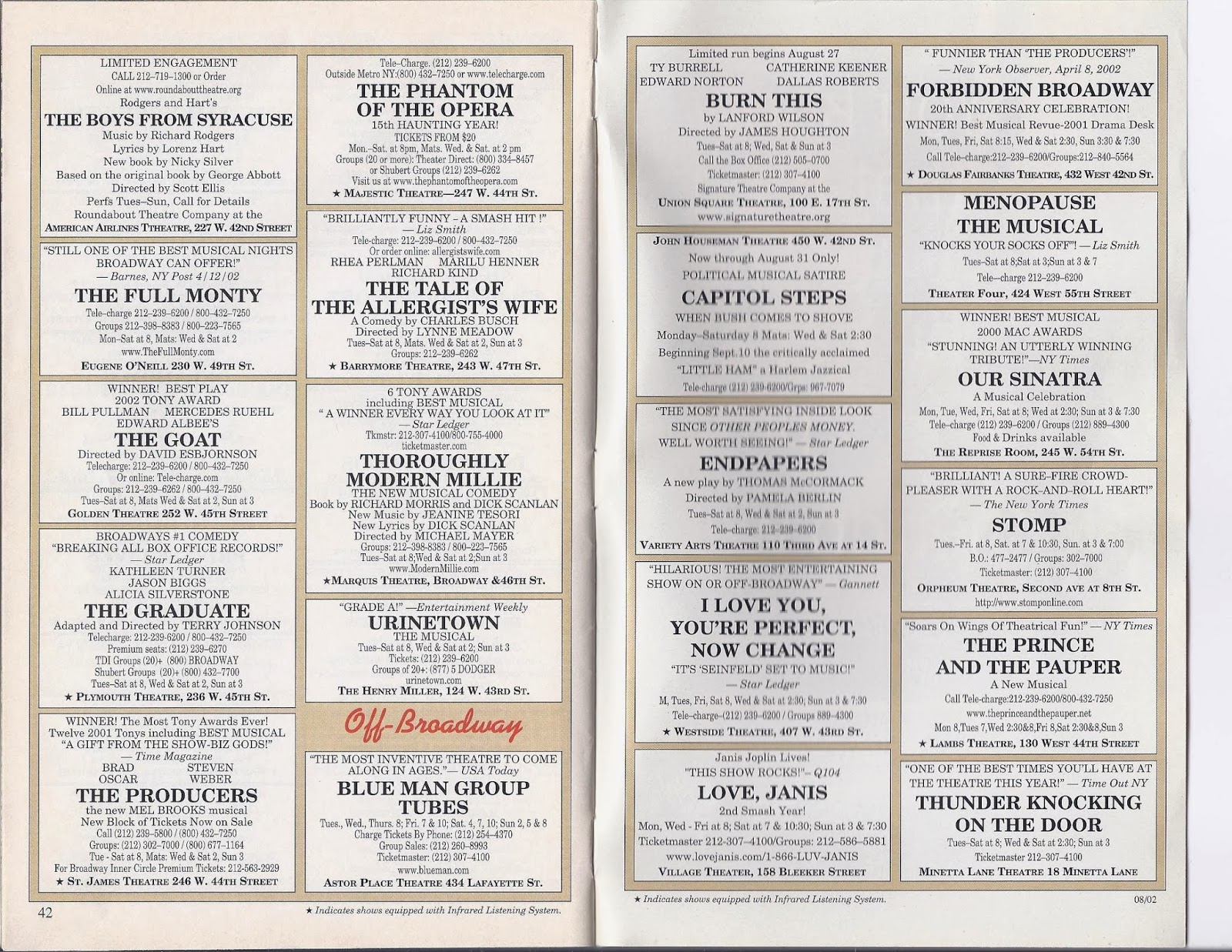
August, 2002. At the 2002 Tony Awards, Urinetown won three Tonys: Best Book of a Musical (Greg Kotis), Best Original Musical Score (Music by Mark Hollmann, Lyrics by Mark Hollmann and Greg Kotis) and Best Direction of a Musical (John Rando). Curiously, in spite of those three major wins, which are,  for all intents and purposes, the three most important creative components of a musical (designers, orchestrators, musical directors, choreographers and all you other important folk, you know I love you as well…xoxo), the Best Musical Tony went to the enormously entertaining and very traditional Thoroughly Modern Millie. At the time, the general consensus was that the Tony voters wanted to return to safer, more familiar ground after the sweep of the previous year's Tony Awards by The Producers. But winning book, score and directing Tonys isn't exactly chopped liver and Urinetown would enjoy a long and profitable run. This tart and tasty political satire about corporate and political corruption and greed, using the premise that people had to pay for the privilege to pee, as the song goes, was exquisitely written by Messrs. Kotis and Hollmann and directed to satiric perfection by Mr. Lando and produced at The Henry Miller, as it was called, as the final production before the theatre closed to make way for an office building. (The interior would be demolished and a gorgeous new theatre rebuilt. It reopened as the Henry Miller, but in 2010 was rechristened the Stephen Sondheim Theatre.) In 2002, The Henry Miller was a bit, well, dowdy. It had obviously seen better days and looked very rough around the edges. It was the perfect theatre for designers Scott Pask, Gregory Dale, Jonathan Bixby and Brian MacDevitt to work their magic and to set the stage for this wonderfully off-kilter show. Leading actors John Cullum and Nancy Opel were both out at the matinee we attended, but were skillfully covered by Don Richard and Rachel Coloff, respectively. Jeff McCarthy and Spencer Kayden were hysterical as Officer Comstock and Little Sally. Jennifer Laura Thompson was both luminous and clueless as Hope Cladwell and the really, really talented Hunter Foster was a terrific hero and stopped the show with the raise-the-roof "Run Freedom Run." For my money, though, the best song in the show is the devilishly evil "Don't Be the Bunny." Satire is hard to do. It can easily go south and just be unbearable. Really good satire is rare. Urinetown is really good satire. Think Threepenny Opera without the tiresome Brecht and Weill stuff. (No, I'm not a fan. Shoot me.) Bob and I laughed and laughed and laughed. It was truly an unexpected delight. - at The Henry Miller, New York
(Sidebar: a 2006 local sit-down production of Urinetown at Chicago's Mercury Theatre was embroiled in a copyright dispute with the creatives of Urinetown who accused the Chicago creatives of plagiarizing the work of the original director and designers. The Chicago production team vehemently denied the charges. The dispute caused the show to close suddenly and at a complete financial loss. The case was settled in federal court and the Chicago production team was ordered to pay the original Broadway team an undisclosed sum of money.)


A snapshot of what was going on in August, 2002. How did we miss Dance of the Vampires?


July, 2003. The marvelous American Conservatory Theater (A.C.T.) in San Francisco mounted this raucous reproduction of the Broadway original at its home base at the gorgeous Geary Theatre. The exceptionally strong cast was headed by Ron Holgate as Caldwell B. Cladwell, who seemed to absolutely relish his every moment on stage, Charlie Pollack as a handsome hero, the radiant Christiane Noll (one of the few good things in Jekyll and Hyde and who would dazzle us a few years later in the revival of Ragtime) as Hope Cladwell, Jim Corti as Hot Blades Harry, Beth McVey as Penelope Pennywise, Meghan Strange as Little Sally and the reliable Tom Hewitt as Officer Lockstock. Hewitt is a consistently fine actor and a favorite of mine. We went with Bob's brother Andy and his husband and sat in practically the last row of the Geary's second balcony. Once again we laughed lots. And take my word for it, the second balcony at the Geary Theater is very high and very steep. Not for the faint of heart. - at the Geary Theatre (A.C.T.), San Francisco

Oops! "U" had only one show, so let's draw again….drum roll……. And we have….
H


April, 2011. Matthew Lombardo's play about a recovering alcoholic therapist nun, a 19-year-old homeless gay drug addict and a priest with control issues was at times very, very funny, at times very, very dramatic and at times very, very melodramatic. The play starred the divine Kathleen Turner as the recovering alcoholic therapist nun, and, yes, it took me a moment or two to wrap my brain around that bit of casting. Kathleen Turner as a nun? No matter. She was a marvel. That inimitable voice combined with her commanding stage presence made her a force to be reckoned with. Evan Jonigkeit played the homeless gay drug addict in a powerful and sympathetic performance with an added dose of full frontal nudity for good measure. Stephen Kunken was fine as the priest and did what he could with the role, but his part was the weakest and easily overwhelmed by the showier roles of the nun and drug addict. I thought it was a powerful, if flawed, play with an accomplished cast, fine production values and good direction. Bob and I liked it; our friends were less than enthused. We saw a preview performance. Good thing, too, since, despite mostly positive notices from tryout productions in Hartford, Cincinnati and St. Louis, the play was soundly spanked by the New York critics and closed at the end of its first week of performances. I suspect it will have a profitable afterlife in regional, educational and amateur theatre. - at the Booth Theatre, New York


February, 2008. There is a scene in this chilling revival of Harold Pinter's The Homecoming where Raul Esparza, as Lenny, confronts his new sister-in-law, Ruth, played by Eve Best. (Yep, Nurse Jackie's Eve Best.) The scene was so quiet, so sexually charged, so dangerous, and in its way, so evil that it literally took my breath away. Rarely have I seen such understated and such powerful acting. Those few minutes alone were reason enough to see this masterful revival of one of Pinter's most highly-regarded plays. Raul Esparza was so robbed of the Tony that year. (Actually, so was this production. Best Revival of a Play Tony went to the slight, if extremely well-done, Boeing, Boeing.) This is not a happy play. It's filled with loathsome characters engaging in despicable behavior and you wonder if anyone among them has any normal interactions in society. The only moderately sympathetic character in the bunch, Teddy, played by James Frain, eventually yields to his monstrous family. Ian McShane played the head of the household and he was a nasty piece of work. (He was a delightfully over-the-top Devil in The Witches of Eastwick in London.) The always excellent Michael McGrath play McShane's brother and Gareth Saxe played brother Joey. They were all superb, but for me the acting honors went to Esparza and Best. I usually find Pinter on the obtuse side. Not this time. This was truly exciting theatre. - at the Cort Theatre, New York
(Note: in the National Tour of the original Broadway production, Carolyn Jones played Ruth. Yes, Morticia from The Addams Family was more than just smoldering looks and finger snaps. She was a well-regarded actress. I so wanted to see that production, I was still in high school when the tour played Chicago and I couldn't manage a matinee. I probably wouldn't have understood it anyhow at that age.)


July, 2011. Part The Boys in the Band, part My Night with Reg, part Love! Valour! Compassion! with a hint of Company thrown in, with none of the qualities of any of the originals, this so-called "epic" play had lots of zingy one-liners, but not a lot of heart and not a lot of characterization. An unlikeable leading character, though well-enough acted, didn't help, nor did the political/sociological riffs that didn't advance the plot. With one glaring exception, the acting was good, and two performances, Elizabeth Ledo and Stephen Cone, were outstanding.  At times I felt like I was at a production of "Party;" it had that camp-for-camp's sake mentality.  At about 2:15, it's at least 15 minutes too long and could probably be a very good play at a snappy, intermission-less 90 minutes.  To be fair, it was liked by the critics and the audience ate it up.  It wasn't bad; it wasn't good, and it does have some promise, but it won't become the next great gay play, even though that was clearly what the author intended this to be. - at About Face Theatre, Chicago


 This talented quartet...don't they all look so young!...would continue to shine in show business. 

September, 1995. At the risk of being tut-tuted, I must confess that I am not much of a Frank Loesser fan. I don't care for Where's Charley? at all, though that could just be a reaction to a bad audition for a local production a century ago down in Bloomington, but I think it's simply because I don't like the show. The supposed charms of The Most Happy Fella escape me. I don't think Guys and Dolls is one of the greatest musicals ever. And although on the cast recording, much of Greenwillow is actually quite beautiful, there are, sadly, more than a handful of real clunkers (e.g. "Clang Dang the Bell" and "Could've Been a Ring") Having said that, however, I'm wild about his zippy satire on big business, How to Succeed in Business Without Really Trying. The book is funny and pointed, as good satire should be, and the score is one great tune after another. By 1995, this show had long been a staple of community theatre groups and high schools, so the opportunity to see Broadway pros in a Tony-winning production directed by Des McAnuff and choregraphed by Wayne Cilento was not to be missed. Matthew Broderick won his second Tony for his portrayal of J Pierrepont Finch. Broderick has the charming hangdog thing down to an art and it worked to his advantage in this role. Pre-Will and Grace Megan Mullally was a total delight as Rosemary, free from Karen-isms and showing off impressive vocal chops. And look who played Smitty…Victoria Clark! Lillias White was a full-throated and funny Miss Jones, Jeff Blumenkrantz whined and kowtowed with vigor as Frump, Ronn Carroll was an appropriately pompous J.B. Biggley and Pamela Gold did a fine job subbing as Hedy. In the chorus were Jeffry Denman and Martin Moran! Enormously entertaining. - at the Richard Rodgers Theatre, New York


June, 1996. All-grown up at 33, the Karate Kid, Ralph Macchio, gave a solid, entertaining performance in the First National Company of the 1995 Broadway revival of How to Succeed in Business Without Really Trying. Duplicating the look and feel of the Broadway version, this was a high-quality tour with a troupe of seasoned actors including Shauna Hicks as Rosemary, Richard Thomsen as J.B. Biggley, Susann Fletcher as Smitty, who admirably gave a program nod as sharing her home and heart to her female partner and this was in 1996!, a big-voiced Tina Fabrique as Miss Jones, Roger Bart as Frump a few years before he skyrocketed to fame in The Producers, and as a special treat Pamela Blair (the original "Tits and Ass" girl) as Hedy. Professional and enjoyable. - at the Shubert Theatre, Chicago


August, 2011. The 1995 revival was pure pleasure, but the sparkling 2011 revival was an infectious, joyous romp, in no small measure thanks to the ridiculously wonderful performance by its leading man, is-there-anything-he-can't-do?, Daniel Radcliffe. When he was only 17, Radcliffe made an impressive West End debut that won him critical acclaim in the award-winning Equus. Critics were not only impressed by his considerable range as an actor, but also by the fact that he fearlessly shattered his Harry Potter persona by performing the famed nude scene with class and dignity. He repeated his Equus assignment on Broadway two years later in his Broadway debut and once again received acclaim from the critics. For only his second appearance on Broadway, Radcliffe chose to portray one of the most difficult young leading man parts in musical history, that of Finch in How to Succeed. This part requires the actor to not only be charming and impish and adorable, but also show cunning and ambition, yet that cunning and ambition can never be overpowering or threatening. Radcliffe carried the part with great élan not only due to his considerable talent, but also due to the fact that he worked tirelessly to make sure everyone in the audience had a terrific time. While he may not have carried off the singing and dancing chores with the same slick professionalism that a more seasoned musical performer would have, he more than compensated for it by sheer energy and a smile that made us feel like he was having the time of his life. And I suspect he was. The fact that he wasn't even nominated for a Tony Award still has me shaking my head in disbelief. Mr. Radcliffe wasn't alone in this endeavor, however. He was surrounded by an sensational group of fellow actors who added immeasurably to the fun. John Larroquette, in his Tony-winning role, was just so good as J.B. Biggley and the visual of the 6'4" Larroquette opposite the 5'5" Radcliffe was priceless. Rose Hemingway was excellent as Rosemary, Christopher J. Hanke pouted to perfection as Frump, Tammy Blanchard was a comic sexy Hedy, Mary Faber, Patty Goble and Rob Bartlett were great as Smitty, Miss Jones and Twimble, respectively. Brightly designed, directed and choreographed with crisp efficiency and played by a superb pit band, this was just pure joy. I was grinning from ear-to-ear when we left the Hirschfeld. - at the Al Hirschfeld Theatre, New York


That's it for today. More later....Ta!
© 2013 Jeffrey Geddes

CONCERTS AND TUNERS AND PLAYS…OH, MY! - vol. 1

  CONCERTS AND TUNERS AND PLAYS…OH, MY! vol. 1 Spring is finally here. And what better way to celebrate than by strolling down theatrical ...