Showing posts with label Martin Moran. Show all posts

Tuesday, January 17, 2017

"T" FOR TWO (OR MORE…) ... A WHOLLY-OWNED SUBSIDIARY OF ALPHABET SOUP

"T" FOR TWO (OR MORE…)
A WHOLLY-OWNED SUBSIDIARY OF ALPHABET SOUP

The first blog post of 2017, after the tumultuous year known as 2016, chats about a 70s comedy that had its moment in the spotlight, but then faded away to Samuel French limbo; a frothy musical based on a frothy film; a film legend's Broadway debut in a fascinating, but flawed play; a well-acted play that oddly left me less moved than I felt I should have been; and finally, a stunning, stunning one-man show about survival. They all start with the letter "T," so come get comfy and join our very own "T" party. ("T" party. Get it? Okay, I'll stop.)

TWIGS
 – Broadhurst Theatre, New York


"Twigs" stayed at the Broadhurst for only a couple of months. It played most of its run at the Plymouth.


November, 1971. I thought Twigs playwright George Furth's book for the landmark musical Company was brilliant, still do in fact, so I was excited to see what he would do with his follow-up show. The result was an evening of four interconnected one-acts that was often very funny, but which completely left your memory the moment each playlet was done. Would it be unjust of me to say it felt like really well-written sitcom episodes for someone like Carol Burnett (see Sidebar)? Produced with class by Frederick Brisson, better known as Rosalind Russell's husband, Twigs was skillfully designed by Peter Larkin (scenic), Sara Brook (costumes), and David F. Segal (lighting), with assured direction, in a rare departure from musicals, by Michael Bennett, hot off of his back-to-back triumphs with Company and Follies. Stephen Sondheim even provided the incidental music for his Company colleague. It featured a cast of pros, including A. Larry Haines, Conrad Bain, and Simon Oakland. But what ultimately elevated Twigs from being just another competent, yet inconsequential comedy, was its leading lady, Sada Thompson, in a performance, as the woman in each of the playlets (three sisters and their mother), that had the critics falling over themselves in praise. It was her performance, and make no mistake, Ms. Thompson was definitely driving this bus, that took the play to profitability and earned her a well-deserved Tony Award for Best Actress in a Play, Twigs' only Tony nomination. It wasn't the best comedy ever written, but in the assured hands of Sada Thompson, it glittered like a polished diamond. It has since become one of those forgotten 70s comedies. – at the Broadhurst Theatre, New York
Sidebar: Ironically, in 1975, CBS aired a televised version of Twigs starring Carol Burnett, rather than its originator Sada Thompson. In 1975, Burnett was a huge television name and her eponymous The Carol Burnett Show was one of television's biggest hits. Thompson would gain television stardom a year later as the wise and loving matriarch in Family. She'd also win an Emmy Award in the process. Although widely considered one of our finest actresses both on stage and on television, Twigs was Thompson's biggest success, running nearly 300 performances. She appeared on Broadway only twice after Twigs, both shows quick-closing failures. She died in 2011 at the age of 83.

– Blackstone Theatre, Chicago


October, 1972. Following its successful and profitable Broadway run, producer Frederick Brisson loaded up the sets and costumes, hired some skilled actors, retained his Tony-winning star and embarked on a six-month national tour. Sada Thompson was still dazzling and provided a tour-de-force; her vehicle seemed even less accomplished on a second viewing. Oh, it was still quite funny and very professional, but now firmly felt like sitcom on a legit stage. As a play, eminently forgettable. As a showcase for Sada Thompson, totally memorable. – at the Blackstone Theatre, Chicago

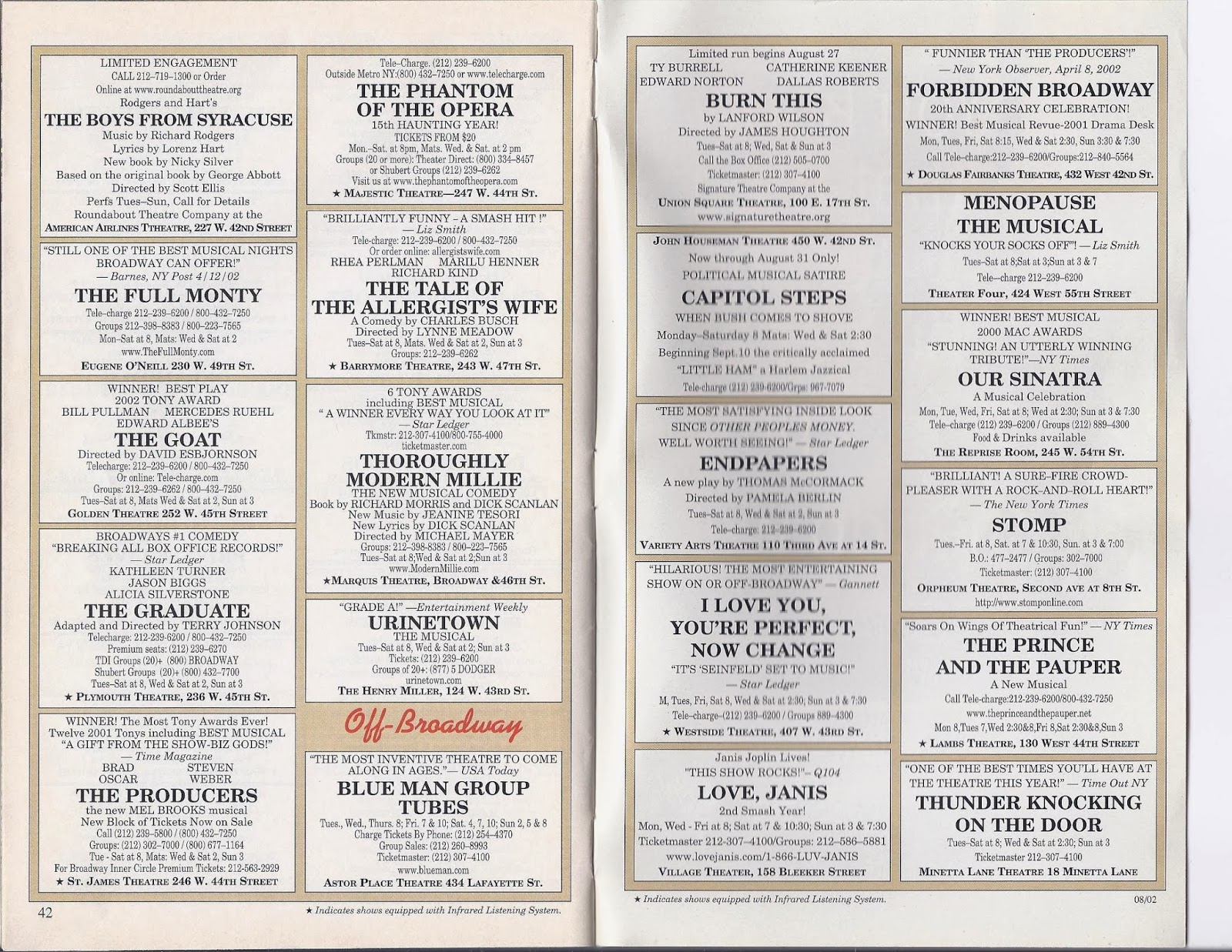
THOROUGHLY MODERN MILLIE – Marquis Theatre, New York


May, 2002. A few years back, I watched, for the first time in 30+ years, Thoroughly Modern Millie, the film on which this frothy treat of a musical is based upon. The film, although equally frothy and light as air, doesn't quite hold up to the stage incarnation. Oh, sure, the film stars Julie Andrews at her effervescent best as Millie, in a performance that gave a tantalizing glimpse at how wonderful her stage performance in The Boy Friend must have been; and it featured a delightful, if sinfully underused, Mary Tyler Moore; and charming performances by James Fox and John Gavin; and had some great numbers. But, it also featured an odd performance by Beatrice Lillie, and, yes, I'm probably the only person on the planet who didn't faint over her, and an even odder and jarringly over-the-top performance by Carol Channing, who would, for reasons known only to the Academy Awards nominating committee, get an Oscar nomination for Best Supporting Actress. (I assume this was her consolation prize for the egregious casting of the horribly miscast Barbra Streisand instead of Channing in the, ultimately, terrible film version of Hello, Dolly!) All my misgivings about the film, however, vanished seconds after the curtain rose as Sutton Foster, all delicious charm and talent, started singing her first number. Cheerfully old-fashioned and without a care in the world, Millie was a wide smile from start to finish. The book by Richard Morris and Dick Scanlan kept the somewhat convoluted plot clipping along, but it was the new score, courtesy of the always wonderful Jeanine Tesori, and the new lyrics by the aforementioned Mr. Scanlan that gave the musical a verve and sass that was missing from the film. Expensively designed, smartly directed, with terrific choreography, Millie featured a raft of great performances from Marc Kudisch's pompous Mr. Trevor Graydon to Gavin Creel's sweetly romantic Jimmy Smith to Angela Christian's cluelessly naïve Miss Dorothy to Anne L. Nathan's drill sergeant office manager (a great small part) to Ken Leung and Francis Jue's hysterically evil Chinese henchman to Sheryl Lee Ralph's glamorous Muzzy Van Hossmere. But it was Harriet Harris' diabolical and diabolically funny Mrs. Meers and Sutton Foster's powerhouse performance as Millie which left the most lasting impressions. Both would win Tony Awards (Best Actress for Foster and Best Supporting Actress for Harris) and both would go on to gift the theatre with other memorable performances. My only minor quibble was Foster's eleven o'clock number, "Gimme Gimme." Though technically faultless, this was the one instance where I could see Foster working. The smile was a bit strained, the energy a bit mechanical. All this, however, became academic as she brought the number to a sensational finish. Strained and mechanical or not, when that number ended, you knew you were witnessing the birth of a new star. – at the Marquis Theatre, New York.
Sidebar: Despite reviews which ranged from full-out raves to complete pans, with much of the negative press citing a lack of freshness and sincerity, Thoroughly Modern Millie won six Tony Awards, including the all-important Best Musical beating out Urinetown, the Tony-winner for both book and score. There were many raised eyebrows over Millie's win. Urinetown is, in my opinion, the better show, the more inventive one, but many believe people didn't want another satiric musical to win the year after The Producers famously swept the 2001 Tonys. With three big Tony wins, Millie went on to a run of just over 900 performances and a long national tour.
Casting Tidbits: In a classic "you're going out a youngster but you've got to come back a star!" piece of 42nd Street life-imitates-art, Sutton Foster stepped up from the ensemble when the original Millie. Erin Dilly, didn't meet expectations during the La Jolla Playhouse tryouts, took the show to Broadway and became an "overnight" sensation. (Foster had been in four Broadway productions prior to Millie.) She's one of my favorites and I'm pretty much convinced there's nothing she can't do. (Miscellaneous fun tidbits: Kristin Chenoweth played Millie during workshops, but left the production to work on a sitcom that was cancelled after six episodes. Oops! In La Jolla, Pat Carroll played Mrs. Meers and Tonya Pinkins was Muzzy. Now that would have been worth seeing!) Although Sutton Foster is the lead, she's billed as "and introducing SUTTON FOSTER as Millie." (She's a veteran of four Broadway shows and you're "introducing" her?  A bit of PR embellishment?), This is prominent billing, and since she won the Best Actress Tony, apparently qualified as above-title billing, but the first actor billed is Sheryl Lee Ralph, who played the somewhat extraneous role of Muzzy. She was very, very good, mind you, but first billing? I guess when you're an original Dreamgirl and making your first Broadway appearance in nearly twenty years, you wield that kind of billing power. And in the ensemble, a flock of names that I would see in other shows in bigger roles: Kate Baldwin (!!), Jessica Grové, Casey Nicholaw (future Tony-winning director and noted choreographer), Noah Racey, and Megan Sikora. Never, ever underestimate the phenomenal men and women who work in the ensemble!

THREE DAYS OF RAIN – Jacobs Theatre, New York


April, 2006. Playwright Richard Greenberg is a writer I have admired since I read his early play, Eastern Standard. He won a well-deserved Tony in 2003 for his magnificent play, Take Me Out, which is on my Top Ten list of favorite plays. His 2013 play, The Assembled Parties, was a bracing and exciting play about family and social standings. His 1998 play, Three Days of Rain, was a finalist for the Pulitzer Prize. His credentials are impeccable. But impeccable credentials were not the draw for the 2006 production of this time-hopping, somewhat disjointed, somewhat confusing play about truth vs. perceived truth about certain events in a brother, sister, and childhood friend's lives. Nope. No one bit. This was all about Julia Roberts' Broadway debut. Yes, that Julia Roberts. As in uber-popular, Oscar-winning, movie megastar Julia Roberts. It was her name that caused a frenzy at the Jacobs box-office. It was her name that made the limited twelve-week run a sell-out smash. It was her name that put the press and paparazzi into overdrive. So, let's get to the stuff that really matters. How was she? Well, I rather irreverently call it "The Julia Roberts Thing," but what was on view at the Jacobs was actually better than that tart little title would imply. The stage is definitely not her medium. She was frequently tentative, as though she didn't quite trust her instincts as an actor, and more than a bit wooden, as though she didn't feel confident in handling the simultaneously more intimate and bigger acting techniques of the theatre. Having said that, however, her charisma was undeniable. You literally couldn't take your eyes off of her when she was onstage. That isn't to say she stole focus. Far from it. She proved to be every inch the ensemble player and, when not actively participating in a scene, you could sense her really listening and reacting to what was going on. And perhaps this is shallow of me, but when she smiled that luminous Julia Roberts smile, all was right in the world. I'm not quite sure why she picked this particular play to make her Broadway debut in, but she deserves props for choosing a difficult, small, ensemble piece as opposed to a showier role in, say, a comedy where she could show off her comic chops and be dressed in fabulous clothes. (Thought: wouldn't she be terrific in The Little Dog Laughed?) Her costars, Paul Rudd and Bradley Cooper, in his Broadway debut, were more successful in the acting department, but I suspect that's more due to better-written roles than anything else. It was evident that the three actors respected and enjoyed working with each other and that helped the play enormously. Joe Mantello's direction was serviceable, but the unsung star of the day was Santo Loquasto's fabulous set. One final thought… After the performance, folks, not surprisingly, mobbed the stage door. Roberts was the first one out. Though with, I assume, bodyguards to help ease her way to her waiting car, she took her time, smiling to the waiting fans, sharing a word or two with a few, and signing some programs. The smile was at full tilt. She was gracious, at ease, and just plain classy. It wasn't great theatre, but it was unforgettable. – at the Jacobs Theatre, New York
Sidebar: I was on a layover in New York and stood on the cancel line and was rewarded with an 11th row seat. Not bad, not bad at all.

TIME STANDS STILL – Jacobs Theatre, New York


April, 2006. Although the Friedman Theatre is an intimate venue, sitting in the second-to-last row of the mezzanine, we lost a lot of the carefully-directed nuance that Daniel Sullivan brought to the piece. It was there, I could tell it was there, but we felt distant from the characters in Donald Margulies' drama about relationships that want to live in the past, but can't, and want to move forward, but are hesitant to do so, and that distance made for a theatre-going experience that did not land as powerfully as I suspect it would have had we been closer to the action. Perhaps Laura Linney and Brian d'Arcy James, both exquisite actors, were a tad too subtle, where a bit more oomph, for lack of a better word, in their performances could have generated more audience involvement with their characters. And in Ms. Linney's case, I had no idea her face was made up to look scarred until I saw pictures. It just didn't register up in the rafters. Although Linney and d'Arcy James and their characters' ying and yang were the play's focus, it was the broader, more comic, and, ultimately, more affecting performances of Eric Bogosian, as the couple's oldest friend, and, in a surprisingly refreshing performance, Alicia Silverstone, as his much-younger and much less complicated girlfriend, that gave the play, for me, at least, its heart. With beautiful production values and four talented actors, it was a worthy way to spend the afternoon, just not the "wow" the critical reaction would have led one to believe. – at the Friedman Theatre, New York.

THE TRICKY PART – Signature Theatre (the ARK), Arlington, VA


February, 2008. When author Martin Moran was twelve, he was sexually abused by Bob, a retired Vietnam vet and counselor at a Catholic boys' camp. This abuse continued until Moran was fifteen. Horrific by any standards, Moran treated this all with candor and, surprisingly, a great deal of humor in his one-man adaptation of his shattering book of the same name. A gifted storyteller and actor, Moran made his characters come alive with vivid detail, especially Bob. Far from being the stereotypical villain, Moran imbued his abuser with a wide-range of conflicting traits, from downright creepy to unexpected generosity. By making Bob a living, breathing person, it made Moran's abuse even more horrifying. Moran's story of survival following the end of his abuse was compelling and when he finally confronted Bob years later, a wizened old man in a wheelchair, the scene that followed and the grace that Moran gave it, concluded an unforgettable evening that I will long cherish. The warmth and genuineness Moran portrayed onstage is real. After the performance, he took the time to talk to each and every person waiting after the show to thank him for his performance, us included. An absolutely stunning experience. – at the Signature Theatre, Arlington, VA.

And that's it for the first blog of 2017! Until later.
© 2017 Jeffrey Geddes

Thursday, March 20, 2014

NEW YORK IN A HURRY…AND A ROAD TRIP TO MILWAUKEE AND LINCOLNSHIRE

NEW YORK IN A HURRY…AND A ROAD TRIP TO MILWAUKEE AND LINCOLNSHIRE

It's been a while since I've posted a new episode. I've been so busy juggling a myriad of hats with an upcoming production of Cabaret  that Bob is directing now for an April opening, that I've had little time for much of anything else.  But, at long last…a bit of a mixed bag in this post with no real theme or connection. In February, I took a quick two-night trip to New York to see a concert version of Maury Yeston/Peter Stone's Titanic at Lincoln Center. Bob, sadly, had to stay home and suffer through load-in and the start of techs for a lackluster show for which he designed a simply amazing set. Neither of us were happy about that, but I soldiered on and managed to see two additional shows while in Manhattan. (You didn't think I'd let a Sunday go by without a performance, did you?) The other two entries are early March excursions to see a mediocre production of Cabaret and a thrilling production of An Iliad in Milwaukee.


New York first.


February, 2014. When Charles Busch is onstage with longtime friend and collaborator Julie Halston, you can feel the love, trust and fun and the stage sparkles. Add the delectable Cynthia Harris and you've got a mighty trio. There are three other characters and the talented actors all do well enough, but didn't leave much of an impression. To a large degree, that's because Busch's very enjoyable new play is also very uneven. It starts off like gangbusters, but then has a big dip in act two and never completely regains the potential of the wonderful first two scenes. Flaws aside, it's chockablock with delicious one-liners and has an abundance of heart. A fabulous set framed the action and the direction kept everything going smoothly. I liked it and it's always a treat to see Mr Busch and Ms Halston in action. - at 59E59 Theaters, New York


February, 2014. At three hours long, this could use some gentle and judicial trimming. I say this with great reluctance since I have no idea what should go. The second act sometimes gets a little pedantic, so I'd probably trim that down a bit. Effortless performances by a large cast with special kudos to John McMartin. At 84, he handily proves he still has the goods. He is without peer - a true actor's actor and I will happily see him in anything. Other outstanding turns by Michael McKean, Robert Petkoff, Christopher Liam Moore, Betsy Aidem, Roslyn Ruff and Brandon J. Dirden. Bums-in-seats star Bryan Cranston is remarkable as LBJ and makes us care for this complicated man even when he's a cold and unyielding bastard. It was an impressive performance. Everything about this production was top grade. Highly recommended. - at the Neil Simon Theatre, New York


February, 2014. Manhattan Concert Productions presented this. These are the same folks who produced last season's breathtaking concert edition of Ragtime. Last year's performance bordered on a religious experience; this year was no different. It was simply magnificent; a feast for the ears and the soul as Peter Stone and Maury Yeston brought the legendary tragic saga of the ill-fated R.M.S. Titanic to a human level, devoid of the special effects and stereotypes of James Cameron's much-lauded film. (Lest you get the wrong impression, I quite like Mr. Cameron's film. But it's often more spectacle than story.) From Captain to First Class Passenger to the Bellboy, director Don Stephenson and music director Kevin Stites gave us characters we may have loved or hated, Bruce Ismay was really a despicable human being, but we were interested in all of them and cared about many of them. This is not a perfect show. Not every number lands: the Strauses' "Still," ably sung by Alma Cuervo and Ron Raines, tugs at our emotions, but doesn't quite touch us the way the authors intended; "I Give You My Hand," a beautiful song cut during Broadway previews, is pretty to listen to, but seems grafted onto the proceedings; "Mr. Andrews' Vision," while powerful, perhaps could have better made it's point in a frantic spoken monologue. But, then, ladies and gentlemen, there is that opening sequence: a glorious experience that ranks as one of musical theatre's most singular opening numbers. According to the program, seven pieces of music make up this opening, ending with the goosebump-inducing "Godspeed Titanic," which also brings the show to its triumphant conclusion. It's a marvel of acting, singing, and, even in this concert setting, staging. Like last year, a 250-strong chorus added an extra thrilling element to the ensemble numbers. Many of the original cast members returned to reprise their roles and they were all greeted with enthusiastic "welcome home" entrance applause. This remarkable cast included, in addition to Ms. Cuervo and Mr. Raines, Michael Cerveris, David Constabile, John Bolton, John Cunningham, David Garrison, Jill Paice, Michele Ragusa, Ryan Silverman and other talented Broadway pros. Top honors, though went to David Elder as Frederick Fleet with a haunting "No Moon" to close Act One, Joseph Castinado, a high school junior, whose excitement at being in this production in the role of Bellboy was positively contagious and totally endearing, but most especially to Brian d'Arcy James (Frederick Barrett) and Martin Moran (Harold Bride) whose duet of "The Proposal/The Night Was Alive" stopped the show cold and when they appeared together at bows, brought the already loud and enthusiastic applause to a deafening roar of cheers and bravos. My good pal, Gina, joined me and she remarked that she'd seen nothing quite like this. I agree. - at Avery Fisher Hall, Lincoln Center, New York


FYI, Cabaret is not about a bowler hat and a damn chair. Stop it this instant!

March, 2014. What I liked: the male ensemble's "Tomorrow Belongs to Me," the briefcase business during "The Money Song," the finale to Act One. What I didn't like: pretty much everything else. Sanitized and not at all sexy. It's unclear why Marriott chose to produce the 1998 Broadway revival since they excised all the edginess out of it. I suspect it had a great deal to do with being able to perform the revised 1998 song line-up inclusion of "Mein Herr," "Maybe This Time," "The Money Song" and "I Don't Care Much," none of which were remarkable. Director David H. Bell delivered a muted, bland production with muddy choreography by Matt Raftery, uninteresting acting and indifferent singing. Nancy Missimi's costumes looked as though she pulled the stock from Marriott's Thoroughly Modern Millie and called it a day. There were no surprises, not a single "wow" moment and it was about as dangerous as a Disney movie. The most hysterical moment occurred early in the proceedings when Bobby and Cliff kissed. A gasp went through the audience. I'm serious. A gasp. Really? People, it's 2014! Geez! Everything was very professional, but very dull. A disappointment. - at the Marriott Theatre, Lincolnshire IL


March, 2014. Sometimes you see a performance that is so amazing, so breathtaking in scope and execution, so singularly excellent that you simply can't find adequate words to describe it. This was the Milwaukee Rep's production of Lisa Peterson and Denis O'Hare's An Iliad. Surrounded by the typical production excellence that the Rep consistently delivers, actor Jim DeVita and cellist Alicia Storin, under the flawless direction of John Langs, created theatrical magic that transported the audience to another time, yet one that seemed disturbingly current, and another place, yet one that had a disquieting ring of familiarity. You could hear a pin drop throughout the performance and there were moments when I simply forgot to breathe. Powerful ideas and words; thrilling theatre. - at the Milwaukee Rep, Milwaukee

We're off to New York for a long weekend for the incredibly wonderful Broadway Backwards. Naturally, we'll see other shows as well. Stay tuned! In the meantime, go see a show. Cheers.

© 2014 Jeffrey Geddes

Tuesday, December 10, 2013

ALPHABET SOUP - Part 3!

ALPHABET SOUP (3)

It's that time again to shake up things, draw a letter from my blue London coffee mug and pick the first five shows from that letter's pile of programs.

Without further ado, drum roll, please…. Today's letter is….
U


Ready? Set? Go!


August, 2002. At the 2002 Tony Awards, Urinetown won three Tonys: Best Book of a Musical (Greg Kotis), Best Original Musical Score (Music by Mark Hollmann, Lyrics by Mark Hollmann and Greg Kotis) and Best Direction of a Musical (John Rando). Curiously, in spite of those three major wins, which are,  for all intents and purposes, the three most important creative components of a musical (designers, orchestrators, musical directors, choreographers and all you other important folk, you know I love you as well…xoxo), the Best Musical Tony went to the enormously entertaining and very traditional Thoroughly Modern Millie. At the time, the general consensus was that the Tony voters wanted to return to safer, more familiar ground after the sweep of the previous year's Tony Awards by The Producers. But winning book, score and directing Tonys isn't exactly chopped liver and Urinetown would enjoy a long and profitable run. This tart and tasty political satire about corporate and political corruption and greed, using the premise that people had to pay for the privilege to pee, as the song goes, was exquisitely written by Messrs. Kotis and Hollmann and directed to satiric perfection by Mr. Lando and produced at The Henry Miller, as it was called, as the final production before the theatre closed to make way for an office building. (The interior would be demolished and a gorgeous new theatre rebuilt. It reopened as the Henry Miller, but in 2010 was rechristened the Stephen Sondheim Theatre.) In 2002, The Henry Miller was a bit, well, dowdy. It had obviously seen better days and looked very rough around the edges. It was the perfect theatre for designers Scott Pask, Gregory Dale, Jonathan Bixby and Brian MacDevitt to work their magic and to set the stage for this wonderfully off-kilter show. Leading actors John Cullum and Nancy Opel were both out at the matinee we attended, but were skillfully covered by Don Richard and Rachel Coloff, respectively. Jeff McCarthy and Spencer Kayden were hysterical as Officer Comstock and Little Sally. Jennifer Laura Thompson was both luminous and clueless as Hope Cladwell and the really, really talented Hunter Foster was a terrific hero and stopped the show with the raise-the-roof "Run Freedom Run." For my money, though, the best song in the show is the devilishly evil "Don't Be the Bunny." Satire is hard to do. It can easily go south and just be unbearable. Really good satire is rare. Urinetown is really good satire. Think Threepenny Opera without the tiresome Brecht and Weill stuff. (No, I'm not a fan. Shoot me.) Bob and I laughed and laughed and laughed. It was truly an unexpected delight. - at The Henry Miller, New York
(Sidebar: a 2006 local sit-down production of Urinetown at Chicago's Mercury Theatre was embroiled in a copyright dispute with the creatives of Urinetown who accused the Chicago creatives of plagiarizing the work of the original director and designers. The Chicago production team vehemently denied the charges. The dispute caused the show to close suddenly and at a complete financial loss. The case was settled in federal court and the Chicago production team was ordered to pay the original Broadway team an undisclosed sum of money.)


A snapshot of what was going on in August, 2002. How did we miss Dance of the Vampires?


July, 2003. The marvelous American Conservatory Theater (A.C.T.) in San Francisco mounted this raucous reproduction of the Broadway original at its home base at the gorgeous Geary Theatre. The exceptionally strong cast was headed by Ron Holgate as Caldwell B. Cladwell, who seemed to absolutely relish his every moment on stage, Charlie Pollack as a handsome hero, the radiant Christiane Noll (one of the few good things in Jekyll and Hyde and who would dazzle us a few years later in the revival of Ragtime) as Hope Cladwell, Jim Corti as Hot Blades Harry, Beth McVey as Penelope Pennywise, Meghan Strange as Little Sally and the reliable Tom Hewitt as Officer Lockstock. Hewitt is a consistently fine actor and a favorite of mine. We went with Bob's brother Andy and his husband and sat in practically the last row of the Geary's second balcony. Once again we laughed lots. And take my word for it, the second balcony at the Geary Theater is very high and very steep. Not for the faint of heart. - at the Geary Theatre (A.C.T.), San Francisco

Oops! "U" had only one show, so let's draw again….drum roll……. And we have….
H


April, 2011. Matthew Lombardo's play about a recovering alcoholic therapist nun, a 19-year-old homeless gay drug addict and a priest with control issues was at times very, very funny, at times very, very dramatic and at times very, very melodramatic. The play starred the divine Kathleen Turner as the recovering alcoholic therapist nun, and, yes, it took me a moment or two to wrap my brain around that bit of casting. Kathleen Turner as a nun? No matter. She was a marvel. That inimitable voice combined with her commanding stage presence made her a force to be reckoned with. Evan Jonigkeit played the homeless gay drug addict in a powerful and sympathetic performance with an added dose of full frontal nudity for good measure. Stephen Kunken was fine as the priest and did what he could with the role, but his part was the weakest and easily overwhelmed by the showier roles of the nun and drug addict. I thought it was a powerful, if flawed, play with an accomplished cast, fine production values and good direction. Bob and I liked it; our friends were less than enthused. We saw a preview performance. Good thing, too, since, despite mostly positive notices from tryout productions in Hartford, Cincinnati and St. Louis, the play was soundly spanked by the New York critics and closed at the end of its first week of performances. I suspect it will have a profitable afterlife in regional, educational and amateur theatre. - at the Booth Theatre, New York


February, 2008. There is a scene in this chilling revival of Harold Pinter's The Homecoming where Raul Esparza, as Lenny, confronts his new sister-in-law, Ruth, played by Eve Best. (Yep, Nurse Jackie's Eve Best.) The scene was so quiet, so sexually charged, so dangerous, and in its way, so evil that it literally took my breath away. Rarely have I seen such understated and such powerful acting. Those few minutes alone were reason enough to see this masterful revival of one of Pinter's most highly-regarded plays. Raul Esparza was so robbed of the Tony that year. (Actually, so was this production. Best Revival of a Play Tony went to the slight, if extremely well-done, Boeing, Boeing.) This is not a happy play. It's filled with loathsome characters engaging in despicable behavior and you wonder if anyone among them has any normal interactions in society. The only moderately sympathetic character in the bunch, Teddy, played by James Frain, eventually yields to his monstrous family. Ian McShane played the head of the household and he was a nasty piece of work. (He was a delightfully over-the-top Devil in The Witches of Eastwick in London.) The always excellent Michael McGrath play McShane's brother and Gareth Saxe played brother Joey. They were all superb, but for me the acting honors went to Esparza and Best. I usually find Pinter on the obtuse side. Not this time. This was truly exciting theatre. - at the Cort Theatre, New York
(Note: in the National Tour of the original Broadway production, Carolyn Jones played Ruth. Yes, Morticia from The Addams Family was more than just smoldering looks and finger snaps. She was a well-regarded actress. I so wanted to see that production, I was still in high school when the tour played Chicago and I couldn't manage a matinee. I probably wouldn't have understood it anyhow at that age.)


July, 2011. Part The Boys in the Band, part My Night with Reg, part Love! Valour! Compassion! with a hint of Company thrown in, with none of the qualities of any of the originals, this so-called "epic" play had lots of zingy one-liners, but not a lot of heart and not a lot of characterization. An unlikeable leading character, though well-enough acted, didn't help, nor did the political/sociological riffs that didn't advance the plot. With one glaring exception, the acting was good, and two performances, Elizabeth Ledo and Stephen Cone, were outstanding.  At times I felt like I was at a production of "Party;" it had that camp-for-camp's sake mentality.  At about 2:15, it's at least 15 minutes too long and could probably be a very good play at a snappy, intermission-less 90 minutes.  To be fair, it was liked by the critics and the audience ate it up.  It wasn't bad; it wasn't good, and it does have some promise, but it won't become the next great gay play, even though that was clearly what the author intended this to be. - at About Face Theatre, Chicago


 This talented quartet...don't they all look so young!...would continue to shine in show business. 

September, 1995. At the risk of being tut-tuted, I must confess that I am not much of a Frank Loesser fan. I don't care for Where's Charley? at all, though that could just be a reaction to a bad audition for a local production a century ago down in Bloomington, but I think it's simply because I don't like the show. The supposed charms of The Most Happy Fella escape me. I don't think Guys and Dolls is one of the greatest musicals ever. And although on the cast recording, much of Greenwillow is actually quite beautiful, there are, sadly, more than a handful of real clunkers (e.g. "Clang Dang the Bell" and "Could've Been a Ring") Having said that, however, I'm wild about his zippy satire on big business, How to Succeed in Business Without Really Trying. The book is funny and pointed, as good satire should be, and the score is one great tune after another. By 1995, this show had long been a staple of community theatre groups and high schools, so the opportunity to see Broadway pros in a Tony-winning production directed by Des McAnuff and choregraphed by Wayne Cilento was not to be missed. Matthew Broderick won his second Tony for his portrayal of J Pierrepont Finch. Broderick has the charming hangdog thing down to an art and it worked to his advantage in this role. Pre-Will and Grace Megan Mullally was a total delight as Rosemary, free from Karen-isms and showing off impressive vocal chops. And look who played Smitty…Victoria Clark! Lillias White was a full-throated and funny Miss Jones, Jeff Blumenkrantz whined and kowtowed with vigor as Frump, Ronn Carroll was an appropriately pompous J.B. Biggley and Pamela Gold did a fine job subbing as Hedy. In the chorus were Jeffry Denman and Martin Moran! Enormously entertaining. - at the Richard Rodgers Theatre, New York


June, 1996. All-grown up at 33, the Karate Kid, Ralph Macchio, gave a solid, entertaining performance in the First National Company of the 1995 Broadway revival of How to Succeed in Business Without Really Trying. Duplicating the look and feel of the Broadway version, this was a high-quality tour with a troupe of seasoned actors including Shauna Hicks as Rosemary, Richard Thomsen as J.B. Biggley, Susann Fletcher as Smitty, who admirably gave a program nod as sharing her home and heart to her female partner and this was in 1996!, a big-voiced Tina Fabrique as Miss Jones, Roger Bart as Frump a few years before he skyrocketed to fame in The Producers, and as a special treat Pamela Blair (the original "Tits and Ass" girl) as Hedy. Professional and enjoyable. - at the Shubert Theatre, Chicago


August, 2011. The 1995 revival was pure pleasure, but the sparkling 2011 revival was an infectious, joyous romp, in no small measure thanks to the ridiculously wonderful performance by its leading man, is-there-anything-he-can't-do?, Daniel Radcliffe. When he was only 17, Radcliffe made an impressive West End debut that won him critical acclaim in the award-winning Equus. Critics were not only impressed by his considerable range as an actor, but also by the fact that he fearlessly shattered his Harry Potter persona by performing the famed nude scene with class and dignity. He repeated his Equus assignment on Broadway two years later in his Broadway debut and once again received acclaim from the critics. For only his second appearance on Broadway, Radcliffe chose to portray one of the most difficult young leading man parts in musical history, that of Finch in How to Succeed. This part requires the actor to not only be charming and impish and adorable, but also show cunning and ambition, yet that cunning and ambition can never be overpowering or threatening. Radcliffe carried the part with great élan not only due to his considerable talent, but also due to the fact that he worked tirelessly to make sure everyone in the audience had a terrific time. While he may not have carried off the singing and dancing chores with the same slick professionalism that a more seasoned musical performer would have, he more than compensated for it by sheer energy and a smile that made us feel like he was having the time of his life. And I suspect he was. The fact that he wasn't even nominated for a Tony Award still has me shaking my head in disbelief. Mr. Radcliffe wasn't alone in this endeavor, however. He was surrounded by an sensational group of fellow actors who added immeasurably to the fun. John Larroquette, in his Tony-winning role, was just so good as J.B. Biggley and the visual of the 6'4" Larroquette opposite the 5'5" Radcliffe was priceless. Rose Hemingway was excellent as Rosemary, Christopher J. Hanke pouted to perfection as Frump, Tammy Blanchard was a comic sexy Hedy, Mary Faber, Patty Goble and Rob Bartlett were great as Smitty, Miss Jones and Twimble, respectively. Brightly designed, directed and choreographed with crisp efficiency and played by a superb pit band, this was just pure joy. I was grinning from ear-to-ear when we left the Hirschfeld. - at the Al Hirschfeld Theatre, New York


That's it for today. More later....Ta!
© 2013 Jeffrey Geddes
CONCERTS AND TUNERS AND PLAYS…OH, MY! - vol. 1

  CONCERTS AND TUNERS AND PLAYS…OH, MY! vol. 1 Spring is finally here. And what better way to celebrate than by strolling down theatrical ...