Showing posts with label Barbara Lang. Show all posts

Sunday, November 12, 2017

ALPHABET SOUP (12): SPECIAL EDITION! FEATURING A RANDOM LETTER OF THE ALPHABET AND SOME SHOWS THAT BEGIN WITH THAT LETTER

ALPHABET SOUP (12): SPECIAL EDITION!
FEATURING A RANDOM LETTER OF THE ALPHABET AND SOME SHOWS THAT BEGIN WITH THAT LETTER

L
All about a Sondheim masterpiece in three-quarter time. For sophisticated tastes. 

Cue the strings….

A LITTLE NIGHT MUSIC
"Good God! – an adult musical!" was how New York Times' critic Clive Barnes ended his review of Hugh Wheeler, Stephen Sondheim, and Harold Prince's A Little Night Music upon its premiere on February 25, 1973. Nearly forty-five years later, this musical, suggested by Ingmar Bergman's film Smiles of a Summer Night, remains a work of sophistication, elegance, and musicality that few musicals since then, if any, have even approached, let alone surpassed. Wheeler's book is clever and witty and compact with nary an extraneous word. Sondheim's score, written in variations of three-quarter time, envelops the entire show with melodies that both caress and soar, and lyrics that are filled with finesse, style, and, frankly, brilliance. The last of the triumvirate of musicals in the early 70s that cemented Sondheim's place as our greatest contemporary lyricist/composer, the other two being 1970's Company and 1971's Follies, A Little Night Music charms and enchants. This is not Sondheim's masterpiece. That title belongs to Sweeney Todd. (Sorry, kids. Sunday in the Park with George is wonderful, but I find the score often unapproachable, and the second act is a letdown from the first act. Into the Woods is pure commercialism…with a message. Nothing wrong with that, mind you. It just doesn't create a masterpiece.) A Little Night Music still has us waltzing to its three-quarter beat and that's a reason to celebrate.


 – Majestic Theatre, New York


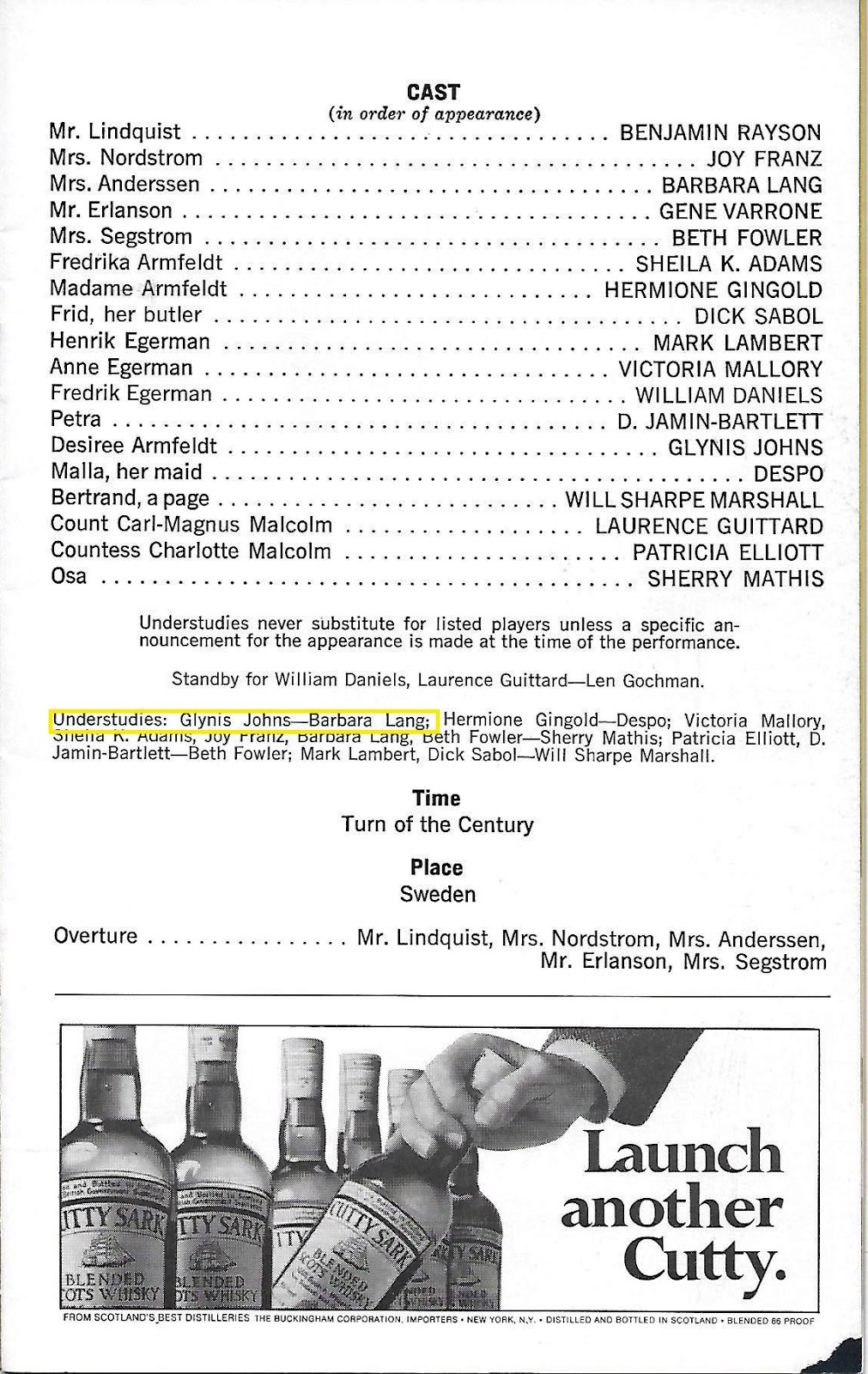
Barbara Lang, one of my favorites, was Glynis Johns' understudy.

April, 1974/June, 1974. The glittering design trio of Boris Aronson (scenic), Florence Klotz (costumes), and Tharon Musser (lighting) created the gorgeous environment that complemented A Little Night Music's story of love: young, puppy-like love, past love, mature love, and good, old-fashioned lust. Jonathan Tunick's orchestration were, as always, a joy and the sizeable orchestra in the pit, especially in the string department, gave the score a glorious instrumental voice. Patricia Birch's choreography/musical staging flowed with grace, and Harold Prince's seamless, effortless direction seemed almost invisible. William Daniels was now playing Fredrik and he gave a solid, musically strong performance. You felt his frustration at the unrequited love from his still-virgin bride and his desire for his great love, Desiree. Follies' Victoria Mallory (Young Heidi) and Mark Lambert, in his Broadway debut, were delightful as the hormonally-challenged youngsters. D. Jamin-Bartlett, in her Broadway debut, oozed barely suppressed sexuality and her "The Miller's Son" was one of the show-stoppers of the show. Laurence Guittard as Carl-Magnus was a sexy, vain, and handsome strutting peacock of a man. And acting as a sort of a Greek chorus was that wonderful quintet of singers, Benjamin Rayson, Joy Franz, Gene Varrone, Beth Fowler, and one of my favorite performers, Barbara Lang. Wonderful as everyone was, however, much of the critical praise, and in my opinion deservedly so, fell to three remarkable ladies, each in a different season of life. At seventy-six years old, the legendary Hermione Gingold was a wise, seen-it-all-and-then-some Madame Armfeldt, gruffly affectionate to her daughter and granddaughter, and showing us all how it's done…and from her character's wheelchair, no less. Patricia Elliott, as Charlotte, was a young thirty-five when I saw the show, and her cynical acceptance of the vicissitudes of love was dignified and truthful, and her duet with Ms. Mallory, "Every Day a Little Death" was a highlight. Leading it all was Glynis Johns, then fifty, whose radiance and breeziness as Desiree gave A Little Night Music its glorious heart. And when she sat down in that gorgeous red dress and sang "Send in the Clowns," as it was meant to be sung, you could hear a pin drop, and you felt all her regrets expressed in that smallish, unusual voice. Divine. But this was not the showstopper of the evening. Nope. That distinction fell to the first act finale, the dazzling "A Weekend in the Country," a number so brilliantly conceived and executed, I didn't want it to end, and when it did, I didn't want to stop applauding. – at the Majestic Theatre, New York
Sidebar: A Little Night Music won six Tony Awards at the 1973 Tonys: Best Musical, Best Actress in a Musical (Glynis Johns), Best Supporting Actress in a Musical (Patricia Elliot), Best Costumes, Best Book, and Best Score. At 601 performances, it was a financial success. At 23, I was terribly excited to see Glynis Johns, an actress I'd admired since her delicious turn in Mary Poppins and in the little-known aviation potboiler, No Highway in the Sky. I was not disappointed. Favorite Barbara Lang was Johns' understudy and both times I saw the show in New York, I kind of hoped she'd be on as Desiree. No such luck, though. (Johns became ill before the New York opening and Lang took over for a bit, a turn praised by Harold Prince in his autobiography.)

– Shubert Theatre, Chicago


October, 1974/November 1974/November 1974/December 1974. Okay, so I was a teensy bit obsessed with the show when the National Tour stopped off at the Shubert. But, it was so good, I had to see it more than once. This was a duplicate of the original production: gorgeous to look at and listen to, expertly staged, and well-cast. Original cast alum (the original Frid) George Lee Andrews was perhaps, at thirty-two, a bit too young to play Fredrik, but he was handsome and a superb actor and singer. Ed Evanko, who became a priest in his sixties (!!), Virginia Pulos, Andra Akers, Stephen Lehew, and Mary Ann Chinn were cast in the major supporting roles, and they were all excellent. The big difference between this production and the original was in its two primary ladies, Desiree Armfeldt and her mother, Madame Armfeldt. In New York, Glynis Johns was an earthy, bawdy Desiree, with a full-throated laugh and an obvious love for life. Hermione Gingold was equally earthy and though cynical as she went down memory lane in "Liaisons," you knew she had a grand time doing it. Johns and Gingold complemented each other perfectly. For the tour, Harold Prince had the good sense to cast two actresses who would give their own takes on these roles and complement each other as well. Film star Jean Simmons took a break from her cinematic career to take on the role of Desiree Armfeldt. Arguably, Simmons was more glamorous than Glynis Johns, and her Desiree was a bit more sophisticated, a bit more reserved than Johns'. The Wicked Witch of the West as Madame Armfeldt? Seriously? Yes, indeed. Margaret Hamilton's long career was more than just one movie, of course, and she worked constantly for decades, but The Wizard of Oz and the WW of the West, are what she will forever be remembered. So let's give her some props for going on stage at seventy-two, in what would be her final stage role, in a role identified by its originator. Unlike Gingold, Hamilton was more regal, haughty even, as she prowled the Shubert stage in her wheelchair, dismissing the people who invaded her house as though they were beneath her. Her "Liaisons" was more spoken than sung, and you got the impression her affairs were truly more business transactions that paid off handsomely than affairs of the heart, a performance truly in harmony with Simmons' more reserved Desiree. They were both magnificent. The show received a warm reception from the Chicago critics and had a successful run of nearly three months. – at the Shubert Theatre, Chicago

– Melody Top Theatre, Milwaukee


The Melody Top sign on Good Hope Road, Milwaukee


 The interior of Melody Top. It was not a small venue.

The dinner at the top of Act 2. Lois Hunt, center, looks years older than Earl Wrightson (behind her) even though he was eight years her senior. That's David Holliday at the right and a young and quite glam Holland Taylor, as Charlotte, behind him.

Melody Top

August, 1976. It's not especially often that I don't remember much about a show I've seen. That usually means there was nothing particularly memorable, good or bad, about the production. Curiously, both shows I saw at Melody Top Theatre in Milwaukee that summer, Bells Are Ringing with Tab Hunter and Rita Moreno, and this production of A Little Night Music, fall into the "don't remember much" category. As summer stock goes, Melody Top was highly-regarded. They hired really good people, and if the production values weren't on a par with, say, Candlelight Dinner Playhouse or Marriott Lincolnshire, the shows still had a professional sheen to them. I do remember not especially liking Zoya Leporska's Madame Armfeldt. Not-married-to-each-other-but-everyone-thought-they-were performing duo of Earl Wrightson and Lois Hunt played Fredrik and Desiree. Company alum Alice Cannon played Anne. David Holliday, all blond and good-looking, and the rather insipid male romantic lead in Coco, played Carl-Magnus and, most interesting of all, a young Holland Taylor, already known from television and who go on to great fame as the lead in Moose Murders, played Charlotte. I suspect everything was done well, if not especially compelling. What I remember most about the evening was what I wore that night: a dark blue (roughly the color of my car) suit made out of Qiana, that god-awful, completely unnatural faux-silk fabric popular in the 70s because it flowed really well on the dance floor. Didn't breathe, you sweated like a pig, but you looked good. Designed and impeccably made by my good friend, Durkin, it consisted of a pirate-style shirt cut down to there and loose-fitting drawstring pants. Now granted, I was a mere wisp of a thing back then, but, seriously, what was I thinking? I cringe to this day. – at Melody Top Theatre, Milwaukee 

Sidebar: Old-school, classic summer stock, Melody Top was a celebration of the golden-age of musicals, with the occasional foray into the 70s, operetta, and pre-Oklahoma! musicals. In addition to A Little Night Music,1976's season included: A Funny Thing…Forum starring Arte Johnson, 1776 starring Ross Martin and Stubby Kaye, My Fair Lady with Leonard Nimoy (huh?), the aforementioned Bells Are Ringing, Shenandoah with John Raitt, and Irene starring Jane Powell. No skimping on recognizable names there. Many stars returned to Melody Top season after season. One of the more interesting castings was in the 80s when Jo Anne Worley starred as Rose in Gypsy. Melody Top was class, but the times and public tastes changed, and after twenty-three seasons, it rather unceremoniously closed its doors, cancelling its planned 1987 season.
Apologies to Holland Taylor: Okay, mentioning 1983's Moose Murders perhaps was a bit naughty, but MM is one of Broadway's legendary flops, perhaps the gold-standard for sheer awfulness. Taylor, an established star in 1983, took over the lead role during previews from Eve Arden, fired after only a handful of performances. (Shades of Sandy Duncan and Finding Neverland!) For the record, Samuel French holds the rights to Moose Murders. A ghastly read, but fun in a train-wreck way. Thankfully, the wonderful Ms. Holland survived the ordeal and went on to further acclaim and set the theatre world on its ear with her exquisite performance as Ann Richards in the solo show, Ann. I saw Ann.  I can vouch for her performance.

– Ravinia Pavilion, Ravinia, IL


August, 2002. For those of you who don't believe Patti LuPone ever tanks in a show, I give you Exhibit A: A Little Night Music in a staged concert presentation at the Ravinia Festival in north suburban Ravinia, IL. A year after Ms. LuPone and co-star George Hearn thrilled us all with Sweeney Todd at Ravinia, the powers-that-be decided to pair the two again in another Sondheim classic. And it was pretty awful. And it was pretty awful primarily because Patti LuPone was miscast and poorly directed in a part that simply didn't translate well to her formidable skill set. Putting her in a ghastly blonde wig didn't help either. The discussion at the interval was whether or not we wanted to subject ourselves to more of the same. We decided to stay and were rewarded with, pre-Spamalot and Tony Award, Sara Ramirez as Petra kicking all sorts of serious butt with her thrilling rendition of "The Miller's Son." (see YouTube) The cast was laden with talent: George Hearn (Fredrik), Zoe Caldwell (Madame Armfeldt...oddly subdued), Marc Kudisch as Carl-Magnus (appropriately asshole-ish), and a really good Hollis Resnick as Charlotte. But Patti was the big ticket item, and, sadly, she just failed to deliver. The role of Desiree requires a careful balance of theatricality and subtlety, and LuPone couldn't or wouldn't walk that tightrope. In the interest of fairness, the Tribune's critic did critical cartwheels over this production. I stand by my opinion that this was a miss. – at the Ravinia Pavilion, Ravinia, IL.
Sidebar: LuPone would redeem herself and then some a few years later when her first visit as Rose in Gypsy stormed this same venue. There are many reasons why Patti LuPone is one of our contemporary musical theatre legends, and I'm a big fan, but even legends have their off shows and this was one of them.

– Walter Kerr Theatre, New York


December, 2009. Preview performance (one of the last before opening). A long line at the Kerr box office greeted us when we arrived to hopefully purchase tickets. From overheard snippets while waiting on line, it looked grim. But the fates were with us, thanks to a potential customer who didn't like what was offered to her, and we snared two seats for that evening's performance near the back of the orchestra of the smallish Walter Kerr. To our pleasant surprise, we discovered that one of Bob's former students, Betsy Morgan, was one of the quintet. To our not-so-pleasant surprise, the curtain rose on a dour, gloomy, and frankly ugly set. Gorgeous costumes, though. The nine-piece orchestra, wisely using a harp as one of its instruments, played the score excellently, but it sounded thin and under-nourished, and I often felt, well, musically cheated. Plus the slow tempos for many of the songs gave a lumbering feel to the evening. I felt Trevor Nunn's direction was often heavy-handed. This is a romantic, diaphanous show, Trevor. We're not storming the barricades here. "A Weekend in the Country," partially because of the scenic design, partially because of the size of the orchestra, and partially because of the tempo, lacked pacing and excitement, didn't soar, and didn't leave us panting for more. Where this production shone, however, was in its three principal players. Catherine Zeta-Jones as Desiree was a revelation, giving the part subtlety, humor, and refreshing dollop of sexiness. The magnificent Angela Lansbury gave Madame Armfeldt a regal edge that was slightly self-mocking at the same time. Alexander Hanson, reprising his London Menier Chocolate Factory role, was astonishingly good, sexy, and handsome as Fredrik. Erin Davie (Charlotte), Leigh Ann Larking (Petra), Hunter Ryan Herdlicka, especially endearing as Henrik, Ramona Mallory (Anne), playing the role her mother, Victoria Mallory, originated in 1973, and Aaron Lazar, all bluster and ego as Carl-Magnus, rounded out the major roles. The quintet (Stephen R. Buntrock, Jayne Paterson, Marissa McGowan, Kevin David Thomas, Betsy Morgan) sang beautifully. The Menier Chocolate Factory, where this production originated, is a very small London venue, not capable of all the bells and whistles available in larger houses. By not adapting the production design to the larger Kerr stage, the show itself looked on the cheap. (This cheap look was also noticeable in the 2016 West End transfer of Menier's Funny Girl.) The critics were divided; some loved it and some hated it. I was a fan of the performances, but not of the production. Catherine Zeta-Jones would win the Tony Award for Best Actress in a Musical, the revival's only Tony win. Some felt she didn't deserve it. They were wrong. – at the Walter Kerr Theatre, New York
Sidebar: Much was made of Zeta-Jones' performance of "Send in the Clowns" on the Tony Awards. It wasn't particularly good. Vocal problems were cited as the reason. At the performance we caught, she was excellent and in fine voice. So there.
Backstage Sidebar: Betsy met us afterwards and took us backstage. Bob was in geek heaven.

And as the final waltz comes to an end, we'll say goodbye to A Little Night Music.
© 2017 Jeffrey Geddes

Sunday, September 29, 2013

MUSICAL MAYHEM: MY TOP TWENTY-FIVE MUSICALS The Honor Roll - Part 1

MUSICAL MAYHEM: MY TOP TWENTY-FIVE MUSICALS
The Honor Roll - Part 1

Over the past nearly half-century, I have seen many, many musicals. Some I was neutral towards; a few I hated; most I liked; some I loved and a select few I really, really loved. Those select few make up my list of my top twenty-five musicals. Like my selection of my top twenty-five plays, this list is completely subjective. These are musicals I like, not influenced either by critical acclaim or critical disdain. These musicals run the gamut from high-profile mega-hits to modest successes to, well, financial failures. Despite their position in the financial plus or minus column, though, each of these shows holds a special place in my theatre-going heart. Shows that speak to me, that inspire me, that delight me. Perhaps some of these are your favorites as well.

I'll begin this series with the fifteen shows that make up my musical Honor Roll. Because this will be a lengthy post, I'll only chat about one show today, the phenomenal 1776.

1776 - Music and Lyrics by Sherman Edwards, Book by Peter Stone
For decades, Sherman Edwards' and Peter Stone's remarkable musical based on the events leading up to the signing of the Declaration of Independence was my most-seen show. (Note: Follies is now most-seen show by a comfortable margin.) Between December, 1970 and May, 1972 I saw the show eleven times. During its Chicago run, I auditioned for the First National Company to replace the Leather Apron and understudy the Courier. (see Sidebar 1) In 1975, I played the Courier in a production at Fort Campbell, Kentucky. (see Sidebar 2) I enjoyed the film version. Surprisingly, this show is rarely professionally produced and somehow Bob and I missed the Roundabout revival in the late 1990s, so it wasn't until this year, 2013, that I saw my first professional production of 1776 after a span over forty-one (!!) years.


Happily, time has not diminished my love for this wonderful show. Peter Stone's book is rock-solid, often thought-provoking and frequently funny, with the character of Ben Franklin getting most of the choicer bon mots. Sherman Edwards' score briskly moves the plot along with terrific character songs, a frightening paean to conservatism ("Cool, Cool, Considerate Men"), a truly lovely ballad ("Yours, Yours, Yours") and a thrilling, no holds barred eleven o'clock number ( "Molasses to Rum"). It's a triumphant score by any standards and, sadly, Edwards' only Broadway contribution except for providing incidental music for a play in 1960. What is most impressive to me is the fact that this show is not afraid to have lengthy book scenes when such scenes are necessary to provide the proper dramatic arc and flow. What's even more impressive, and especially noticed when we saw the show most recently, was that audience was involved and engrossed during these lengthy scenes. That is a tribute not only to the talents of the cast, but also to the strength of Mr. Stone's book. If only all U.S. history could be so entertaining!

**********


December, 1970. My introduction to this amazing show. I loved everything about it. Peter Stone's book, Sherman Edwards' score, Patricia Zipprodt's costumes, Jo Meilziner's lighting and set and the incredible cast of actors who brought this story to vivid life. Irish actor Patrick Bedford, not to be confused with Brian Bedford, was a fiery John Adams, yet revealed a refreshing softness in his scenes with his wife, Abigail, beautifully played by a favorite of mine, Barbara Lang. And look who was in the cast…a young George Hearn as the Conservative's conservative, John Dickinson. Fun factoid: Rex Everhart, who  was deliciously tart as Benjamin Franklin, is the Franklin on the original Broadway cast recording of 1776. Howard Da Silva, the original Franklin ,was ill for the first few weeks of the New York run. As Da Silva's standby, Everhart took over and since cast recordings back then were traditionally recorded the first Sunday after opening, when the show was dark (Sunday matinees were a rare exception on Broadway and not the rule in those days), his interpretation of Franklin has been immortalized on the superlative original cast recording.  This was the First National Company, which opened in the spring of 1970 and played through 1972. Amazingly, it closed with Bedford, Everhart and Lang still playing their original roles. Amazing because today for a leading actor to stay in a show for six months is more or less standard; for that actor to stay a year is considered a long run; for that actor to stay over two years is all but unheard of. This was also my introduction to the vibrant Milwaukee theatre scene. Uihlein Hall was only about one year old when this tour breezed through and I became enamored of its sleek, somewhat cold design that seemed both large and intimate. I would see many shows there over the years. And as if that weren't enough, I met Barbara Lang's mother and (very hot) brother on the C&NW train back to Waukegan (they went on to Chicago). - at Uihlein Hall, Milwaukee, WI
**********


October, 1971 - May, 1972. By the time the First National Company of 1776 took up residence at the Shubert Theatre for a seven-month stay, Edmund Lyndeck had assumed the role of Dickinson and a few other characters were being acted by different folks than the ones I had seen in Milwaukee ten months earlier. During the Chicago run further replacements were made, but Patrick Bedford, Rex Everhart, Barbara Lang, and Michael Davis, the Broadway veteran who was superb as "Molasses to Rum" Edward Rutledge, were with the show the entire run and only seemed to grow in stature as the run progressed. As you can see from the ticket stub display, I saw the Shubert production more than a few times. One could say I was a wee bit obsessed with it. Just a bit. By the time the film version came out, I had become so used to Patrick Bedford's outstanding portrayal of John Adams, that I was initially a bit put off by William Daniels' (the original John Adams) performance. Fun sidebar: All of the Adams/Abigail scenes are exchanges of letters with both actors onstage reacting to, but not necessarily reacting with, the other actor, if that makes sense. Well, anyway, in the first Adams/Abigail scene, Adams is describing how other members of the Congressional Congress feel about him. As he lists his perceived faults, Abigail enters and responds to this list of unflattering comments. At the final performance, Bedford read off the first negative comment, but no response from Abigail. Barbara Lang had missed her entrance. Being a pro, he continued reading off the list and at the very last possible second, Lang hurried onstage and delivered her line to the obvious relief of Bedford. By this time, of course, I knew there had been an oops, but it's a credit to the professionalism of both Bedford and Lang that no one in the audience had a clue anything was amiss.  This show was such an important part of my early adulthood. - at the Shubert Theatre, Chicago

Sidebar 1: Auditioning for the First National Company. I had no clue how to go about this. I did it, frankly, on a dare. As I remember, this was an open call, first come, first served. I was so unprepared.  I was so young (21). I was so naïve. I had a hastily typed-up resume, but no headshot. By this time in my collegiate career, I knew I didn't want to act professionally, so why have one?  My resume was a paltry affair:  all educational theatre, and not even much of that, and one local summer theatre credit when I was still in high school. Everyone around me had much more impressive resumes. Everyone around me was oozing actor confidence and assurance. Me? I wanted to escape. But then I heard my name called and it was too late. The show's musical director, Glen Clugston, was at the piano and when he saw I didn't have any music with me (who knew I would need music?), asked me what I wanted to sing. Well, Clugston had recently been the musical director for multiple productions of The Fantasticks and everyone  in my group backstage up to that point had sung the same damn 16 bars of "Try to Remember." I shrugged and asked, "Can I sing the song from the show, "Momma, Look Sharp?" (God, I can't believe how clueless I was!). Was I mistaken or did I detect a look of relief from Mr. Clugston? He agreed and suddenly I found myself on the stage of the Shubert Theatre on the legendary Jo Mielziner's amazing set. Oddly enough, I wasn't panicked. I sang what I thought were 16 bars, thanked the People in the Dark and started to walk offstage. Suddenly from the house I heard, "Where are you going?" Huh? Me: "Uh…"  People in the Dark: "Could you sing the entire song for us?" Huh??? Me: "Uh, sure." And I did. The entire song. All of it. And as I did, I could see two of the People in the Dark move closer to the stage. WTF? I finished. People in the Dark: "Thank you. That was great." Me (in a daze): "You're welcome. Thank you." and I scurried off the stage to be met by a "good job" and beaming smile from Glen Clugston and some glares from the other auditionees. And that, as they say, was that. That was my only professional audition to date. Since you don't see my name on a Broadway marquee, I obviously didn't book the gig. And that's show biz, kids.

**********


September, 2013. It took over forty-one years for me to see another professional production of 1776. The moment I read on Playbill.com that this was being produced at San Francisco's A.C.T., I immediately ordered tickets. We went to the first preview. Magnificent! Not a weak link in the sizable cast. Great physical production. A few minor technical items need to be addressed and there was the occasional odd directorial choice by Frank Galati, especially in the Adams/Abigail scenes and the odd entrance-exit choice for the Courier, but overall this Broadway-caliber performance was a thrilling evening at the theatre. We even saw a Chicago face in the cast: Jarrod Zimmerman, who was the only true bright spot as Oscar in the otherwise sad production of "Sweet Charity" last winter at Writers' (see an earlier post). He played Rutledge and knocked the exciting and difficult "Molasses to Rum" out of the proverbial ballpark. Well done, Jarrod! Intelligent. Stirring. Unforgettable. Bravo, A.C.T. - at the Geary Theatre (A.C.T.), San Francisco

**********
Sidebar 2: The Courier in Kentucky. It may surprise you to learn that military bases, at least U.S. Army bases, have active arts programs. Over the years I was active in the theatre program at Fort Sheridan, IL, near my then-home of Waukegan. The Army sponsors the U.S. Army Festival of the Arts and the Fort Campbell production of 1776 was Fort Campbell's entry in 1975. My good friend Joe was the musical director for the  show (he had moved from Waukegan to Hopkinsville, KY, near Fort Campbell, with his then-boyfriend for reasons that elude me now.) Joe encouraged me to try out for the Courier. I figured what the hell. It'd be a fun weekend with friends if nothing else. I had absolutely no illusions that I would actually get the part. I did. (Full disclosure: according to Joe, what tipped the scales in my favor was that I could say my eleven lines and sing the song without a trace of a southern accent. Well, duh! I'm a northern Illinois boy.) I flew down to Fort Campbell twice to rehearse the Courier's scene, then went down for the final ten days of rehearsal and the four performances. It was rough going. I felt I was miscast. The song went to the very top of my range and I didn't feel I was singing it well. The cast, while pleasant enough, treated me as though I were an outsider. (Well, I was.) I wanted to quit. I didn't. I got better in the part. My voice adapted to the vocal demands of the song. I worked hard and cooperatively and eventually the cast warmed up to the "Yankee infiltrator." And on the last night, after my song, I got up from my perch (John Adams' desk) that hung over the orchestra pit, stepped back behind the curtain line and stood in darkness as the curtain fell on Act One. Dead silence. And then thunderous applause. Thirty-eight years later, that performance remains the finest work I have ever done onstage. I am intensely proud of it.


March, 1975. The Courier. Beautiful set. Exquisite costumes built specifically for us so they fit like gloves. Mine was a combination of corduroy and cotton that was hot as hell under the stage lights. Authentic, yes, but, damn! The cast, a combination of civilians and active military, were all personable, talented folks. Our Abigail Adams, Nancy Moffitt, was especially luminous. It was a thrill to work with these people. - Fort Campbell Community Theatre, Fort Campbell, KY

Sidebar 3: Some fun stuff specific to doing theatre on an Army base. First…cast listings. In Army theatre, if you're active military (or a reservist), your rank is shown, hence SP5, 1LT, etc. At Fort Sheridan, if you were a dependent, say spouse or child, of active military personnel, you would have (DEP) after your name, e.g. Jeffrey Geddes (DEP). If you were a civilian working on the base, you'd have (DAC) after your name. If you were a plain, old civilian, you would either have nothing after your name or (CIV). At Fort Sheridan, I was either Jeffrey Geddes (CIV) or just Jeffrey Geddes. I'm not sure if it was a requirement, but as a director at Fort Sheridan I was strongly encouraged to cast at least one active military member, preferably more, depending on the cast size. DEPs counted, but didn't score as many "points." There was also an unwritten protocol when working with or addressing military personnel, especially when dealing with those of different ranks. As a director, I tend to call my actors by their first names rather than by their character names. However, if I was staging a scene between an enlisted soldier and an officer, for example, the dialogue would go something like this: "Private Jones, I'd like you to cross to Major Smith. Major, take the letter from the Private and then cross center." It sounds a bit stiff and formal, but it soon became second-nature. Even in the collaborative environment of the theatre, rank was still, well, rank. It wasn't snobbish; it was just the way things were done.

Celebrate the upcoming week by planning on attending a live performance. More later....Ta.


Wednesday, May 8, 2013

"B" SHOWS: The Underrated Gems


"B" SHOWS: The Underrated Gems

Back in the days of vinyl records (remember those?), and most especially in the case of 45s, there was an "A" side and a "B" side. Typically the "A" side was the song that the record company wanted promoted; the song that they hoped would become a hit. The "B" side was considered the secondary recording, the stepsibling, so to speak, of the "A" side. That isn't to say, however, that the "B" side songs were bad songs. Not at all. They simply were the other side of the record. I wonder how many of you only played the "A" side of a 45 until one day, either by accident or design, you played the "B" side and went, "Wow. That's pretty good! What a surprise!" I know I did. And according to Wikipedia, the monster hits "I Will Survive," "Maggie May," and "I'll Be Around" were originally the "B" sides to "Substitute," "How Could I Let You Get Away," and "Reason to Believe," respectively. Remember those great "A" side tunes? Me, neither.

Similarly in the movies, a "B" picture was originally the less publicized second film of a double feature. Often the production values were excellent with quality actors, but for whatever reason, just not commercial or good enough to get the full studio treatment. (Sidebar: "B" movies also referred to wonderfully cheesy horror movies and vanity projects that still often featured well-known actors and/or creatives.) Today, a direct-to-DVD film could be considered a "B" picture. A good example of a modern "B" movie would be the enjoyable, direct-to-DVD  "Unconditional Love" with Kathy Bates, Jonathan Pryce and Rupert Everett.

Unlike the film and recording industries, the theatre doesn't have a "B" category. Nowadays, the only categories that seem to exist are hit and flop with nothing to categorize the shows that fall in the middle. Ben Brantley, main theatre critic for the NY Times, uses three measurements: a thumbs up and a big smile for shows he likes, a thumbs down and a "bleh" frown for shows he doesn't and an "on the fence" for those he's ambivalent about. So what is a "B" play or musical? Since there's no official definition, let me give you mine. A "B" show, for the purposes of this blog, is a musical or play that for whatever reason just doesn't catch on. These shows may be written by newcomers, but often they have a good and/or proven pedigree. These shows usually, though not always,  receive mixed reviews, have a short(ish) run and, more often than not, close as financial failures. The reasons can involve something in the production itself that's the "fatal flaw" (often it involves the writing) or it simply could be a really decent work, but nothing out of the ordinary that would attract that all-important, for lack of a better term, tourist audience, especially with today's ticket prices. Offhand I can't think of a single playwright, lyricist or composer who doesn’t have at least one "B" show in their oeuvre. These shows are usually not the ones you immediately think of when the authors are named. For example, do you automatically think of Dear World when Jerry Herman is mentioned? Jule Styne wrote Gypsy, but he also wrote Do-Re-Mi. Harnick and Bock, those Fiddler guys? The Apple Tree. (Yes, I know, I know. I love the show and it had a run of over a year, but it still lost money and has enough flaws in its construction to merit "B" show status.)   What about the Cabaret duo of Kander and Ebb? The Happy Time.  Surely not Rodgers and Hammerstein. Yep. Allegro. And let's not forget the playwrights and their "B" shows. Arthur Miller has After the Fall; Edward Albee has Everything in the Garden; Tennessee Williams wrote the divinely "B" Suddenly Last Summer. Well, you get the drift. All of these shows featured top creative and performing talent. In a handful of cases, a "B" show has won the Tony Award (one to be discussed later). What I guess I'm trying to say is that the true "B" show and especially those I'll chat about, all have wonderful qualities, yet they all are missing that sometimes indefinable something that puts a play or musical into the "A" ranks. Before the costs of producing a show became so onerous with musicals costing in the double-digit millions and plays in the single-digit millions (compared to 1971's Follies which was, at the time, one of the most expensive shows produced on Broadway at just over $525,000 or, depending on the source, $675,000 or thereabouts), a "B" show could run the better part of a season and might even have an afterlife. Sadly, today's theatrical financial environment doesn't allow much wiggle room for a show that doesn't get critical approval (exceptions exist, of course, for those "critic-proof" shows like Wicked and Mamma Mia! that bring in the crowds despite critical ennui).The "B" show, while it still exists, is now typically just a blip on a Broadway season and we theatregoers are the worse for it. But for now, sit back and join me in celebrating some of my favorite "B" shows.


August & September, 1967. I love this quirky, muddled show. Talk about pedigree! Take a look at this: book and lyrics by Alan Jay Lerner; score by Burton Lane; direction by Robert Lewis; musical staging by Herbert Ross; scenery by Oliver Smith; costumes by Freddy Wittop; lighting by Feder. And that was just the creative team. Heading up the original cast was Barbara Harris, John Cullum, William Daniels, Clifford David, Rae Allen and Tito Vandis. Now that's a damn impressive lineup all the way around. On a Clear Day has a terrific hook and the Lerner/Lane score should rank, if it already doesn't, as one of the finest in the musical theatre. But what it doesn't have is a consistently coherent book and plot and that's why this is perhaps the quintessential "B" show and not the "A" show it could have been. Lerner's take on reincarnation, past lives, psychological therapy, and how chain-smoking, psychic powers and gardening are all somehow and improbably related was often witty and engaging, but there were times when it all just fell apart. It closed after a Broadway run of only 280 performances.  Several of the songs became pop standards and that apparently was good enough street cred for producer Zev Bufman to mount a first-class national tour and this, a revised version as I've since discovered, was the production I saw both on opening night in Chicago and on my 17th birthday. The production starred Howard Keel of movie fame and he scored top marks for being a handsome, big-voiced leading man. For me, however, the star of the show was the young lady who played the female lead (the Barbara Harris role) - Barbara Lang. A fine actress, a good comic and a sensational, earthy singer (note: her "What Did I Have That I Don't Have?" stopped the show cold at the Shubert and kept it stopped for a while), she was able to earn a living acting and should have been one of the great theatre discoveries of the late 60s. But, for whatever reason, she wasn't and that, truly, was the theatre's loss. I've tried Google/Wikipedia, etc., but apparently she just disappeared from show business sometime in the late 80s. (No, she is not Barbara Lang, the movie actress, who died in 1982.) On a Clear Day You Can See Forever is my all-time favorite "B" show. Sadly, over the years it has been subjected to a dreadful movie adaptation starring a woefully miscast Barbra Streisand and a 2011 reimagined (mis-imagined?) revival starring Harry Connick, Jr., that will be featured in a future post. - at the Shubert Theatre, Chicago


May, 2007. The critics didn't care much for this as a play, but to a person, they praised the estimable talents of its two A-list-and-then-some stars, Angela Lansbury and Marian Seldes. This play marked Lansbury's return to Broadway after a 24-year absence. The plot concerns two former women's doubles tennis champions who are reunited for a tribute at the U.S. Open. During the course of a match, they reminisce about the good old days, old grudges, old friends and the reasons they ended their partnership and, essentially, their friendship. When Mr. McNally kept his focus on the two ladies, the play had a certain easy charm and some surprisingly big laughs. Unfortunately, however, he also added two sports commentators who provided "color" and gave the audience a lot of background history (couldn't that have been woven into the dialogue between the leads?) and a fan who sort of functioned as a one-man Greek chorus, with a number of heartfelt soliloquies about what these two ladies mean to him. While the actors portraying these characters were all very professional and competent, their contributions muddied the play and that is why this is a "B" show. Had McNally written a two-hander, this could easily have been the sleeper hit of the season. As it was, it completed its advertised limited run of 121 performances, plus previews, and closed at a loss. For the record, the audience at the attended matinee, including us, were quite enraptured with Misses Lansbury and Seldes. Talk about your class acts! - at the Music Box Theatre


July,2005. A rare opportunity to see this underrated musical: the sole collaboration between theatre greats Richard Rodgers, Stephen Sondheim and Arthur Laurents. Based on his play, The Time of the Cuckoo, Laurents' book is a bit of a mess which some nicely drawn characters and others who, well, could be cut without any real harm to the story. The heroine is a bit of a pain in the ass, the hero is a dishonest opportunist and adultery abounds. The glory, though, is in the score: a richly melodic, lyrically nuanced treat for the ears. With a better, more consistent, book (and, I suppose, if the authors had actually all played well together), this could have been a modest "A" list show instead of a negative memory for the creative team. A surprising choice for the we-usually-play-it-safe Theatre at the Center, this well-produced, well-directed and well-acted production featured outstanding performances by Chicago favorites Hollis Resnick (a stunning Leona) and Paula Scrofano (a wise and worldly Signora Fioria), with Larry Adams ably portraying the somewhat despicable DiRossi. The matinee audience  seemed to enjoy it, yet at the same time I felt they secretly wished they were watching something a bit lighter in flavor.  In my opinion, long overdue for an Encores production with, perhaps, a revised and sharpened book. - at the Theatre at the Center, Munster, IN


March, 1979. Fourth preview performance. Unofficially based on the film, Buona Sera, Mrs. Campbell (there's no program credit), the plot revolved around Carmelina Campbell, three GI lovers, a daughter from one of them, 17 or so years of triple child support, a secret admirer and a GI regimental reunion. Myriad complications ensued and there was a happy ending as the curtain fell. With a creative team to die for - book by Alan Jay Lerner and Joseph Stein, lyrics by Lerner, music by Burton Lane - and designed by the cream of theatre designers to give the show a lush look and performed by a cast that included Cesare Siepi for that Italian ambiance and the incomparable Georgia Brown to provide some good, old-fashioned star power, this certainly should have been a winner. Sadly, however, most of the critics dismissed it as being old-fashioned and out-of-step with the times and it closed after only 17 performances. I loved it. It was funny, literate, gorgeous to look at, well-acted (and Georgia Brown was divine!) and had a phenomenal score, capped off with a killer 11:00 number for Brown that had the capacity audience at the St. James applauding like mad. It deserved a much longer run. Old-fashioned? Out-of-step with the times? Perhaps, but I hope the theatre always has a place for the well-written, solid show with great production values; one that places good story-telling and defined characters above flashy projections and gimmicks. Had Carmelina been produced 10-15 years earlier, the critical outcome probably would have been much different and the show would have had a decent, profitable run. Ironically, twenty years later, another version of the source film would open in London (2001 in New York), this time not nearly as well-constructed with a really mediocre script, but with an ABBA treasure trove of hits for a score. It would survive critical drubbings in London and New York and at this writing (May, 2013), is still packing them in eight times a week. That show, of course, is Mamma Mia! and it's one of my guilty pleasures. I wonder, though, if the creators of that show ever think about or know of this little gem that did it all first. - at the St. James Theatre, New York


November, 2006. Bob and I saw this very funny and sometimes very silly play on our anniversary. Considering the plot revolves in part around the U.S. government's legal definition of marriage, it was an appropriate choice. From a production point-of-view, this show was an absolute wow: fabulous set, wonderful lighting and gorgeous clothes. The fabulous Christine Baranski and the late George Grizzard headed up the fine cast, with a tasty and tart turn by Sian Phillips and the scene-stealing Jackie Hoffman doing her best in a role that was simultaneously both overwritten and underwritten.  It finished its scheduled run and that was that. What's the "B" show factor here? Well, folks, it's the Paul Rudnick script. Now understand, I like Paul Rudnick, but I do feel all of his writing, including his fiction, just runs out of steam somewhere along the line, loses focus, and strives too hard to be witty and this play was no exception. The pivotal plot point of gays going on strike for a day to show the world how much the world relies on GLBT people and their talents is a great one and he mined it to good advantage here, but at two acts, it all just seemed too long and I believe the play would have benefited enormously by cutting and trimming it into a smart and sassy 90-minute one act. The reviews were dismissive; reader comments were negative. I liked it quite a lot. It deserved better. - at the New York City Center Stage 1 (MTC), New York


May, 1997. This charmer by Kander and Ebb received mixed to negative reviews and managed only a three month run. Set in Atlantic City at a marathon dancing competition during the Depression, Steel Pier was about second chances, redemption, fleeting fame and making choices on how to live your life. Susan Stroman provided the choreography and mighty good choreography it was, too. Kristin Chenoweth made her Broadway debut as a small-town girl who turns out to be more devious that her wholesome looks indicated. Debra Monk was both hilariously bringing the show to a grinding and sustained halt with "Everybody's Girl" and heartbreakingly desperate in "Somebody Older." Daniel McDonald, who would tragically die at a young age from cancer ten years later, played the hero in a charming, understated performance. Gregory Harrison was the handsomely sleazy marathon manager in a very un-Trapper John, M.D. performance. But it was the remarkable Karen Ziemba's portrayal of faded celebrity Rita Racine which gave the show its heart and center. Ziemba is highly-regarded in the theatre world. There's a reason for that. A terrific, expressive singer, an amazing dancer and a sophisticated, nuanced actor, she's been pretty damn wonderful in everything I've seen her in. "Well, Jeff, if this show was so good, why do you consider it a "B" show?," you ask. It's a "B" show simply because it couldn't find an audience. It just didn't have the must-see reviews. In a season of disappointing and critically underwhelming shows (FYI: this was the season of the dreadful Jekyll and Hyde), this flawed beauty should have run much longer, but sadly that was not to be. I'm so glad we saw this! (Sidebar: future Tony-winning choreographer Andy Blankenbuehler was a member of the ensemble!) - at the Richard Rodgers Theatre, New York

Winter, 2005. Remember my mentioning that on occasion a "B" show has won the Tony? Hallelujah, Baby! Is one of those shows. Winner of the 1968 Tony Award for Best Musical, this has a dynamic score by Betty Comden, Adolph Green and Jule Styne, shown off to top advantage by the original cast album featuring a awesomely wonderful Leslie Uggams. I somehow managed to miss the tour when it came through Chicago, so I was very excited to finally get the chance to see this in Washington, DC while on a layover. (Note: I planned my flight schedule for that month so I would have a DC layover that would allow me to see this.) The show initially ran for just under 300 performances in New York, opened to very mixed reviews and would close at a loss. Ironically, the Tony Awards the show won would garner no box office bump since it had already closed months before the Tonys were handed out. What makes this Tony winner a "B" show is its confusion about what it wants to be. Ostensibly it's about the history of African Americans over the last century using show business as its narrative engine. But was it supposed to be an entertainment? A political study? A lesson in race and race relations? Arthur Laurents revised his book for this production, first produced at the George Street Playhouse, in part, I believe, to remedy some of the critical concerns of the original production. Even with the revisions, however, the show remained somewhat of a mystery to me. It was very entertaining, the story line was compelling and the performances were all excellent, but there was a undercurrent of anger throughout the show that kept me from truly caring about the characters. Yes, there has been rampant prejudice and despicable behaviour from whites towards blacks, but, as portrayed in the show, the leading character, Georgina, sometimes caused the bad things to happen to her because she was just an insufferable bitch and despite all of Suzzanne Douglas' talents, it was hard to warm up to her character. This has the potential to be a great show. It just needs a loving, balanced revision of its confused book. (Sidebar: songwriter Amanda Green contributed additional lyrics to this production.) - at the Kreeger Theatre (Arena Stage), Washington, DC

That's it for today. Comments welcome. More later!

CONCERTS AND TUNERS AND PLAYS…OH, MY! - vol. 1

  CONCERTS AND TUNERS AND PLAYS…OH, MY! vol. 1 Spring is finally here. And what better way to celebrate than by strolling down theatrical ...