Friday, October 20, 2017

ALPHABET SOUP (11): FEATURING A RANDOM LETTER OF THE ALPHABET AND SOME SHOWS THAT BEGIN WITH THAT LETTER

ALPHABET SOUP (11)
FEATURING A RANDOM LETTER OF THE ALPHABET AND SOME SHOWS THAT BEGIN WITH THAT LETTER

L

It's hard to believe that it's been over a year since I consulted the Blue London Coffee Mug for inspiration. But today I did, and it decided today's letter would be "L." Today: a stunningly-acted, critically-dismissed play about a legendary star; a pink-themed romp that evaporates into the air the second the final curtain comes down; one of the funniest plays ever; a once locally popular play, now forgotten; an acclaimed one-woman solo show; and finally, a star-studded train wreck.  

Ready? Let's begin.


LOOPED – Lyceum Theatre, New York


February, 2010. Third preview. Set in a sound studio in 1965, legendary star Tallulah Bankhead is called in to loop one line in what would be her final film, Die! Die! My Darling!. Up in the booth, a sound technician (Michael Mulheren) watches and a film editor (Brian Hutchinson) coaxes and flatters as Bankhead struggles to get the one line on tape. That's the basic premise. But, in reality, the evening was all about the great Tallulah as seen through the eyes of playwright Matthew Lombardo. In a tour-de-force performance by Valerie Harper, the iconic Bankhead came to crackling life with one-liners delivered with laser-focus zing mixed in with copious amounts of deliciously irreverent profanity and some surprisingly touching moments, especially the pain reflected in Harper's face as she recalls her critically-reviled portrayal of Blanche DuBois in a Florida revival of A Streetcar Named Desire. It's Harper's show and she commanded the stage like a true diva and, like Kathleen Turner in Lombardo's High the following year, gave the project a patina that elevated the play from being just another middling celebrity-driven vehicle. Harper gave the show, and her role, heart. The production was efficiently directed by Rob Ruggiero and William Ivey Long's dress for Harper was a stunner. The audience had a grand time; the critics less so. It would close after a short run of 27 previews and 33 performances. – at the Lyceum Theatre, New York
Sidebar: Kathleen Turner also played Tallulah Bankhead in a solo show called Tallulah. Bob and I saw it in Chicago when it made a stop at the Shubert in what was planned as a pre-Broadway tour. It closed for "rewrites" and that was that. Looped's creatives were a couple of rows behind us in the largely-empty mezzanine at the performance we attended. I gave what I hoped was a reassuring thumbs-up to them as we exited the theatre. Like I said, I liked it. Perhaps in a smaller house it would have fared better. Although post-Broadway productions have been mounted, I have searched high and low for the script. It doesn't appear to be published and a Google search for amateur rights comes up empty. Curious.

LEGALLY BLONDE – Palace Theatre, New York


May, 2007. Based on the 2001 film starring Reese Witherspoon, Legally Blonde, the musical, boldly shattered stereotypes and, in just under two and one-half hours, demonstrated that perky sorority blondes with an affinity for pink can go to Harvard Law, graduate at the top of her class, and get the guy, all the while remaining the elusive true-to-herself. Omigod, you guys! Too rad! But, too rad or not, Legally Blonde was like a confectioner's treat: sweet, tasty, and full of empty calories. And totally enjoyable. Creators Heather Hach (book), Nell Benjamin and Laurence O'Keefe (music and lyrics) gave their talented cast, including Laura Bell Bundy, Christian Borle (pre-Tony Award wins), Orfeh, Michael Rupert, Kate Shindle, Andy Karl (doubling in smallish roles), future Tony winner Annaleigh Ashford, Leslie Kritzer, and Submissions Only co-creator, writer, and actor Kate Wetherhead, lots to do. Directed and choreographed with flair by Jerry Mitchell, in his Broadway directorial debut, Legally Blonde moved like a well-oiled machine, and any parts in the show where it bogged down a bit were steamrolled over to the next segment. The book, all surface and no depth, pretty much adhered to the film, and the score, though energetic and tuneful, didn't leave a trace behind after a song's final note had been sung. The "gay or European" bit went on far too long and bordered on both condescending and offensive, and some of the jokes rankled, but when all is said and done, Legally Blonde was professional, well-crafted, fun, and the audience left the Palace Theatre happy, especially the gazillion teenaged girls in the audience. The musical got a mixed critical reaction, received no Tony love despite multiple nominations, and, even though it racked up a decent run of 595 performances, did not recoup its original investment. A great example of a "B" musical, Legally Blonde was a pleasant way to spend a Sunday evening. – at the Palace Theatre, New York
Sidebar: Legally Blonde may have closed on Broadway as a financial failure, but don't weep sad tears for it. It launched two successful and profitable touring companies, is an enormously popular title in the MTI catalog, and even generated one of those reprehensible "Jr." editions. Not bad for a show that doesn't have an especially memorable moment in it.

THE LITTLE DOG LAUGHED – Cort Theatre, New York


October, 2006. Preview performance. On its own, Douglas Carter Beane's The Little Dog Laughed is an extremely funny play, but seeing it onstage with the incomparable Julie White, in a Tony-winning, career-highlight comic masterpiece performance, had me and the entire audience at the Cort laughing so hard and so consistently, I feared that we would all wet our collective pants. This isn't an Odd Couple comedy, filled with rambunctious, yet endearing, characters spouting clever one-liners. This is a no-holds-barred, often expletive-laden, ferocious comedy that skewers the singularly American preoccupation with one's sexual orientation. Can you be both gay and a Hollywood heartthrob at the same time? Do you always have to abide by the "rules" to be happy and successful? There's a seriousness hovering over The Little Dog Laughed, but it never got in the way of the outrageously funny goings-on on the Cort stage. Scott Ellis knows his way around a comedy, and he directed the proceedings with precision. That Thing You Do's Tom Everett Scott made for a lovable, conflicted, would-be heartthrob. Roseanne and pre-Big Bang's Johnny Galecki was spot-on as a lovable, conflicted rent boy, who demonstrated beyond a shadow of a doubt, in a very brief, if-you-blinked-you-missed-it, full frontal nudity moment, that big things can come in small packages. For the record, Mr. Scott  acquitted himself honorably in this moment as well. No, I'm not being a complete perv. It's just that I was thirteen rows back on the correct side of the theatre to get the full, uh, benefit of this bit. Or big bit, as the case may be. STOP!!!! Ari Graynor as Galecki's sometimes girlfriend was the play's least developed character, and that's a handicap right off the bat, and, unfortunately, Ms. Graynor couldn't rise to the challenge, and her performance, though professional and competent, was disappointingly bland. The success or failure of The Little Dog Laughed depends on how well the actress playing the role of Diane fares, and Julie White owned the role, and, though never stealing focus away from other actors in scenes, she owned the stage as well. This is a mammoth role. It requires razor-sharp timing. It requires the skill to take a monologue and turn it into a spoken aria that brings down the house upon completion. Julie White had the timing and the skill and she was simply, wonderfully, totally magnificent. This was a performance on a par with Dorothy Loudon's in Noises Off, and that is meant as a sincere compliment of the highest order. Is this great theatrical literature? No. And perhaps in 2017, it may even be a bit dated. And with a less accomplished cast, it could seem less than stellar. But, at least in its Broadway outing, this was a comic triumph. I loved it. – at the Cort Theatre, New York
Sidebar: I saw White in an off-Broadway production of Teresa Rebeck's 2009 playThe Understudy playing a role similar to her role in The Little Dog Laughed. In this as well, her comic genius shone. She has also been the mistress of ceremonies several years running at Broadway Backwards. The theatre is fortunate to have her.


February, 2007. I knew Bob would love this show, so we went shortly before it closed. Zoe Lister-Jones, who originated the part of Ellen in The Little Dog Laughed's off-Broadway premiere in the winter of 2006, the role played by Ari Graynor in October, was back in the role and, frankly, was a welcome cast change. Familiarity with the show did not diminish the enjoyment and once again I, Bob, and our Cort mates laughed ourselves silly. And for the record, this time I was seated on the opposite side of the stage so during the big "reveal," as it were, Mr. Scott only displayed his backside while Mr. Galecki remained in full view. Sorry to dwell, but you just don't get naked bits in Barefoot in the Park. – at the Cort Theatre, New York

LUNCHING – New Broadway Theatre, Chicago


November, 1983. Alan Gross' 1977 comedy about two yuppie couples, whining about how, at 30, their lives were essentially over and filled with ennui, angst, and infidelity, was a huge hit back in the day. It came back in 1983 in a revised edition, and as a production, it was fine. I just didn't care. Blah, blah, blah, whine, whine, whine. Ugh. Steve and I went because one of his clients, Robert Neches was in it and we got comps. Set in Chicago and the suburbs and laden with local references, Lunching is one of those plays that, despite local popularity, never go anywhere and is not in the Samuel French, Dramatists, or Dramatic Publishing catalogs. Playwright Gross returned to the Chicago theatre scene in 2009 with a new play based on his childhood in suburban Skokie called High Holidays. It received a poorly-received production at Goodman Theatre's smaller space and, like Lunching, disappeared from sight. – at the New Broadway Theatre, Chicago
Sidebar: The New Broadway Theatre was located in the Jane Addams Hull House Center on North Broadway. A center for community service and home to several theatre companies, the building was sold and remodeled to become the trendy Lakeview Athletic Club.

LENA HORNE: THE LADY AND HER MUSIC – Blackstone Theatre, Chicago
 
 
May, 1984. Lena Horne's life and career were full of challenges, prejudices, discrimination, injustices, and racism. She was a beautiful black woman, too talented and too light-skinned to be easily slotted into Hollywood's preconceived notion of what a black woman should be on screen. But talent won out and by the time Horne decided to tell all onstage in her Tony-winning show, she had become a true legend. She took New York by storm; now it was Chicago's turn. The evening started off with a thrilling rendition of Cole Porter's "From This Moment On," and her commentaries on the songs gave an immediacy to the numbers she so delectably sang. Her stories about her life and career in an era of prejudice, racism and discrimination were told sometimes with humor or cynical reflection, sometimes with a quiet anger, sometimes with a sad resignation. The audience was with her 100%, but then, in Act Two, it all changed. At first the change was subtle…rants and complaints about her Broadway management (the producers for this tour were different) that, though funny at first, devolved into a spoiled diva's pout fest. Then, inexplicably, she turned on her predominantly white audience, as though every one of us was personally responsible for the pain, slights, and slurs she'd endured for much of her career. Fourteen hundred theatergoers instantly turned off. People started walking out, some vocally. And through it all, Horne had this self-satisfied smug look on her face. I get it. Discrimination and racism in any form is horrible. As a gay man, I've experienced it and the LGBT community is still experiencing it. People of color are still experiencing it. Minorities and women are still experiencing it. We're a country of deeply-rooted racism and prejudices, racism and prejudices celebrated and encouraged by the current administration. But, attacking your audience is neither the time nor the place to make a point, if that's what she was doing. Her stories were making their points on their own. We were all experiencing Horne's pain and frustration, as well as her happiness, but then.... The evening continued, but the joy was sucked out of the performance. I couldn't wait for it to end. – at the Blackstone Theatre, Chicago
Sidebar: I've only had two other experiences where I completely lost respect for a performer. One was Danny Kaye in Two by Two, to be discussed in a future post, and the other was Dionne Warwick after seeing her in concert during my ISU days. After what seemed like an interminable delay, Dionne Warwick took to the portable stage in ISU's Horton Field House, appeared totally disinterested, sang for exactly thirty-five minutes, then left the stage, never to return. The large audience was gobsmacked. Sure, we only paid $5.00 for the tickets, but back in 1969, that was a fair amount of money for a college student. The student press was less than kind, no explanation for the very short concert was offered, and I've never listened to a Dionne Warwick song by choice ever again.

LEGENDS! – Shubert Theatre, Chicago


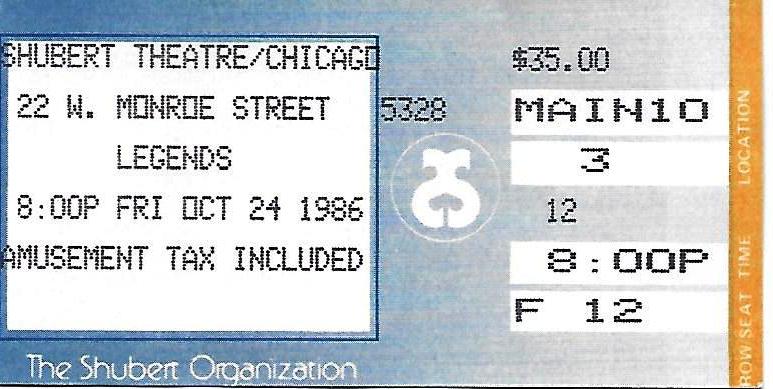
October, 1986. What becomes a legend most? Well, certainly not Legends! On paper this looked like a can't-miss smash: Mary Martin and Carol Channing onstage…together!, a script by James Kirkwood, author of the fabulously funny P.S. Your Cat Is Dead! and Tony and Pultizer Prize winner for the book for A Chorus Line, and directed by Clifford Williams, the esteemed RSC associate director and director of Sleuth. How could this possibly fail? Oh, let me count the ways. When you write a comedy for two bona-fide legends of the theatre, you'd better make it funny and not rely on your two leading ladies to utilize every bit of every tool at their command to make the play the moderately funny evening it ended up being. It was terrible, all right, but not at all a waste of an evening since it gave the capacity audience a rare non-musical glimpse of two of the most beloved stars in theatre. The material let them down, but Carol Channing and Mary Martin did not let us down. Pros even when they had to put up with the nonsense that director Williams and writer Kirkwood put them through. As a harried agent trying to nail the deal to get the two life-long enemies to star in a, hopefully, career-resuscitating Broadway play, Gary Beach was manically funny, giving hints of his future Tony performance in The Producers. But then…sigh. We had a sassy black maid, all stereotype and seriously not very funny, gamely played by Annie-Joe. There was a male stripper scene. Why? And there was a oh-my-god-this-will-just-have-them-rolling-in-the-aisles scene involving hashish brownies that didn't have us rolling in the aisles. Now understand, there were laughs and some huge ones at that, and the audience gave their legends a heartfelt standing ovation at the bows, but in the end, everyone would have been better off if Kirkwood would have just contrived something along the lines of An Evening with Mary Martin and Carol Channing and let his stars do their respective things. Or have them read and sing the Chicago phone book. It would have been better. – at the Shubert Theatre, Chicago.
Legendary Sidebars: Legends! never made it to Broadway, despite rumors to the contrary and an annoucement to the contrary at the show's closing two months after its Chicago run. For reasons known only to their therapists, a production starring Joan Collins and Linda Evans was mounted in 2006 and it traipsed around the country to horrible reviews and shuttered without its proposed stop on Broadway. I didn't see it when it stopped off at the LaSalle Bank Theatre (formerly the Shubert). I didn't feel the need to put myself through that sort of torture. For the record, Legends! is handled by Samuel French in case anyone wants to mount a production. Please feel free NOT to invite me.
Required Reading: James Kirkwood's 1989 Diary of a Mad Playwright: Perilous Adventures on the Road with Mary Martin and Carol Channing should be required reading for anyone interested in the theatre. Recounting every moment of Legends! journey, it's catty, riotously funny, touching, sometimes sad, and thoroughly detailed, letting the reader in on all the happenings and perils of mounting a Broadway-bound play. Though Mary Martin and Carol Channing don't completely get off the hook, as it were, Kirkwood's affection for both ladies is evident, and when you finish the book, you wish the project had had a happier ending.

Until next time…
© 2017 Jeffrey Geddes


Friday, September 8, 2017

MUSICAL MAYHEM: MY TOP TWENTY-FIVE MUSICALS – Part 13b: THE TOP TEN – #6

MUSICAL MAYHEM: MY TOP TWENTY-FIVE MUSICALS – Part 13b
THE TOP TEN – #6

NOTE: Due to the length of this entry, I'm dividing it into two parts. This is part two of two.


And picking up where I left off in Part One...more Company!


10:30 PM? Say what?


Interesting billing for Melissa Hart. Although listed second, the font size is the same as most of the cast except for Davis and Dailey. One could argue, with justification, that as far as Chicago audiences were concerned, she was equal to Irene Dailey and Michael Davis as far as star power.


Melissa Hart was hugely popular in Chicago, playing both Sally Bowles in Cabaret and Fran Kubelik in Promises, Promises in lengthy runs at the Shubert. She won a Jefferson Award for her portrayal of Amy. She would pretty much retire from performing in the 70s, get her MFA, now teaches in St. Paul, and continues to act. A few years ago we saw her as Mrs. Higgins in My Fair Lady at the Guthrie. 

September, 1972. A present to me from me on my 22nd birthday. This locally-mounted Company was the first musical produced at the Forum Theatre in suburban Summit, a newly-opened 425-seat proscenium house next door to its older, very successful in-the-round sibling, the superlative Candlelight Dinner Playhouse. With a cast of Chicago and New York actors and starring Michael Davis, Irene Dailey, and Melissa Hart, this was the Chicago premiere of the Tony-winning musical. The touring company slated to play the Shubert earlier in the year had cancelled its engagement due to unexpected poor box office sales. Seriously? Wow. Everything about this production was first-rate, yet I felt the production didn't quite work. Melissa Hart, a favorite of mine from the Chicago tours of Cabaret and Promises, Promises, was terrific as Amy. Michael Davis, the full-throated Rutledge of Chicago's 1776, was a handsome, suitably remote Robert, and he sang the crap out of the songs. Irene Dailey, while certainly an accomplished actress, didn't do it for me as Joanne, however. Now, that could very well be because the only Joannes I had seen up to that point had been Elaine Stritch and Jane Russell, both formidable ladies whose performances were a combination of powerful personalities, talent, and an abundance of star power, and compared to them, Ms. Dailey's performance, though assured, didn't quite cut it. Now please understand, I didn't dislike this production because I did like it. Quite a lot. I just wasn't in love with it. – at the Forum Theatre, Summit, IL
Sidebar: According to the program, the orchestra for this production numbered three musicians who played over a dozen instruments. I remember a full sound, so bravo, ladies and gentlemen of the orchestra. Cast as Jenny, Ami Silvestre would sizzle as Phyllis in a widely-acclaimed production of Follies a year or so later at Candlelight. Iris Lieberman, Marta in this production, would become a staple on the Chicago theatre scene and is still active today. Sadly both the Forum and Candlelight would close debt-ridden in 1997.
Holy Second Show, Batman!: On Saturdays, the Forum's performances were at 7:00 PM and a mind-boggling 10:30 PM. What this means is that Company's second show didn't come down until after 1:00 AM! And they had a show at 3:30 the following afternoon! No. Just no.


November, 1972. Just because I had mixed feelings about this production didn't mean I didn't want to see it again. Melissa Hart had withdrawn due to illness and was replaced by a very capable Judy Rice. Now a few months into its run, this was a tighter performance than the one I'd seen that September, but I was still underwhelmed with Irene Dailey. – at the Forum Theatre, Summit, IL


 October, 1995. It would be twenty-three years before I would once again visit Robert and those "good and crazy people," his married friends in Company. This was my first encounter with the superb Roundabout Theatre Company, a company that consistently turns out quality work. This was also the first Broadway revival since Company's premiere twenty-five years earlier. Scott Ellis' sparkling production, aided by Rob Marshall's choreography, didn't necessarily offer any new insights, despite the addition of "Marry Me a Little," cut from the original production, and revisions to the Robert/Peter/Susan scene that implies at least one homosexual liaison between Robert and Peter, but, then again, it didn't have to blaze new trails. Another interesting change was lyrically in "You Could Drive a Person Crazy" which replaced "I could understand a person if it's not a person's bag/I could understand a person if a person was a fag." with "I could understand a person if he said to go away/I could understand a person if he happened to be gay." Doesn't have the same pop, perhaps, but is far less offensive. And look at that cast, among them Danny Burstein, Kate Burton, Diana Canova, Veanne Cox, Charlotte d'Amboise (Kathy…danced up a storm), Jane Krakowski (April…terrific!), La Chanza (Marta…OMG!), and Debra Monk. Boyd Gaines opened the show as Robert, but experienced health issues early in the run and was replaced for most of it by understudy James Clow, who was terrific. This was the first time I saw Debra Monk, and I became an instant fan. She had the unenviable job of tackling a role so irrevocably identified with its originator, and making that role her own. Let's face it. It isn't easy following Elaine Stritch, even twenty-five years later, but Monk did it and did it extremely well. I liked her a lot. But the standout performance of this production was Veanne Cox, whose performance as Amy was breathtakingly funny and heartbreakingly touching at the same time. She stopped the show dead cold. A class production all around. It's always good to visit an old friend. – at Criterion Center Stage Right (Roundabout), New York


December, 2006. In 2005, director John Boyle brought a critically-praised production of Sweeney Todd, starring Patti LuPone and Michael Cerveris, to Broadway in which the actors doubled as the show's musicians. It was an interesting concept, one I felt didn't always work, but the critics went crazy for it and producers were probably ecstatic over the cost savings of not having to use both actors and musicians for a musical. So, a year later, director Boyle brought another Stephen Sondheim classic, Company, to Broadway, via Cincinnati Playhouse in the Park, and once again, the actors doubled as the show's musicians. And once again, an interesting concept, but, I'll admit it, I missed a full orchestral sound, and sometimes those damn instruments just got in the way. There were three instances, though, where this actors-as-musicians really worked: 1) In "The Little Things You Do Together," Barbara Walsh, as Joanne, played the triangle. In and of itself, that wasn't remarkable. What was remarkable was the look of total been-there-done-that that she gave the audience every time she rang the triangle. Priceless.; 2) Marta, Kathy, and April using saxophones instead of "do-do-do-do-DO!" during "You Could Drive a Person Crazy.; 3) Raúl Esparza accompanying himself on the piano for "Being Alive." A lovely touch. The electric "Tick Tock" was axed in this production, reducing Kathy's role to basically nothing, something I missed as a Company veteran. The production design was sleek and minimal and suited this production. The cast was uniformly good. Barbara Walsh's Joanne was dry and wise and she delivered a thoughtful, masterful "The Ladies Who Lunch." Esparza's Bobby was suitably vulnerable, suitably remote, and carried with him a simmering sexuality in every scene. However, and this is a big however, the entire performance suffered from a lack of energy. Everything was done well, but it was all very low-key. The show had opened a day or so earlier after a 4-week preview period, so perhaps everyone was tired and needed a couple of days off. Both the NY Times and Variety fainted over it. I less so. Curiously, I was mad about the PBS Great Performances video of this production. Made me want to see the stage version again. – at the Barrymore Theatre, New York
Sidebar: John Boyle tried a actors-as-orchestra Mack and Mabel in London. It got an indifferent reception there. And Watermill Theatre in the UK mounted a actors-as-orchestra Sunset Boulevard. While it's a bold concept, it does somewhat limit your casting. Not every bankable star and not every hard-working Equity actor can play an instrument. Patti LuPone played the tube in Sweeney Todd, and admittedly that was great good fun, but added nothing to either her character or the show. She could play the tuba, so she played the tuba.Today, the musicians are sometimes on stage and play an active part in the action, witness Bright Star and Come From Away, and sometimes the actors will play a bit here and there, but the full-blown concept of actors-as-orchestra has pretty much died down. I, for one, am happy about that.


April, 2011. Forty years after that performance seated in the last row of the Mezzanine at the Alvin Theatre. Recipe: Take a landmark 1970 musical. Add the New York Philharmonic Orchestra with the peerless Paul Gemignani as the conductor. Add a staggering cast of stars from the stage and television. Stir it with skillful direction by Lonny Price and choreography by Josh Rhodes. Put it on stage at Avery Fisher Hall at Lincoln Center. The result? A Company unlike any Company I've seen. Cast-wise, it was Company on steroids. In alpha order: Craig Bierko, Stephen Colbert, Jon Cryer, Katie Finneran, Neil Patrick Harris, Christina Hendricks, Aaron Lazar, Patti LuPone, Jill Paice, Martha Plimpton, Anika Noni Rose, Jennifer Laura Thompson, Jim Walton, and Chryssie Whitehead. Except for Robert, the ladies in Company have the meatier roles, always have, so before I go any further, I want to give a well-deserved shout-out to all the hard-working, under-appreciated guys in the show. Well done, gentlemen! And now, on to the ladies. Misses Paice, Thompson, and Whitehead all did well in the less-flashier female roles. Martha Plimpton's scene with Stephen Colbert was comic genius. Anika Noni Rose gave an urgency to the anthemic "Another Hundred People." Katie Finneran was simply delicious as the reluctant bride, Amy. Mad Men's Christina Hendrick as April was a revelation…touching, vulnerable, and very, very funny. And what about NPH, you ask? As Robert, he was the most adorable of the talented gentlemen I've seen as Robert, looked good shirtless, and anchored the show with confidence and ease, but that adorableness sometimes worked against him. I've never thought of Robert as being particularly adorable. Charming, funny, a pal…yes. Adorable, no. I'm being churlish. Harris' performance was solid and thoroughly enjoyable. But, the no-holds-barred, jaw-dropping performance of the evening was Patti LuPone as Joanne in a remote, chilling performance. Her hair-raising "The Ladies Who Lunch" threatened to blow the roof off of Avery Fisher Hall. This was LuPone at her absolute finest. So privileged to have been in the audience. This was not the definitive Company, the inimitable 1970 original still holds that title, but it certainly was the starriest. – at Avery Fisher Hall, Lincoln Center, New York

And finally...

A friend gave me this program. By March, 1972, the Broadway production had closed, and this tour was in its final months. Some of the last New York cast moved to the tour which was now doing bus-and-truck stops before ending in Washington in May. Tandy Cronyn, daughter of Jessica Tandy and Hume Cronyn, played Amy. Allen Case was Robert, and, perhaps most interesting, cabaret great Julie Wilson played Joanne. I've seen Ms. Wilson in her cabaret act. I can only imagine how wonderful she was in the role.

Company! Everybody rise!
© 2017Jeffrey Geddes

Wednesday, September 6, 2017

MUSICAL MAYHEM: MY TOP TWENTY-FIVE MUSICALS – Part 13a: THE TOP TEN – #6

MUSICAL MAYHEM: MY TOP TWENTY-FIVE MUSICALS – Part 13a
THE TOP TEN – #6

NOTE: Due to the length of this post, I'm dividing it into two parts. THIS IS PART ONE OF TWO..

Tony Awards for Best Musical, Best Book of a Musical, Best Score, Best Director of a Musical, Best Scenic Design. A landmark musical. A musical definitely of its time, yet one that still is relevant and current. "Phone rings, door chimes, in comes company."

 # 6: COMPANY  – Book by George Furth; Music and Lyrics by Stephen Sondheim
Urban and urbane. Bitter, disillusioned, yet ultimately hopeful. Populated with people that you knew you shouldn't care about, yet, somehow, you did. From the driving title tune, to "Another Hundred People" pulsating with the vibrancy of the city, to the vaudevillian "What Would Be Do Without You?," to the fierceness of "The Ladies Who Lunch," to the comic brilliance of "Getting Married Today," to the tenderness of "Someone Is Waiting," to the soaring "Being Alive," Stephen Sondheim's score bristles, even today, with innovation, life, and sheer brilliance. George Furth's book shows a bit of creakiness these days. The pot scene with Jenny and David now seems a bit too coy, but in 1970, when Company debuted, this was really quite outré. And the depiction of airline flight attendants, née stewardesses, as vapid, air-headed bimbo sex objects is the stuff of the past, though, as a retired flight attendant I hang my head in shame to admit this, very funny, and, I suspect, still the view held by the more Neanderthal straight males in our society. And frankly, I don't know how April's scenes could be rewritten to reflect the times and still be that combination of innocence and comedy. (Character change to male perhaps? Vapid, air-headed bimbo male sex object? Hmmm.)


Company has legions of fans who adore it and legions of people who loathe it. Many feel it's anti-marriage. I don't think it is, but I don't necessarily agree with its core premise that one needs to be committed to someone to be happy, a premise that oddly conflicts with the musical's conclusion when Bobby is alone on stage and he happily smiles. Is that because his friends are leaving him alone for once or is it because he is alone? The question of Bobby's sexuality has been the subject of debate since the show opened. By the time the 1995 revival rolled around, some tweaks had been made to the show and the scene with Susan and Peter now concludes with Peter coming on to Bobby to possibly rekindle a former liaison, indicating that Bobby is bisexual or, perhaps, sexually fluid. (Yes, there's a difference. Google it.) Many feel the character of Joanne was always meant to be male, something Sondheim has vehemently denied over the decades. But time marches on. Views about relationships have matured, sexual dynamics have evolved. I've read that a production of Company is being mounted in the U.K. with a female lead, now called "Bobbie." Sondheim has approved and tweaks to the script are being made. Perhaps it's time for an all-male Company, an all-female Company, a Company with a sexually versatile Bobby with gay, straight, transgender, and pansexual couples and lovers. Company may be, GASP!, a few years shy of being fifty years old (!!), but it is still a powerful, relevant show. Long live Company! "Company! Lots of company. Life  is company! Love is company! Company!"


February, 1971. The lights dimmed. From the pit, hauntingly, teasingly, voices sang "Bobby, Bobby, Bah Bah Bah Bah Bah Bah Bah Bah, Bobby…" as the curtain rose on Boris Aronson's now iconic set of levels, scaffolding, elevators, and projections, cold and utterly breathtaking at the same time. I was hooked before a word was even spoken. I mean one of the characters was wearing a wedding dress and another was wearing a flight attendant, née stewardess, uniform, for crying out loud. Who wouldn't be hooked? Company was unlike anything I had seen up to that point. I was twenty. This was only my second trip to New York, my third Broadway show. (The first two were Coco and Applause.) I was dead center in the last row of the rear mezzanine of the Alvin Theatre. It didn't take long for me to realize that this wasn't a case of a legendary star single-handedly, with some brilliant help from designer Cecil Beaton, making a mediocre show shine like a diamond (Katharine Hepburn, Coco) or a case of a legendary star taking on an iconic role in a musical version of an iconic film and making it her own by sheer force of her personality (Lauren Bacall, Applause). As the title number came to a close, I knew I was watching something very special indeed. Harold Prince's staging and Michael Bennett's choreography kept everything moving, and in the case of "Tick Tock," Bennett's dazzling tour-de-force for the character of Kathy, thrillingly so, foreshadowing Bennett's pinnacle of choreographic genius, "The Music and the Mirror," which would be a few years down the road. Stephen Sondheim's music and lyrics always seemed so right, totally in sync with the characters and the plot. I wanted to be Donna McKechnie, Susan Browning or Pamela Myers so I could do "You Could Drive a Person Crazy."  Pamela Myers' electrifying "Another Hundred People" gave me chills of delight. Beth Howland's hysterical and inimitable "Getting Married Today" was just about the funniest thing I'd seen on stage. Is there a better Act Two opening number than "Side by Side by Side/What Would We Do Without You?" Off-hand, I can't think of one. Donna McKechnie blazed through "Tick Tock" with a passion and a precision that was breathtaking to behold. Larry Kert thrilled the audience with a heartfelt and hopeful "Being Alive" that pretty much wrapped up the evening. But Company reached its peak when the incomparable Elaine Stritch uttered "I'd like to propose a toast" and then proceeded to give a master class in what happens on that rare occasion  when performer and material are totally and unequivocally aligned. Her performance of "The Ladies Who Lunch" is justifiably considered one of the great moments in musical theatre. This was a true show-stopping moment, back when stopping the show meant more than over-amplified screeching. You can see videos of Stritch performing the number on various specials, but, trust me, while it's thrilling to watch her on film, it's nothing compared to seeing her do the number, live and in character, in total command of the stage and taking no prisoners. To Company. I'd like to propose a toast! – at the Alvin Theatre, New York
Sidebar: Although I have never been in a production of Company, that show was an important part of my performing life during the 70s. In 1974, at Fort Sheridan, my acting/directing home-away-from-home, I performed in a Sondheim revue conceived by Ft. Sheridan's artistic director called A Funny Thing Happened to Stephen Sondheim. This was a few years before Side by Side by Sondheim and before Sweeney Todd, Into the Woods, Sunday in the Park with George, etc. The set, a riff on Boris Aronson's design, was levels and steps, simple and elegant. (Partially because the set looked good and partially because it was, if you'll pardon the expression, built like a brick shithouse, it would stay up for years and be the basis for other shows' scenic designs. It was a concept that was rarely successful, scenically speaking.) In the show, my solo was "The Ladies Who Lunch," sung in tandem with "The Little Things You Do Together," which was performed by a group of ladies sitting downstage. In another revue at Ft. Sheridan, I would sing, at last!, the Donna McKechnie part in "You Could Drive a Person Crazy." I would perform "Ladies" off and on at singing engagements, but my biggest Sondheim "hit," to use the term loosely…very, very loosely, was "Getting Married Today" a song I would perform often in gigs with my singing partner, Pat. (She sang the Teri Ralston and Steve Elmore parts; I sang the Beth Howland part. And, yes, I could rattle off those lyrics at breakneck speed when I was younger. Today? Not a prayer.) This all seems like a lifetime ago. Ironically, the last show I performed in before taking a twenty-four year hiatus, was a production of another Sondheim revue, Side by Side by Sondheim, where my big solo was "Could I Leave You?" In both "Ladies" and "Leave You," I was too young to really appreciate what I was singing. Now in my late 60s, I could do killer versions of both.
Sidebar of the Above Sidebar: A Funny Thing…Stephen Sondheim was Ft. Sheridan's entry in a Army-wide competition, the big prize being the Irving Berlin Award. At the time, fine arts programs were widely supported by Army brass, and, as a result, good work was frequently presented on Army base stages.  Actor Jerry Orbach spent part of his youth in my hometown of Waukegan, Illinois. He went to Waukegan Township High School and was a friend of our set designer. For whatever reason, Orbach was in town and came to our Saturday performance. Added a bit of show-biz pizzazz to the evening.
Casting Fun Fact: Elaine Stritch's understudy was Sandra Deel, who would play Lucille Early in the Chicago company of No, No, Nanette.


June, 1971. In late May/early June, 1971, I made my first "official" trip to New York, i.e. the first trip to New York my parents knew about. I was twenty, still a minor according to the laws of the day. (!!) In the intervening months since my first visit to Company, many cast changes had occurred, the most intriguing being the casting of film star, WWII pin-up goddess, and Playtex "'Cross-Your-Heart Bras' for us full-figured gals" spokeswoman Jane Russell in her Broadway debut, and only Broadway appearance, in the Elaine Stritch role of Joanne. (Stritch left to join the First National Tour.) Russell was noted for being a devout Christian and to accommodate her beliefs, Sondheim temporarily changed lyrics in "The Little Things You Do Together" from "And, Jesus Christ, is it fun!" to "And, my oh my, is it fun!" I don't think it bothered anyone in the audience, but, since by this time, I knew the cast recording forwards and backwards, I found the change jarring. But lyric changes and breast-size notoriety notwithstanding, her performance was polished, totally professional, and suitably acerbic. She seemed to be enjoying herself, and the audience clearly loved her. In addition to Russell, there was one other standout replacement: Marian Hailey in the Beth Howland role of Amy. Funny and touching as Amy, her career as an actress was short-lived, despite critical success, especially in the film Lovers and Other Strangers, and she is now the author of children's books and a psychotherapist.  Larry Kert was still on hand as Robert. Future Tony-winner Priscilla Lopez was an understudy. This production was a perfect example of how, with careful and thoughtful recasting and TLC from its director and choreographer, a show can remain as vibrant, as exciting as it was with the original cast. – at the Alvin Theatre, New York
Sidebar: Today the Tony Award broadcast  takes place in early June, with a qualification cutoff date around May 1. But that wasn't always the case. In 1971, the Tony broadcast was held on March 28. So when Company won its Tonys, it had been open for almost a year.


November, 1971. On my way to New York for a Thanksgiving weekend of Broadway, I decided to stop over in Cleveland for the night to catch the First National Tour of Company starring Oscar-winner George Chakiris as Robert and the indomitable Elaine Stritch as Joanne. Some folks from the New York company I saw in June, most notably Marian Hailey reprising her triumph as Amy, had left the Broadway company by this time to tour the provinces and were in the Cleveland cast. (Mini Sidebar: In the dance-centric role of Kathy was Carolyn Kirsch, who, a few years later, would play the Blackstone Theatre in Chicago as Velma Kelly in Chicago.) As Joanne, Stritch commanded the stage with ease and the ferocity of her interpretation remained intact. George Chakiris brought a smoldering sexuality to the part of Robert, contrasting with the easygoing good pal vibe Larry Kert brought to the role. Both valid interpretations, but this Bobby positively sizzled, boy, did he sizzle, and the penultimate scene between Joanne and Robert crackled with sensuality and electricity. A memorable evening in Cleveland. – at the Hanna Theatre, Cleveland
Sidebar: The Hanna Theatre was a lovely legitimate house that seated approximately 1500 patrons. Built in 1921, for many years it was Cleveland's theatre of choice for touring shows. But theatre economics changed, and producers began to book larger, more impersonal houses, and the charming Hanna fell out of favor, closing in 1989. After an extensive renovation which reduced capacity to 550, it reopened in 2008 and, though perhaps no longer used to house touring Broadway hits, it is still a viable venue and the main performing space for the Great Lakes Theater. And a theatre being used as a theatre is always a good thing.


The original London cast.

OMG! Those prices!!!


(revised from an earlier post)
May, 1972. My first West End show. My first trip to London. I was 21. I was pretty much obsessed with Company back then, so it's not surprising I would see it in London. A chance to see Elaine Stritch again in her landmark performance? Well, duh! Actually, I saw it twice that week. Another reason I really wanted to see Company in London was to see Dilys Watling, who was Tony-nominated for her role in the short-lived Georgy. She played Amy and was very good in the role, but it was Julia McKenzie as April who captured my heart. I adore this woman and have seen her in several shows since then, both in London and New York, and even had the privilege of sharing a drink with her after a performance of Sweeney Todd back in 1994. This was a replacement cast with London actors taking over from their American counterparts who opened the show. Larry Kert, Marti Stephens (from the Cleveland cast), and Elaine Stritch were the holdovers, and all of them, not surprisingly, gave assured performances. What was surprising, however, was that this very New York show was quite a success in London. A perfect introduction to the West End and a perfect way to begin my love affair, not only with Ms. McKenzie, but also with the London theatre scene. – at Her Majesty's Theatre, London.
Sidebar: In 1972, a decent, modest B&B-type hotel cost under 2 quid a night (The Crescent Hotel, Cartwright Gardens, London. Still in business, though my single with shared facilities is now ₤78/night…a bit of an increase!). You could see a show in the gallery for 40p. I left the States with just over $100 and lived off that for my week's stay and even came back with about $10. Ah….those were the days!
Stritch Sidebar: London loved Stritch and Stritch loved London. She would move there and not return to the United States until the mid-1980s.

And that's it for part one. Part two coming soon.
© 2017Jeffrey Geddes

CONCERTS AND TUNERS AND PLAYS…OH, MY! - vol. 1

  CONCERTS AND TUNERS AND PLAYS…OH, MY! vol. 1 Spring is finally here. And what better way to celebrate than by strolling down theatrical ...