Tuesday, January 17, 2017

"T" FOR TWO (OR MORE…) ... A WHOLLY-OWNED SUBSIDIARY OF ALPHABET SOUP

"T" FOR TWO (OR MORE…)
A WHOLLY-OWNED SUBSIDIARY OF ALPHABET SOUP

The first blog post of 2017, after the tumultuous year known as 2016, chats about a 70s comedy that had its moment in the spotlight, but then faded away to Samuel French limbo; a frothy musical based on a frothy film; a film legend's Broadway debut in a fascinating, but flawed play; a well-acted play that oddly left me less moved than I felt I should have been; and finally, a stunning, stunning one-man show about survival. They all start with the letter "T," so come get comfy and join our very own "T" party. ("T" party. Get it? Okay, I'll stop.)

TWIGS
 – Broadhurst Theatre, New York


"Twigs" stayed at the Broadhurst for only a couple of months. It played most of its run at the Plymouth.


November, 1971. I thought Twigs playwright George Furth's book for the landmark musical Company was brilliant, still do in fact, so I was excited to see what he would do with his follow-up show. The result was an evening of four interconnected one-acts that was often very funny, but which completely left your memory the moment each playlet was done. Would it be unjust of me to say it felt like really well-written sitcom episodes for someone like Carol Burnett (see Sidebar)? Produced with class by Frederick Brisson, better known as Rosalind Russell's husband, Twigs was skillfully designed by Peter Larkin (scenic), Sara Brook (costumes), and David F. Segal (lighting), with assured direction, in a rare departure from musicals, by Michael Bennett, hot off of his back-to-back triumphs with Company and Follies. Stephen Sondheim even provided the incidental music for his Company colleague. It featured a cast of pros, including A. Larry Haines, Conrad Bain, and Simon Oakland. But what ultimately elevated Twigs from being just another competent, yet inconsequential comedy, was its leading lady, Sada Thompson, in a performance, as the woman in each of the playlets (three sisters and their mother), that had the critics falling over themselves in praise. It was her performance, and make no mistake, Ms. Thompson was definitely driving this bus, that took the play to profitability and earned her a well-deserved Tony Award for Best Actress in a Play, Twigs' only Tony nomination. It wasn't the best comedy ever written, but in the assured hands of Sada Thompson, it glittered like a polished diamond. It has since become one of those forgotten 70s comedies. – at the Broadhurst Theatre, New York
Sidebar: Ironically, in 1975, CBS aired a televised version of Twigs starring Carol Burnett, rather than its originator Sada Thompson. In 1975, Burnett was a huge television name and her eponymous The Carol Burnett Show was one of television's biggest hits. Thompson would gain television stardom a year later as the wise and loving matriarch in Family. She'd also win an Emmy Award in the process. Although widely considered one of our finest actresses both on stage and on television, Twigs was Thompson's biggest success, running nearly 300 performances. She appeared on Broadway only twice after Twigs, both shows quick-closing failures. She died in 2011 at the age of 83.

– Blackstone Theatre, Chicago


October, 1972. Following its successful and profitable Broadway run, producer Frederick Brisson loaded up the sets and costumes, hired some skilled actors, retained his Tony-winning star and embarked on a six-month national tour. Sada Thompson was still dazzling and provided a tour-de-force; her vehicle seemed even less accomplished on a second viewing. Oh, it was still quite funny and very professional, but now firmly felt like sitcom on a legit stage. As a play, eminently forgettable. As a showcase for Sada Thompson, totally memorable. – at the Blackstone Theatre, Chicago

THOROUGHLY MODERN MILLIE – Marquis Theatre, New York


May, 2002. A few years back, I watched, for the first time in 30+ years, Thoroughly Modern Millie, the film on which this frothy treat of a musical is based upon. The film, although equally frothy and light as air, doesn't quite hold up to the stage incarnation. Oh, sure, the film stars Julie Andrews at her effervescent best as Millie, in a performance that gave a tantalizing glimpse at how wonderful her stage performance in The Boy Friend must have been; and it featured a delightful, if sinfully underused, Mary Tyler Moore; and charming performances by James Fox and John Gavin; and had some great numbers. But, it also featured an odd performance by Beatrice Lillie, and, yes, I'm probably the only person on the planet who didn't faint over her, and an even odder and jarringly over-the-top performance by Carol Channing, who would, for reasons known only to the Academy Awards nominating committee, get an Oscar nomination for Best Supporting Actress. (I assume this was her consolation prize for the egregious casting of the horribly miscast Barbra Streisand instead of Channing in the, ultimately, terrible film version of Hello, Dolly!) All my misgivings about the film, however, vanished seconds after the curtain rose as Sutton Foster, all delicious charm and talent, started singing her first number. Cheerfully old-fashioned and without a care in the world, Millie was a wide smile from start to finish. The book by Richard Morris and Dick Scanlan kept the somewhat convoluted plot clipping along, but it was the new score, courtesy of the always wonderful Jeanine Tesori, and the new lyrics by the aforementioned Mr. Scanlan that gave the musical a verve and sass that was missing from the film. Expensively designed, smartly directed, with terrific choreography, Millie featured a raft of great performances from Marc Kudisch's pompous Mr. Trevor Graydon to Gavin Creel's sweetly romantic Jimmy Smith to Angela Christian's cluelessly naïve Miss Dorothy to Anne L. Nathan's drill sergeant office manager (a great small part) to Ken Leung and Francis Jue's hysterically evil Chinese henchman to Sheryl Lee Ralph's glamorous Muzzy Van Hossmere. But it was Harriet Harris' diabolical and diabolically funny Mrs. Meers and Sutton Foster's powerhouse performance as Millie which left the most lasting impressions. Both would win Tony Awards (Best Actress for Foster and Best Supporting Actress for Harris) and both would go on to gift the theatre with other memorable performances. My only minor quibble was Foster's eleven o'clock number, "Gimme Gimme." Though technically faultless, this was the one instance where I could see Foster working. The smile was a bit strained, the energy a bit mechanical. All this, however, became academic as she brought the number to a sensational finish. Strained and mechanical or not, when that number ended, you knew you were witnessing the birth of a new star. – at the Marquis Theatre, New York.
Sidebar: Despite reviews which ranged from full-out raves to complete pans, with much of the negative press citing a lack of freshness and sincerity, Thoroughly Modern Millie won six Tony Awards, including the all-important Best Musical beating out Urinetown, the Tony-winner for both book and score. There were many raised eyebrows over Millie's win. Urinetown is, in my opinion, the better show, the more inventive one, but many believe people didn't want another satiric musical to win the year after The Producers famously swept the 2001 Tonys. With three big Tony wins, Millie went on to a run of just over 900 performances and a long national tour.
Casting Tidbits: In a classic "you're going out a youngster but you've got to come back a star!" piece of 42nd Street life-imitates-art, Sutton Foster stepped up from the ensemble when the original Millie. Erin Dilly, didn't meet expectations during the La Jolla Playhouse tryouts, took the show to Broadway and became an "overnight" sensation. (Foster had been in four Broadway productions prior to Millie.) She's one of my favorites and I'm pretty much convinced there's nothing she can't do. (Miscellaneous fun tidbits: Kristin Chenoweth played Millie during workshops, but left the production to work on a sitcom that was cancelled after six episodes. Oops! In La Jolla, Pat Carroll played Mrs. Meers and Tonya Pinkins was Muzzy. Now that would have been worth seeing!) Although Sutton Foster is the lead, she's billed as "and introducing SUTTON FOSTER as Millie." (She's a veteran of four Broadway shows and you're "introducing" her?  A bit of PR embellishment?), This is prominent billing, and since she won the Best Actress Tony, apparently qualified as above-title billing, but the first actor billed is Sheryl Lee Ralph, who played the somewhat extraneous role of Muzzy. She was very, very good, mind you, but first billing? I guess when you're an original Dreamgirl and making your first Broadway appearance in nearly twenty years, you wield that kind of billing power. And in the ensemble, a flock of names that I would see in other shows in bigger roles: Kate Baldwin (!!), Jessica Grové, Casey Nicholaw (future Tony-winning director and noted choreographer), Noah Racey, and Megan Sikora. Never, ever underestimate the phenomenal men and women who work in the ensemble!

THREE DAYS OF RAIN – Jacobs Theatre, New York


April, 2006. Playwright Richard Greenberg is a writer I have admired since I read his early play, Eastern Standard. He won a well-deserved Tony in 2003 for his magnificent play, Take Me Out, which is on my Top Ten list of favorite plays. His 2013 play, The Assembled Parties, was a bracing and exciting play about family and social standings. His 1998 play, Three Days of Rain, was a finalist for the Pulitzer Prize. His credentials are impeccable. But impeccable credentials were not the draw for the 2006 production of this time-hopping, somewhat disjointed, somewhat confusing play about truth vs. perceived truth about certain events in a brother, sister, and childhood friend's lives. Nope. No one bit. This was all about Julia Roberts' Broadway debut. Yes, that Julia Roberts. As in uber-popular, Oscar-winning, movie megastar Julia Roberts. It was her name that caused a frenzy at the Jacobs box-office. It was her name that made the limited twelve-week run a sell-out smash. It was her name that put the press and paparazzi into overdrive. So, let's get to the stuff that really matters. How was she? Well, I rather irreverently call it "The Julia Roberts Thing," but what was on view at the Jacobs was actually better than that tart little title would imply. The stage is definitely not her medium. She was frequently tentative, as though she didn't quite trust her instincts as an actor, and more than a bit wooden, as though she didn't feel confident in handling the simultaneously more intimate and bigger acting techniques of the theatre. Having said that, however, her charisma was undeniable. You literally couldn't take your eyes off of her when she was onstage. That isn't to say she stole focus. Far from it. She proved to be every inch the ensemble player and, when not actively participating in a scene, you could sense her really listening and reacting to what was going on. And perhaps this is shallow of me, but when she smiled that luminous Julia Roberts smile, all was right in the world. I'm not quite sure why she picked this particular play to make her Broadway debut in, but she deserves props for choosing a difficult, small, ensemble piece as opposed to a showier role in, say, a comedy where she could show off her comic chops and be dressed in fabulous clothes. (Thought: wouldn't she be terrific in The Little Dog Laughed?) Her costars, Paul Rudd and Bradley Cooper, in his Broadway debut, were more successful in the acting department, but I suspect that's more due to better-written roles than anything else. It was evident that the three actors respected and enjoyed working with each other and that helped the play enormously. Joe Mantello's direction was serviceable, but the unsung star of the day was Santo Loquasto's fabulous set. One final thought… After the performance, folks, not surprisingly, mobbed the stage door. Roberts was the first one out. Though with, I assume, bodyguards to help ease her way to her waiting car, she took her time, smiling to the waiting fans, sharing a word or two with a few, and signing some programs. The smile was at full tilt. She was gracious, at ease, and just plain classy. It wasn't great theatre, but it was unforgettable. – at the Jacobs Theatre, New York
Sidebar: I was on a layover in New York and stood on the cancel line and was rewarded with an 11th row seat. Not bad, not bad at all.

TIME STANDS STILL – Jacobs Theatre, New York


April, 2006. Although the Friedman Theatre is an intimate venue, sitting in the second-to-last row of the mezzanine, we lost a lot of the carefully-directed nuance that Daniel Sullivan brought to the piece. It was there, I could tell it was there, but we felt distant from the characters in Donald Margulies' drama about relationships that want to live in the past, but can't, and want to move forward, but are hesitant to do so, and that distance made for a theatre-going experience that did not land as powerfully as I suspect it would have had we been closer to the action. Perhaps Laura Linney and Brian d'Arcy James, both exquisite actors, were a tad too subtle, where a bit more oomph, for lack of a better word, in their performances could have generated more audience involvement with their characters. And in Ms. Linney's case, I had no idea her face was made up to look scarred until I saw pictures. It just didn't register up in the rafters. Although Linney and d'Arcy James and their characters' ying and yang were the play's focus, it was the broader, more comic, and, ultimately, more affecting performances of Eric Bogosian, as the couple's oldest friend, and, in a surprisingly refreshing performance, Alicia Silverstone, as his much-younger and much less complicated girlfriend, that gave the play, for me, at least, its heart. With beautiful production values and four talented actors, it was a worthy way to spend the afternoon, just not the "wow" the critical reaction would have led one to believe. – at the Friedman Theatre, New York.

THE TRICKY PART – Signature Theatre (the ARK), Arlington, VA


February, 2008. When author Martin Moran was twelve, he was sexually abused by Bob, a retired Vietnam vet and counselor at a Catholic boys' camp. This abuse continued until Moran was fifteen. Horrific by any standards, Moran treated this all with candor and, surprisingly, a great deal of humor in his one-man adaptation of his shattering book of the same name. A gifted storyteller and actor, Moran made his characters come alive with vivid detail, especially Bob. Far from being the stereotypical villain, Moran imbued his abuser with a wide-range of conflicting traits, from downright creepy to unexpected generosity. By making Bob a living, breathing person, it made Moran's abuse even more horrifying. Moran's story of survival following the end of his abuse was compelling and when he finally confronted Bob years later, a wizened old man in a wheelchair, the scene that followed and the grace that Moran gave it, concluded an unforgettable evening that I will long cherish. The warmth and genuineness Moran portrayed onstage is real. After the performance, he took the time to talk to each and every person waiting after the show to thank him for his performance, us included. An absolutely stunning experience. – at the Signature Theatre, Arlington, VA.

And that's it for the first blog of 2017! Until later.
© 2017 Jeffrey Geddes

Friday, November 11, 2016

MUSICAL MAYHEM: MY TOP TWENTY-FIVE MUSICALS – Part 11 - THE TOP TEN – #8

MUSICAL MAYHEM: MY TOP TWENTY-FIVE MUSICALS – Part 11
THE TOP TEN – #8

It's time to reveal the musical holding the #8 spot in my Top Ten. A joyous paean to anyone who has ever loved a musical, this is your show!


# 8: THE DROWSY CHAPERONE  – Book by Bob Martin and Don McKellar; Music and Lyrics by Lisa Lambert and Greg Morrison
This unassuming, absolutely charming import from Canada (yet another reason to love Canada!) certainly grew from a kick-ass engagement party entertainment to a Tony-winning musical, but despite all the bells and whistles it acquired along the way, this show never lost its heart, its sincerity, its humanity, and, yes, its decency. The Drowsy Chaperone is a celebration of the power that theatre in general and musicals in particular have to lift our spirits, soothe our souls, and enrich our lives. From the first lines told in the extended blackout that begins the show to the final triumphant moments when our host and narrator, the Man in Chair, gloriously interacts with the cast of the show he's introduced us to, the fictional 1928 musical comedy, The Drowsy Chaperone, we in the audience leave our troubles behind and become a willing participant in the Man in Chair's journey. The plot of the musical within the musical is 1920s-era nonsense, but delicious nonsense. The surprise in the show may be that, as you discover more and more about the timid, agoraphobic Broadway musical superfan who acts as our guide, you find yourself caring deeply about him. So it's not just fluff; it's fluff with a heart and soul. It's a joy. The concept of a cast album, and, yes, I mean album in the LP sense, coming to life while the Man in Chair regales us with interesting facts and gossip is refreshing and inventive. The book is silly most of the time, but has an almost subversive depth when it needs to. The score is marvel of pastiche and great tunes. At the 2006 Tony Awards, it won five Tonys, including the coveted ones for Best Book and Best Score, but lost out on Best Musical to the jukebox sensation, Jersey Boys. It played for 674 performances and made its money back. It had a successful Equity tour, and now is a popular show among amateur/community theatre groups. I'm smiling now just thinking about it. Go ahead, play the cast recording now. I'll wait. … I know, I know. It's fabulous, isn't it? A perfect show for these tense times.


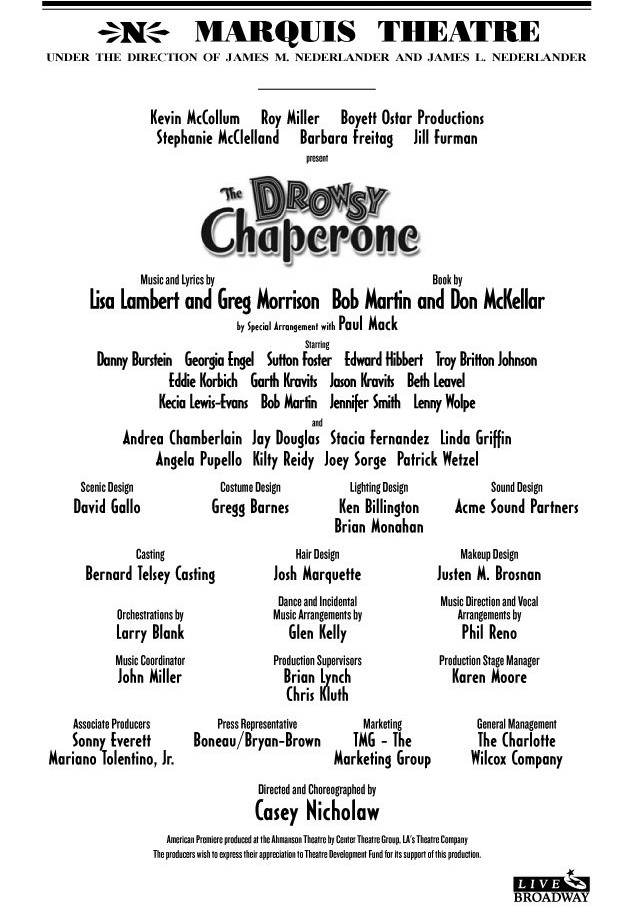
June, 2006. Fresh from winning five Tony Awards two weeks earlier, the capacity audience at the Marquis Theatre embraced this show with love, laughter, and applause from the moment the house lights went down. And with good reason. David Gallo's clever, stylish and inventive scenic design, Gregg Barnes' fabulous costumes, and Ken Billington and Brian Monahan's spot-on lighting gave the show its atmosphere. A fine pit orchestra under the direction of Phil Reno brought the infectious score by Lisa Lambert and Greg Morrison to joyous life. Casey Nicholaw's direction and choreography was subdued when it needed to be, flashy when it needed to be, and gave the show its sass. But it was the extraordinary company of actors assembled on the stage of the Marquis Theatre who gave the show its heart. From Bob Martin's instantly endearing Man in Chair to the talented ensemble, this was as perfect a cast as any show could possibly want. Playing Bob Martin and Don McKellar's book with a just-right wink and a just-right amount of over-the-top, this was a joy to watch. Troy Britton Johnson as Robert Martin was a fitting 20s-matinee-idol, with Eddie Korbich as his stalwart best man. Lenny Wolfe was properly frazzled as a Mob-harassed producer, with a wonderfully spacey Jennifer Smith as his ditzy girlfriend. Jason and Garth Kravits played the dancing gangsters with delightful aplomb. Kecia Lewis-Evans made the most out of her role as Trix, the Aviatrix, Queen of the Skies. Danny Burstein's singular performance as Aldolpho was a master class in this-close-to-over-the-top acting and just plain adorable silliness. Georgia Engel's Mrs. Tottendale may have been a retread of her character of Georgette from television's The Mary Tyler Moore Show, but it didn't matter because her smile and eagerness to please rendered any criticism rather pointless, and partnered with the comic timing genius of Edward Hibbert as Underling (don't you love the character name?), this duo very nearly ran away with the show. And what can I say about Bob Martin's Man in Chair? I felt as though he were my BFF and we were having a wonderful afternoon listening to cast albums in his apartment. He made the large Marquis Theatre intimate and the audience simply fell in love with him. Sutton Foster. Need I say anything? Is there anything she can't do? As Janet van de Graaf, she was simply amazing. Her performance of "Show Off" was worth the price of admission. She radiated charm and star quality. With all the talent on display, however, it was Beth Leavel's Tony-winning performance as The Drowsy Chaperone that shined brightest. Scenery-chewers, take notes from this woman. She is the master. And yet, not a note, not a gesture out of place. Her "As We Stumble Along," which happens to be among my very favorite show tunes, demonstrated with ease how to stop a show while not breaking a sweat. The audience started whooping and hollering as she held her penultimate note, paused for second, and then basically screamed as she brought the song to a close. We couldn't get enough of her. Or the show. Delightful and everything a musical comedy should be. – at the Marquis Theatre, New York.

December, 2006; February, 2007. Although it's not especially unusual for us to see a show more than once, lately it is unusual for us to pay full price to see a show on a return visit, notable exceptions being Next to Normal and Follies. Not surprisingly, Bob loved the show as much as I did and he suggested the return visit in February. Good choice. At the February performance, Andrea Chamberlain was filling in for Sutton Foster, and she was smashing. All the rest of the original cast principals were there to wow us. Bob especially liked Beth Leavel (duh!), Bob Martin, and Danny Burstein. Great times at the theatre. – at the Marquis Theatre, New York.

Bob and Beth Leavel

Jeff and Danny Burstein

Jeff and Bob Martin

Sutton was so thrilled we stopped by!

The Two Bobs....Estrin and Martin

Six Degrees of Separation Tidbit: Bob Martin (Man in Chair) is married to Janet van de Graaf. Janet van de Graaf is the name of the character originally played by Sutton Foster in The Drowsy Chaperone and Robert Martin is the name of the character that the musical's Janet van de Graaf marries. Here's the six degrees part: Janet van de Graaf went to New Trier High School. Bob retired from teaching theatre at New Trier High School. It's unclear whether or not their paths crossed, but this prompted some lively chat at the stage door between my Bob and Bob Martin. 


April, 2008. Bob and I adore this show and were delighted that it was just as wonderful on tour as it was in NYC.  The late Jonathan Crombie was amazing as the Man in Chair. There was a very touching vulnerability about him, an open sweetness that just drew the audience in. He made the part his own, and with all respect and admiration for the wonderful Bob Martin, I preferred his interpretation. Georgia Engel was on hand to the delight of the audience with her daffy portrayal of Mrs. Tottendale. Nancy Opel was a very competent Chaperone, but I didn't feel she nailed the part. Where with Beth Leavel, it just seemed effortless, with Opel, it was almost as if she didn't quite trust the role. Her "As We Stumble Along" was still fun, but not a show-stopper. Andrea  Chamberlain, as Janet van de Graaf, truly stopped the show with "Show Off."  In the year since we saw her cover for Sutton Foster in New York, she had grown in the part to make it a star-making turn. What fun! – at the Cadillac Palace Theatre, Chicago
Sidebar: Jonathan Crombie's one Broadway appearance was as a replacement for Bob Martin in the original New York company of The Drowsy Chaperone, a role he would perform for most of the national tour. He would tragically die in 2015 of a brain hemmorrage at the very young age of 48.


May, 2010. The critics liked this version. I wanted to, I really wanted to, but, despite the best efforts of Paula Scrofano (Mrs. Tottendale), Gene Weygandt (Underling), Adam Pelty (Aldolpho), and an effective, if not entirely successful James Harms as Man in Chair, this production felt flat, a bit listless, and a lot forced. Linda Balgord as The Drowsy Chaperone  ("And LINDA BALGORD as The Drowsy Chaperone" per the program) seemed miscast. Now Ms. Balgord has some serious credits, but here she just was uninteresting and, well, disappointing. Marc Robin's in-the-round staging didn't serve the show especially well, and without a dynamic cast, (it was a competent cast, but not a terribly dynamic one) all the production bells and whistles of the New York and touring productions were greatly missed. For whatever reason, the folks at Marriott Theatre decided to put an intermission into this intermissionless show. This was a very, very bad decision because it totally killed the show's momentum, and the show never regained it in the second act. I'm sure this was to accommodate the senior citizen demographic of the Lincolnshire venue, but c'mon, people. The show's only 100 minutes long. You can't sit for 100 minutes without peeing? The folks at the Marquis in New York and the Cadillac Palace in Chicago didn't seem to have a problem with the length. I'm sure they had to get approval for this, but, sorry, the intermission really ruined the show. I wasn't overly enthusiastic during Act One; I was pretty much totally disinterested in Act Two. I expected a better production from Marriott. – at the Marriott Theatre, Lincolnshire.

And so ends another installment. See you soon!
© 2016 Jeffrey Geddes

Thursday, October 20, 2016

"P" SOUP: A WHOLLY-OWNED SUBSIDIARY OF ALPHABET SOUP

"P" SOUP
A WHOLLY-OWNED SUBSIDIARY OF ALPHABET SOUP

A musical behemoth and its more modest half-sibling. A Gershwin masterpiece "reimagined" for its latest Broadway outing. A slight, but happily entertaining musical with one of the best opening numbers ever. An over-produced musical version of a terrific Australian film. It's all musicals today. So get comfy and let's begin.

THE PHANTOM OF THE OPERA
 – Forrest Theatre, Philadelphia


July, 1995. This is from the Variety review dated January, 26, 1988: "The Phantom Of The Opera is romantic musical theater hokum in the grand manner …and it justifies the feverish buildup that has given it a $16,500,000 advance. It’s good for a Broadway run of several years." (underlining mine) Several years, indeed. It may no longer be selling out with regularity, but, in October, 2016, as I type this, it's still running at the Majestic Theatre and has amassed over 12,000 performances. It is hands-down the longest-running musical in Broadway history and will likely remain so for a very long time to come, if not forever. The original London production recently celebrated its 30th anniversary at its original home, the Her Majesty's Theatre. It has spawned numerous touring companies in the United States and Canada (all Equity, thank you very much!), international companies around the world (it was especially popular in Germany), and an unpopular film version. Hugely popular. Irresistible plot. Buckets of money for all involved. And, frankly, a bit of a snooze. Don't get me wrong. As presented at Philadelphia's historic and beautiful Forrest Theatre, the Second National Company was a first-rate production all the way, from the sumptuous Maria Björnson and Andrew Bridge design, to Gillian Lynne's spot-on musical staging and choreography, to seamless direction by the legendary Harold Prince, to the lush singing and professional acting by the company, starring Rick Hilsabeck (the Phantom), Sarah Pfisterer (Christine), and a very young and handsome Jason Danieley (Raoul). For whatever reason, however, the show just didn't grab me. It was all a bit too melodramatic and over-the-top. Oh, Andrew Lloyd Webber's tunes are tasty enough, but everything lacked a depth. Not the actors fault. Not the director's fault. Cliché as it may be, I put the blame squarely on the book by Richard Stilgoe and Lloyd Webber. It went for the obvious and despite everyone's best efforts, I didn't give a crap about any of the characters. And to top it all, the much-publicized chandelier-crashing-to-the-stage effect? In Philadelphia, the chandelier lurched its way to the stage where it landed with a thud rather than a crash. All very anticlimactic. The evening was enjoyable enough, but I'm at a loss to explain its runaway popularity. - at the Forrest Theatre, Philadelphia
Tidbits: The Forrest Theatre was a popular stop for musicals to tryout on their way to New York. The theatre's designer, Herbert J. Krapp, in a moment of brain fartdom, forgot to put dressing rooms in his design for the theatre. As a result, the dressing rooms are in the building across the alley, connected to the Forrest via an underground tunnel. Possibly its most infamous tenant was the tryout of the doomed Breakfast at Tiffany's. Tony Award-winning actor David Burns died of a massive heart attack onstage at the Forrest following his big number in Kander and Ebb's 70, Girls, 70 during the show's tryout there. Sarah Brightman, then Lloyd Webber's wife, was originally prohibited by Actors' Equity Association from recreating her role as Christine. Shouting matches and threats abounded, but it all worked out in the end, and she opened to modest reviews, most praising her voice and dismissing her acting. Original Phantom Michael Crawford won the Best Actor in a Musical Tony for being onstage for approximately twenty minutes or so. The Phantom of the Opera won seven Tonys at the 1988 ceremony, besting, shockingly, Into the Woods for Best Musical. (Into the Woods, however, would win the trophies for book and score.) And, finally, the Third National Company closed in Los Angeles in 2010 after nearly 18 years on the road. Now that's mighty impressive by any standards!

– Phantom Theatre, The Venetian Resort-Hotel-Casino, Las Vegas

Just "Phantom" on the cover.

'
Now it's "The Phantom of the Opera." Sorry for the blurriness. I tried to sharpen it up to no avail. Sigh.

Now it's "Phantom: The Las Vegas Spectacular."

I'm not sure why I have so many programs from this version.

What is in a name? Back to its legal name.

Yet another program. Is the show's name "Paris"? Huh?

February, 2008. This was marketed as Phantom – the Las Vegas Spectacular, but on the program's credit page, it's called, rightly so, The Phantom of the Opera. Trimmed down to a fast, intermissionless, 95 minutes, this was spectacular indeed. Produced in a theatre especially built for this production, it had more bells and whistles than you could count. And that famed chandelier really lived up to its rep in this version. What little subtlety was in the full-length version was jettisoned in favor of short scenes that set up the "big hit tunes." Backstory? Nope. Not gonna happen, but that's okay. You figure it out. The glorious design elements of the New York original were adapted for this theatre which was designed to make you feel as though you were actually in the Paris Opera House. Hal Prince (director) and Gillian Lynne (musical stager/choreographer) were on hand to make sure the production was on solid ground. It was well-sung and professionally acted, but at the end of the day, it was still The Phantom of the Opera. Enjoyable, yes. Memorable, not especially. – at the Phantom Theatre, Las Vegas
Sidebar: The streamlining of a 2 ½ + hour Broadway musical into a brisker 1 ½ hours is not new in Las Vegas, where audience attention spans aren't geared towards theatre. In the old days, these used to be called tabloid versions. It wasn't by any means a reflection of the quality since production values often mirrored the original and box-office stars were usually in attendance. Instead, it implied that the show's running time had been greatly shortened. This version was a huge success and played for over six years. When we saw it relatively early in its run, it was still featuring alternating Phantoms, Brent Barrett and Tony-winning Anthony Crivello. I can't find anything in my program, insert or otherwise, that tells me which talented gentleman was in the role the night we saw it, and I didn't write it down, duh!, but I'm pretty sure it was Mr. Crivello. We had our seats changed shortly after the performance began since the non-English-speaking folks behind us decided the theatre was a perfect place to eat their dinner and chat loudly while chomping down on their sandwiches. Apparently, basic theatre etiquette is not terribly familiar in Las Vegas. House management were truly customer focused, moved us to premium seats, and offered us comp tickets to a future performance. When this opened in 2006, Las Vegas was being promoted as Broadway West. It didn't happen. Ironically, in 2017, the re-tooled "new" The Phantom of the Opera will return in its full-length glory to Las Vegas' Smith Center. Guess Sin City just can't get enough of that masked man!

PHANTOM – Stage 773, Chicago


PHANTOM – Stage 773, Chicago
October, 2007. Living in the shadow of its flashier and more famous half-sibling (they share the same father, Gaston Leroux) is Arthur Kopit and Maury Yeston's Phantom. Quieter and more compelling than  the overblown Lloyd Webber creation, this version's focus is more character-driven and less on pretty, string-heavy warblings and theatrical special effects. Overall, this is a more satisfying version of the classic tale. Christine isn't portrayed, as she is in the Lloyd Webber version, as a simpering, somewhat vacuous woman. Here the Phantom actually has a name (Erik) and a real backstory. The scene between father and son late in Act Two is so good and so touching, it alone makes the show worth seeing. Porchlight Theatre's Phantom was beautifully sung and competently acted, but not always successful in the design and directorial departments. The chandelier was especially cheesy, and the set, while ambitious, didn't always work. Director L. Walter Stearns obviously cast his actors for their singing abilities more than their acting ones, and though no one was terrible, there were a few that just didn't rise to the occasion. Naomi Landman's Carlotta, for example, failed to mine all the delicious, legitimate scenery-chewing options the part offered, and her "This Place Is Mine," didn't quite land where it should have. Peter Oyloe as the Phantom (Erik), Lara Filip as Christine, and Jim Sherman as Carriere (Erik's father) all imbued the show with an unwavering professionalism and class. The overall scope of the show wasn't an especially good match for Porchlight's limited resources. It wasn't a perfect production, but, I'm so glad I saw it. – at Stage 773, Chicago
Sidebar: Phantom has had over 1000 productions, but has never been produced on Broadway, and, wisely, probably never will be. Maury Yeston has been quoted as saying that Phantom is "the greatest hit never to be produced on Broadway." It had its world premiere in 1991 in Houston. Robert Cuccioli (Jekyll and Hyde) and Kristin Chenoweth have played the roles of the Phantom and Christine in regional productions of the show. Curiously, Phantom received a lukewarm welcome by the Chicago critics, at least those that matter. (This was before Porchlight Theatre became an unassailable critics' darling.) Most of the criticism centered around the staging and the set.

PORGY AND BESS – Richard Rodgers Theatre, New York

The two major revivals and rivals next door to each other on 46th Street. 


January, 2012. Billed as The Gershwins' Porgy and Bess, as opposed to, what?, Jerry Herman's Porgy and Bess?, this was a streamlined and greatly shortened version of the Gershwins' iconic folk opera about life in Catfish Row, Charleston, South Carolina, in the 1930s. Director Diane Paulus and her collaborators famously said prior to its first performances in Cambridge that they were "excavating and shaping and modernizing the story," which are just fancy terms for the dreaded "reimagining." Normally, that is anathema to me, but I had no idea what the original was like, and frankly, I didn't care. The story onstage at the Rodgers was told cleanly and honestly. The songs were beautifully sung. The acting was strong. David Alan Grier was a slimy, detestable Sporting Life and surprised me with his strong vocal abilities. Phillip Boykin was a mesmerizing villain. Joshua Henry and Nikki Renée Daniels  were a solid Jake and Clara. (To show my Porgy and Bess ignorance, I had no idea that Clara sings "Summertime," and not Bess.) The curtain was very late at this performance and a last-minute announcement gave us the news that Norm Lewis had taken ill backstage and his cover, Nathanial Stampley, would be going on. We were told at the interval that this was Stampley's first time in the role. First time or not, he was wonderful, and was loudly cheered at his solo bow. And what can I possibly say about Audra McDonald except divine! She took the part of Bess and sent it into the stratosphere. Here's the deal, though. If Ms. McDonald wanted to sit in a chair and perform the phone book, that would be just dandy with me. It's so much more rewarding, however, when she's onstage in a challenging role. Mixed reviews greeted this production. The critics who loved the show praised this more economical version. The critics who didn't found the new changes detrimental to the intentions of the authors. But everyone agreed on one thing: Audra McDonald's Bess. – at the Richard Rodgers Theatre, New York
Sidebar: Stephen Sondheim created somewhat of a shitstorm when he wrote a letter to the New York Times in response to an article about the changes director Diane Paulus and her collaborators were making to Porgy and Bess, which had not yet begun its run at A.R.T. in Cambridge. He ended his letter by stating it wasn't his intention to pre-judge the show, but rather to point out what he felt was the arrogant attitude of Paulus, et. al. This was not a wise thing to do. You see, Paulus had brought a wildly-successful, Tony-winning revival of Hair to Broadway a couple of years earlier. She was/is the artistic director of the respected American Repertory Theater in Cambridge, Massachusetts. For many, Sondheim remarks were those of a pompous bully and despite any validity of his comments, it all came to bite him in the ass when the 2012 Tony Awards were handed out. You see, his Follies, in a stunning revival, opened in the same season as Porgy and Bess, and though nominated for 8 Tonys, it only won one (for Costume Design), and lost the important Best Revival of a Musical to, you guessed it, The Gershwins' Porgy and Bess, to use its new, convoluted moniker. Memo to Mr. Sondheim: "Steve, darling, don't publically diss your competition if you want to win some swag. Love, Jeff." 

PURLIE – McVickers Theatre, Chicago


September, 1972. "Walk Him Up the Stairs," Purlie's opening number, is one of the most exciting opening numbers in musical theatre. It ranks among my top five opening numbers, the others being the opening segments of Ragtime, Titanic, Cabaret (original, 1966), and Cabaret (Roundabout, 1998). For those first eight minutes or so, the venerable McVickers Theatre was turned into a joyous, gospel tabernacle that had the McVickers' Saturday night audience swaying, leaping to their feet and "amen"-ing, and bringing the entire opening moments to a close with thunderous, rapturous applause. Based on Ossie Davis' play Purlie Victorious, the musical adheres closely to the play's plot of a charismatic preacher's quest to buy Big Bethel, the country church in his hometown in segregation-era Georgia, and free his friends and neighbors, tenant farmers on a cotton plantation, from the clutches of Ol' Cap'n, the dyed-in-the-wool bigot who owns the plantation. Oh, and while he's at it, woo the girl of his dreams. It's all quite silly and all quite funny, yet there are also messages of equal rights and social justice. The characters are painted in broad strokes, more caricatures than actual characters, but Mr. Davis knew the subversive ability of comedy to make important social issues palatable to the general public, and these characters, even the Simon Legree of Ol' Cap'n, never get too deep or too evil. Broadway original cast members Sherman Hemsley (pre-The Jeffersons) and Helen Martin along with Broadway replacements Robert Guillaume (pre-Benson), Patti Jo, and Carol Jean Lewis (Laura Cooper at the performance I attended) headed the tour. While the performance never reached the ecstatic peak of the opening, it was very well-acted and terrifically-sung, with a book, co-authored by Ossie Davis, director Philip Rose, and lyricist Peter Udell, that was surprisingly strong, and a toe-tapping score by Gary Geld (music) and the aforementioned Peter Udell (lyrics) that had elements of gospel, jazz, blues, R&B, top 40 pop, and good old-fashioned Broadway theatre music, including "Purlie," "Big Fish, Little Fish," the hit "I Got Love," and my two favorites, "Down Home" and "He Can Do It." 1972 was a different time. Not necessarily gentler or more innocent, just different. Would Purlie's carefree desire to entertain, broad characters, and not-very-subtle dialogue seem out-of-place in 2016? Would a show written primarily by white folks, Davis being the exception, about black folks during the days of Jim Crow laws be both dismissed and ridiculed in our era of excruciating theatrical correctness? Purlie is a thoroughly entertaining, solid show, but I suspect it is languishing in Samuel French's catalog of musicals. – at the McVickers Theatre, Chicago
Sidebar: I saw Purlie in its second-to-last week of a three-month engagement. It would be one of the last, if not the last, stage show produced at the McVickers. (I wish I could verify this, but no luck on the Internet.) Even though Ossie Davis is credited as a co-author of Purlie, he did not actively participate in the musical, but because much of the dialogue was lifted directly from Purlie Victorious, it was felt he should be acknowledged as one of the book's writers. Both Robert Guillaume and Sherman Hemsley would have hugely successful careers on television. Purlie was Patti Jo's only Broadway appearance. She had a modestly successful career as a recording artist, was apparently very popular on the south Florida cabaret/nightclub circuit, and, sadly, died in 2007 at the young age of 60.  At the 1970 Tony Awards, Purlie was nominated for Best Musical along with Applause, that year's big winner, and Hepburn!, wait, I mean Coco. It would win two Tonys for acting.

PRISCILLA QUEEN OF THE DESERT – Palace Theatre, New York


Listed first among Priscilla's many producers is Bette Midler and she was a tireless promoter of the show during its run.

At London's Palace Theatre, Priscilla's marquee kicks marquee butt!

April, 2011. The Australian film, The Adventures of Priscilla, Queen of the Desert, is about two drag queens and a transgender woman, all a bit down-market performers, who are contracted to do a drag show in Alice Springs, and their adventures as they travel from Sydney to the Outback in their bus, Priscilla. It's a charming, funny, and touching film that ranks among my favorites and is one of the few movies I own. As done in New York, however, it was almost completely charmless, over-produced, over-amplified, under-enunciated, and surprisingly sloppy in more than one spot despite the valiant efforts of its three superior leading men who tried to add heart and characterization to this largely paint-by-the numbers, mechanical endeavor.  The chemistry between the three men was obvious, and that showed in the book scenes.  Come to think of it, the only parts of the show I liked were the book scenes. Hats off, therefore, to Tony Sheldon, Will Swenson, and Nick Adams. You deserved better!  Priscilla desperately needed an original score. The lack of one resulted in an absence of musical depth and didn't allow the players to grow their characters through song. The ladies in the cast did what they could with what little they had to work with. I suspect I may be in the minority here. The straight people around us were in rapture..."Those gay boys are SOOOOO much fun!!!" For me, however, it was a major disappointment. – at the Palace Theatre, New York
Sidebar: Priscilla originated in Australia and, on its way to New York, stopped off in New Zealand, London, and Toronto. With a performance run of 23 previews and a respectable 526 performances, it did not recoup its $15 million production costs. Like its fellow Australian import, The Boy from Oz, Priscilla tried to shoehorn its story to fit the pre-existing songs the show was using. In Oz it worked better, but only just. The Boy from Oz, however, made its money back even with a shorter run, and that was due to the presence of its charismatic leading man, Hugh Jackman. Even with its trio of fine leading performances, Priscilla never created the box office excitement that Oz had. I think I'll stick to the movie.

In fact, I think I'll watch the film now. Until next time….see some theatre!
© 2016 Jeffrey Geddes


CONCERTS AND TUNERS AND PLAYS…OH, MY! - vol. 1

  CONCERTS AND TUNERS AND PLAYS…OH, MY! vol. 1 Spring is finally here. And what better way to celebrate than by strolling down theatrical ...