Wednesday, March 14, 2018

IF THE SHOE FITS… (The Shoebox Files) Part 3

 IF THE SHOE FITS…
(The Shoebox Files)
Part 3

Still more programs snugly stored away in shoeboxes. Let's see…what's on for today?


ONCE – Jacobs Theatre, New York


March, 2012. 4th preview. The primary set piece is a bar and the audience was invited to join cast members and fellow patrons to enjoy a brew and impromptu hootenanny featuring ensemble members of the cast before the show. Kinda cool. The show itself was unabashedly romantic and featured a monstrously talented cast of musician-actors (or actor-musicians, but in this case the music was the focus) lead by Steve Kazee, that devilishly handsome and talented star from 110 in the Shade, and Cristin Milioti, who was just so very good in this show. The packed house loved every second of it. So did we. Wanted to see it again. But here's the thing…six years later, nothing specific about the show stands out. The show was beautifully performed, designed, and staged, but it's all a blur today. What I do remember, however, and this is not an especially good thing, is diction during the musical numbers was, uh, well, spotty, a bit too mumbly and internal. You got the gist, if not the details, and the big hit tune, Oscar-winning Best Song from the film Once, "Falling Slowly," was a bit of a dirge, and, frankly, the most diction-challenged song in the show. Once won a bunch of Tony Awards at the end of the season, including Best Musical and one for Mr. Kazee, and ran for nearly 1200 performances. I don't mean for this to sound negative, because, questionable diction notwithstanding, I thoroughly enjoyed the show. It just didn't stick. For the record, I've not seen it again.– at the Jacobs Theatre, New York
SIDEBAR: This loved-it-when-I-saw-it-but-now-neutral-about-it attitude towards a show has only happened with one other show, Spring Awakening. Thought that was brilliant when I saw it. Now I can't get through the cast album. Go figure.
           
TALLULAH – Shubert Theatre, Chicago


November, 2000. As theatrical literature, Tallulah is minor league. As an opportunity to see the incomparable Kathleen Turner slink about on the Shubert stage for two hours, it's brilliant. The script isn't the greatest, but with Turner mesmerizing us all and doing it on a great physical production, well, it's all great fun. Set in 1948, the feisty Tallulah is busy preparing to host a fund-raiser for incumbent presidential candidate, Harry Truman. As she prepared for the event, we, the audience, became her BFFs as she regaled us with gossip, stories, and lots and lots of "darlings." The critics liked her, didn't like the play, and the planned 2001 Broadway opening was, uh, "postponed," according to a spokesperson, "to allow the creative team to further develop the play." Everyone knows that's showbiz speak for "ain't gonna happen." Turner ended her tenure as Tallulah in early 2001, but returned to Broadway in 2002 in another iconic role, Mrs. Robinson, in The Graduate, recreating her London portrayal. Tallulah was wildly entertaining. – at the Shubert Theatre, Chicago

THAT CHAMPIONSHIP SEASON – Colonial Theatre, Boston


June, 1974. In 1972 when Jason Miller's That Championship Season opened, it won the Tony for Best Play and the Pulitzer. It went on to a successful 700 performance run, a healthy tour, was made into a film, had a successful off-Broadway revival in 1999, and a critically-panned Broadway revival in 2011. I saw it during my first trip to Boston, not because I necessarily wanted to see the play, but because I wanted to see the historic Colonial Theatre, tryout home of many Broadway shows including Follies. (And, yes, that was the deciding factor.) Jason Miller's play about four adult former high school basketball stars and their coach could have been subtitled "Five White Men Bitching." There wasn't an especially likeable one among the lot, but they weren't reprehensible enough or sleazy enough to be interesting. A work of the 70s, if it were produced today (March, 2018), all of them would wear MAGA hats, be huge Trump supporters, and blame their unremarkable adult lives on immigrants, minorities, women, gays, and anyone and anything except themselves. The production I saw was solid and the cast, headed up by Forrest Tucker and including future TV/film star George Dzundza, were all competently professional. I was underwhelmed, but the Colonial Theatre was, and is, a smash! – at the Colonial Theatre, Boston


FIDDLER ON THE ROOF
 – McVickers Theatre, Chicago
Chicago Tribune ad. Note that Paul Lipson is prominently displayed as the matinee star.


The escape plan from the McVickers. That mezzanine/balcony was huge!

February, 1967. The Broadway smash had been open less than two weeks at the McVickers when I saw it. A replica of the New York production and with a cast of 44 (!!!), Fiddler had not yet become the iconic classic it is today. In 1967, it was still just a Broadway hit and Chicago was just another stop on this company's tour. Two Tevyes headed this cast: Luther Adler, the renowned actor/director for the evening performances, and Paul Lipson, Lazar Wolf at evening performances, played Tevye at the matinees. I saw Lipson. Former opera star Delores Wilson was Golde and Ruth Jaroslow was Yente. The production was lovely to look at, directed and choreographed by Jerome Robbins with flair, and everyone was very good. I simply didn't much care for it. The first act seemed interminable and I just wasn't connecting with the folks onstage. This is no defense, but this was, as of March, 2018, fifty-one years ago. I was sixteen and this was only my third professional show, the first two being Hello, Dolly! and Half a Sixpence, so I was still in my infancy as far as being a theatergoer goes, and perhaps my critical faculties weren't acute enough to appreciate the show. Or perhaps I simply didn't especially care for it. Full stop. My attitude would radically change thirty-eight years later. (See next entry.) – at the McVickers Theatre, Chicago
Sidebar: Paul Lipson would go on to play Tevye over 2000 times on tour and on Broadway, first as Zero Mostel's understudy. In Chicago, he would succeed Luther Adler who left the tour shortly before the Chicago engagement ended. At the time of his death, he held the record for playing the most performances as Tevye, later eclipsed by Topol. Delores Wilson's Broadway career included originating three roles in Broadway failures (Cry for Us All, 9 performances; The Yearling, 3 performances; I Remember Mama, 108 performances), a one-performance gig as Vivian Proclo in a revival of The Ritz, which starred porn star Casey Donovan, and a stint as Miss Hannigan in the original production of Annie. Ruth Jaroslow would play Yente in various Broadway revivals of Fiddler for nearly three decades. Her only other IBDB.com credit is originating Vivian Proclo in the original production of The Ritz.
Sidebar: With a run of ten months, Fiddler on the Roof was the longest-running production at the McVickers Theatre during its relatively short life as a legit playhouse. Never the first choice for productions, it had a reputation for being something of a barn with a huge balcony. Not as elegant, perhaps, at the Shubert, the number one choice for musicals, or the Blackstone, the number one choice for non-musicals, or even the Studebaker, the bridesmaid to the Blackstone, I rather liked the McVickers. I was saddened when it reverted to film, then exploitation/blue films, and then was demolished.


A bit of Marriott history back in the days when Marriott was star-driven. Note the "Fiddler Weekend" package! For the record, the theatre is now simply the Marriott Theatre.

– Minskoff Theatre, New York


Bob's former student, Laura Shoop, is just to the right of Andrea Martin.

June, 2005. The first thing one noticed upon entering the Minskoff Theatre was that Tom Pye's elegant, spare set design of trees and wood looked so unlike the classic Boris Aronson design that it was hard to believe you were at a performance of Fiddler on the Roof. This elegance was evident in all the production elements, with only the costumes reflecting a more, well, traditional look, to borrow the musical's catchphrase. The Jerome Robbins choreography was there, as it must be per contractual obligation, but David Leveaux's direction moved the show with an efficiency and, again, elegant sparseness that, for me at least, brought the story of Tevye, Golde, their daughters, their suitors and the folks of Anatevka to vivid life. Where thirty-eight years earlier, my reaction was one of indifference, I was now involved, interested, and I pretty much loved every minute of the show. Harvey Fierstein was, let's face it, an unlikely choice to play Tevye. Edna Turnblad in the Shtetl? But Fierstein took his unmistakable voice, his enormous talent, and his abundance of humanity and gave Tevye depth and nuance, laced with a large dose of humor and a bit of over-the-top acting. I thought his performance was a triumph. Andrea Martin brought her considerable skillset to the role of Golde, holding her own against the larger-than-life Fierstein. Nancy Opel was a fine Yente, though I could have lived without her added-for-this-revival "Topsy-Turvy," a mediocre waste of time that not even the resourceful Ms. Opel could make palatable. The sons/daughters/suitors were all first-rate, including Patrick Heusinger and Laura Shoop. With original stars Alfred Molina and Randy Graff, the critics were divided. Fierstein gave the show a welcome box office boost and this revival is, to date, the longest running Fiddler revival. I loved this production. I have a new appreciation for the show itself, but I don't know if I would necessarily want to see another production of it. – at the Minskoff Theatre, New York
Post-Fiddler Cast Tidbits: In 2010, Patrick Heusinger (Fyedka) would co-star in my favorite play, Next Fall. Playing Hodel was Laura Shoop, a former student of Bob's. In 2016, we had the pleasure of seeing Laura as Amalia Balash in She Loves Me, filling in for an ailing Laura Benanti. We would cheer Andrea Martin in her Tony-winning role in the revival of Pippin. Nancy Opel would appear as Chicago's Drowsy Chaperone during its tour stop at the Cadillac Palace. Harvey Fierstein, along with co-star Christopher Sieber, would give the 2010 Tony-winning revival of La Cage aux Folles a sense of gay verisimilitude that brought new depth to the groundbreaking Jerry Herman musical. In 2017, Fierstein would give an unforgettable performance in the Martin Sherman play, Gently Down the Stream.

GERTRUDE STEIN GERTRUDE STEIN GERTRUDE STEIN – Goodman Theatre, Chicago


March, 1982. No the title is not a typo. Though abbreviated to just Gertrude Stein, this is the official title of this remarkable one-woman show. One person shows are tricky. You need to have an interesting script, unobtrusive, yet efficient, direction, and, probably most important, a star capable of delivering the goods on his/her own. Some stars are better at this than others. As mentioned earlier, Kathleen Turner was great fun in Tallulah, but you were always aware you were watching Kathleen Turner. Ditto Bette Midler in I'll Eat You Last. Midler was amazing, but, again, the Midler charisma was always front and center. Julie Harris, however, totally inhabited the spirit and character of Emily Dickinson in The Belle of Amherst and Robert Morse was unrecognizable in Tru, so completely did he become Truman Capote. Add Pat Carroll as Gertrude Stein to this second group. For those of us who knew Carroll as a superb comic performer and especially as an evil Stepsister in the Lesley Ann Warren Cinderella, her performance as one of the high priestesses of mid-20th century Parisian society was a revelation. By this time Carroll had been playing this show for about three years, to critical acclaim and award glory, including a Grammy for Best Spoken Word Album, the Drama Critics Award for Outstanding Actress in a Play, and the Outer Critics Circle Award for Best Performance in an Off Broadway Play. As staged in the intimate Goodman Theatre Studio in its old home at the Art Institute, this was like sitting in Stein's salon at 27 rue de Fleurus in Paris with our hostess Gertrude Stein regaling us, her special guests, with stories from her life. Everything about this production was class and Ms. Carroll was simply breathtakingly good. – at the Goodman Theatre Studio, Chicago

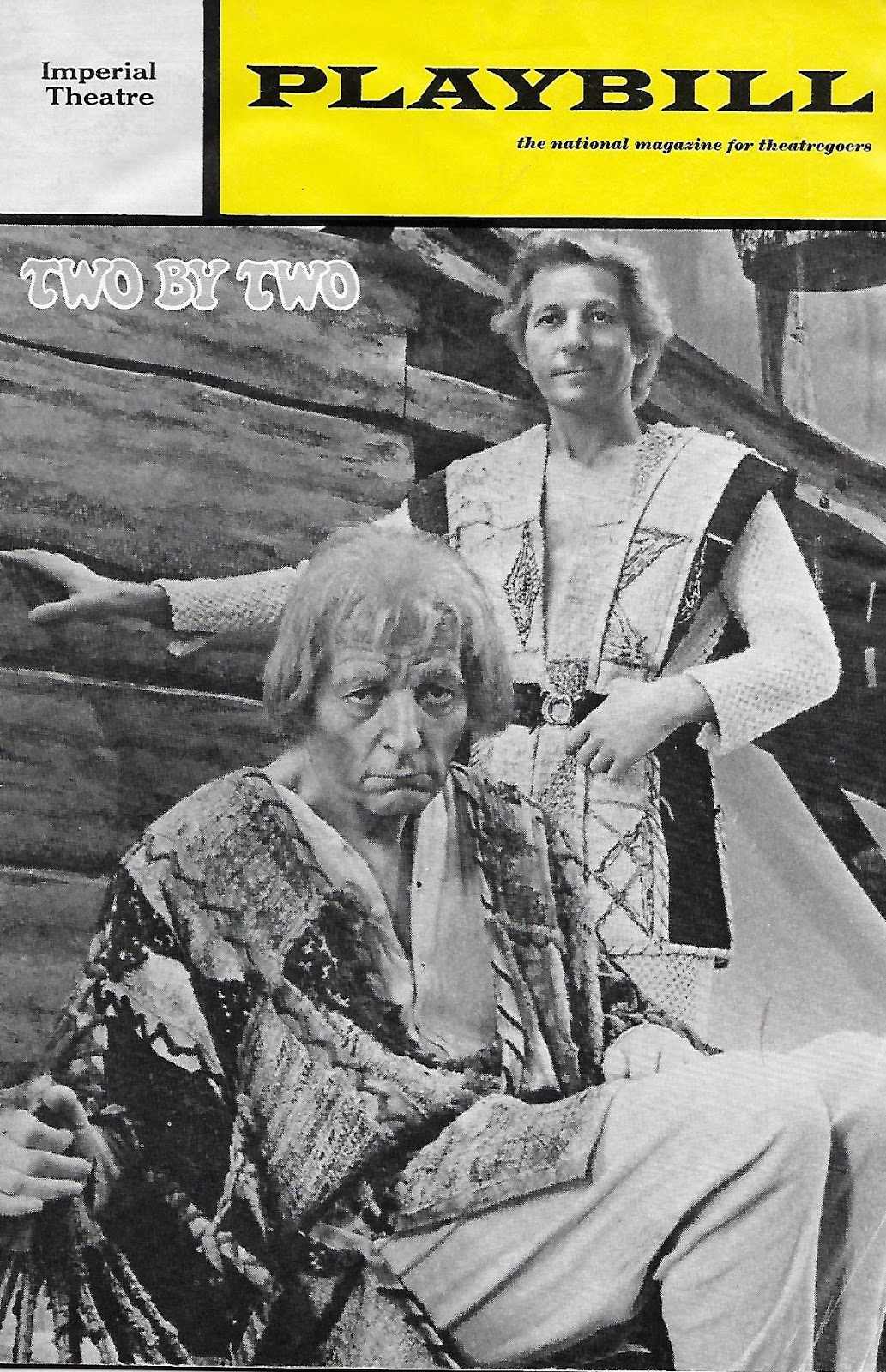
TWO BY TWO – Imperial Theatre, New York


Not sure what it is, but Madeline's rocking it! A biblical dominatrix?

May, 1971.  The 38th Broadway show by esteemed and beloved composer Richard Rodgers, Two by Two does not rank among his finest work. The score is melodic, if not especially compelling, and has two gorgeous ballads in the best Richard Rodgers tradition in "Something Doesn't Happen," movingly sung by Tricia O'Neil, and the takeaway ballad that didn't exactly takeaway, "I Do Not Know a Day I Did Not Love You," a deceptively simple song that's somewhat of a bitch to sing, sung by Walter Willison in his Tony-nominated role. The supporting cast was loaded with talent, including Fiddler alum, Harry Goz; Arthur Miller's sister and Kate Hepburn's Coco standby, Joan Copeland; the already-mentioned Willison and O'Neil; Broadway favorite and future Tony-winner for Woman of the Year, Marilyn Cooper; a really, really handsome Michael Karm; and, in a broadly comic role and saddled with a very strange song, "The Golden Ram," Madeline Kahn, just prior to What's Up, Doc? and stardom. The book by Peter Stone and the lyrics by Martin Charnin were serviceable enough, and it all could have been an enjoyable night at the theatre if it hadn't been for Two by Two's leading man, Danny Kaye. Warmly received by critics when the show opened, he suffered a muscle injury in February, was out for two weeks, and when he returned to show, in a wheelchair and/or crutches (by the time I saw the show, Kaye was using either a cane or a single crutch), he all but abandoned the show, ad-libbing throughout, stealing focus, with all pretenses of character and honoring the material jettisoned. It was the single most unprofessional and disrespectful performance I have seen to date, and nearly forty-seven years later, I'm still angry about it. When Kaye wasn't on stage, which, sadly, wasn't often enough, the show was quite charming. When Kaye was on stage, however, the mood instantly changed. It was sad to see Joan Copeland, an accomplished pro, trying so hard to look like she was actually getting a kick out of all the Kaye antics. If you looked closely, though, you saw the occasional eye roll and the hardening of her smile. The younger cast members often just had a resigned look about them, trying to hold their own and do their roles the best they could while constantly in danger of being sabotaged by the egotistical star. I have despised Kaye ever since. – at the Imperial Theatre, New York
Sidebar: After Two by Two, Richard Rodgers would only pen two more original musicals, Rex and I Remember Mama, both critical and financial failures. Surprisingly, given the difficult working relationship the two had during Two by Two, Martin Charnin was the lyricist on Mama. According to Charnin, that was also a rocky ride. Despite a mixed set of reviews and complaints about Kaye's behavior following his injury, Two by Two became a modest financial hit with a run of 343 performances. Despite the creative pedigree, Two by Two is little more than a footnote today.
Another Sidebar: Kaye threatened to quit if Equity got involved. He was the reason tickets were sold, so the producer, Richard Rodgers, more or less turned a blind eye. At the performance I saw, the audience was clearly divided. Those in the pricey seats downstairs seemed to groove on "The Danny Kaye Show." Those of us upstairs applauded like mad for the supporting actors, and then grew much quieter when Kaye took his bow. Kaye, not surprisingly considering his attitude throughout the performance, didn't seem to care one whit how the cheap seats felt. The Tony committee, however, did take note of Kaye's shenanigans, and perhaps as punishment, awarded Two by Two with a single Tony nomination (Willison's) in a season where only three musicals were up for the major awards: Company (the big winner that year), The Rothschilds, the Harnick and Bock show, which picked up a couple of acting awards, and The Me Nobody Knows, a 70s rock musical about kids in low-income NYC neighborhoods. Nothing for the show itself, its creators, and the biggest, nothing for Kaye. This was a huge snub since Kaye's return was one of the 1970-1971 season's most anticipated events. Danny Kaye, thankfully, would never again be in a Broadway musical, no great loss there, and according to every source I consulted to refresh my memory of the show, Kaye's obnoxious diva behavior started pretty much from Day One, but prior to the accident, he was playing the character and keeping to the script and direction given to him. How things changed!
Still Another Sidebar: At the tender age of twenty, I had a bit of a crush on Walter Willison, thought he was super-cute. He was the reason why I found myself at the Lyceum Theatre in November of 1971 at the first preview of the musical, Wild and Wonderful, which, as I said in an earlier post, was neither, and for decades reigned number one as the worst show I've seen. Handsome Michael Karm hated his experience in his Broadway debut in Two by Two so much, he left the profession and became an accomplished acting instructor and coach. And my personal favorite from the Karma's A Bitch Department, when it came time to cast the role of Oscar Jaffe in On the Twentieth Century, Madeline Kahn, by then a major star, and I quote here from More Opening Nights on Broadway by Steven Suskin, "vociferously vetoed Kaye for the role of Oscar Jaffe." The part went to John Cullum. Sucks to be you, Danny Kaye!
About Madeline's Song: "The Golden Ram." Odd, but melodically addictive, and, truth be told, a filthy song filled with double entendres to keep it, uh, clean, so to speak. Rodgers' melody showcases Kahn's opera training and voice and is an aria in the middle of a musical comedy. A foreshadowing of Kahn's vocal pyrotechnics in 1978's On the Twentieth Century.

And on that note, I'll stop for today. Two one-person shows, a musical classic, two Tony winners, and an egotistical asshole of a star! Quite a mixture. Until next time! And remember, if the shoe fits...
© 2018 Jeffrey Geddes

Monday, January 15, 2018

MUSICAL MAYHEM: MY TOP TWENTY-FIVE MUSICALS – Part 14B: THE TOP TEN – #5

MUSICAL MAYHEM: MY TOP TWENTY-FIVE MUSICALS – Part 14B
THE TOP TEN – #5

NOTE: Due to the length of this entry, I'm dividing it into two parts. This is part two of two.

Continuing our Chicago discussion…..


Overshadowed by A Chorus Line throughout its first incarnation, Chicago nevertheless was a bona fide financial success with a more-than-respectable 936 performances under its belt. When it closed in August, 1977, most folks thought that would be it. They thought wrong.

Jump nearly twenty years to May,1996. Encores series, New York City Center. A staged concert version of Chicago rocks the critics. When the production is transferred to Broadway a few months later in November, the critical reaction is, once again, rapturous. And when the 1997 Tony Awards roll around, there's lots of Tony love as Chicago wins six Tonys, a record at the time for a revival. One of the wins was for Ann Reinking for Best Choreography, an odd choice since what was onstage was essentially a recreation of the Fosse original choreography. The revival made its costs back in a few short months. As of January 14, 2018, the revival of Chicago has played 8795 performances, with no evidence of slowing down. That's just over twenty-one years. That's 2658 performances, or more than six years, longer than the original production of its 1975 rival, A Chorus Line. I guess he who laughs last does laugh best. But, here's the deal. And I'll only say this once. There is virtually no difference between the revival and the original. Got that?  The revival has fewer set pieces and costumes, and the costumes exude a bit more sex, but there isn't any real change in the show itself. A nip here, a tuck there, however it's not as though Walter Bobbie and Ann Reinking reinvented the wheel. The show has always been a biting satire about justice, celebrity and the American way starting with the original 1927 play by Maurine Dallas Watkins. In 1996, however, when the revival opened in New York, the OJ Simpson trial was fresh in everyone's minds and made the show even more relevant and timely than when it first opened.

So what changed? When the revival played New York City Center, the New York Times theatre first-stringer Ben Brantley's review rather neatly summed up the differences between the "Jets/Sharks" of the two great dance musicals, Chicago and A Chorus Line. Exactly what I think, and Mr. Brantley says it better than I ever could, so, take it away, Ben! "Chicago was, in a sense, the evil twin of its rival musical, as acerbic and cold-hearted as the other was sentimental and warm. … A Chorus Line was built on the premise that if you scratch the surface of an entertainer, you'll find a trembling, vulnerable child; Chicago scratched that same surface to uncover a manipulative egomaniac. The anthem of the one show was 'What I Did for Love'; of the other, 'Razzle Dazzle.' The bleating confessions of A Chorus Line were devastatingly echoed in a throwaway line in Chicago: '…none of us got enough love in our childhoods. And, that's show biz, kid.'"

But other factors were in play as well. In 1996, Chicago wasn't overshadowed by a landmark musical (A Chorus Line), a show everyone wanted to see. In 1996, Chicago was the show everyone wanted to see. Finally, no longer the bridesmaid and very definitely the bride. Also, the original production of Chicago had Gwen Verdon and Chita Rivera as its leads, two of the finest dancers ever, and their star power, individually and collectively, and, to a lesser degree, that of Jerry Orbach, were a potent box office engine, with both ladies becoming identified with those roles. As part one entries show, it was frankly hard to replace them. The 1996 cast of Ann Reinking, Bebe Neuwirth, and James Naughton certainly wasn't lacking in talent, but none of those three names listed above a title cause a run at the box office. And, by 1996, in large part thanks to Chicago's nemesis, A Chorus Line, and the invasion of the big British musical, it wasn't a necessity to have big box office names to sell tickets, a philosophy that applies today (see Hamilton, for example). The show itself was the box office draw. It also doesn't hurt that revival lead producers Barry and Fran Weissler are geniuses at casting stars from TV, film, music, and reality TV for very limited runs which give the show financial boosts and press visibility and keep Chicago running. But, arguably, the most important factor, as mentioned in the previous paragraph, is that the times finally caught up with Chicago. The big news of the 70s were Watergate, Nixon's resignation, and the end of the Vietnam War, and, let's be honest, none of that was terribly sexy. By the mid-late 90s, we had the OJ Simpson trial, a razzle dazzle if there ever was one, the Clinton-Lewinsky scandal, finally proving that politics could be sexy, and the Menendez brothers' verdict, another media circus. Chicago was in its element. And with all that is going on in our troubled Trump times today, could it be that the brilliant, cynical, razzle-dazzly Chicago is the perfect musical for our time?


– Shubert Theatre, Chicago


Belle Calaway was filling in for Charlotte d'Amboise. Pretty classy way to announce it.

July, 1997/August, 1997. Returning in Broadway and Tony Awards triumph to its namesake city, the First National Tour of the revival version of Chicago was welcomed home with open arms. And deservedly so, for this production was crackerjack good. From the moment the band started the overture to the final curtain, this was a tight, danced-to-perfection show loaded with top drawer talent. Jasmine Guy played Velma Kelly. A Different World's Jasmine Guy? Really? She can sing and dance? Really? Yes, really. Petite and streetwise, she was a powerful Velma, singing and dancing with an assurance and strength that delightedly surprised the Shubert audience. Dreamgirls' Obba Babatundé was an elegant and slick Billy Flynn. Carol Woods launched her considerable pipes as Matron "Mama" Morton, Ron Orbach played a convincing Amos, and newcomer M.E.Spencer was a delightful Mary Sunshine. Top-billed Charlotte d'Amboise was out at the preview performance we caught in July. Earlier in the tour, she had injured herself and had been out for several weeks as torn tendons healed. In her place was her understudy, Belle Calaway who gave a terrific performance as Roxie. When we returned to the show a few weeks later, the divine d'Amboise was on hand. And truly terrific as Calaway had been, Charlotte d'Amboise brought her über-talent and owned the stage as Roxie. She was sensational.  In fact, so was the entire production. – at the Shubert Theatre, Chicago
Casting Sidebars: In this production Deidre Goodwin played Annie. We would see her six years later in New York as Velma. As the tour progressed, cast changes occurred, of course. One of the more interesting ones was for Matron "Mama" Morton when Lea DeLaria took over the role. (!!) Chicago's Amos, Ron Orbach, was originally cast as Franz Liebkind in The Producers, but blew out his knee during tech rehearsals before its out-of-town opening in, ironically, Chicago.

– Capitol Theatre, Sydney, Australia


(edited from an earlier post)
August, 1999. Since Bob and I both love Chicago, we were delighted to discover it was playing in Sydney during our visit there. A mirror of the 1996 Broadway revival, this production was chock-a-block with Australian musical theatre favorites including Maria Mercedes, a former Norma Desmond, as Matron "Mama" Morton, John Diedrich, whom I saw in London nineteen years earlier as Curly in Oklahoma!, as a suave and handsome Billy Flynn, the totally divine Caroline O'Connor as a scintillating Velma, and Cynthia Gibb, making her professional debut as Roxie. Some debut role! This show started our love affair with the drop-dead talented O'Connor whose Velma was simply divine. Flawlessly danced, sung and acted, this remains by far the sexiest version of the show I've seen with smoking hot men and women in the ensemble who knew how to show off William Ivey Long's costumes to the best sensual advantage. One curious note: an understudy for the understudy stepped in for Mary Sunshine at the performance seen. Having both the listed performer and the understudy out is unusual in and of itself. What was even more unusual in this case was that the role was played that evening by a female. This meant the big reveal in Act Two was cut from the performance for obvious reasons, and the workaround was fine, but strangely and inexplicably, Mary Sunshine's song was cut as well. (Not enough time to get the understudy's understudy up to speed on the song?) The song establishes Mary Sunshine's character, but it's not crucial to the show and truthfully wasn't missed. In the show, a newspaper headline proclaims "Roxie Rocks Chicago!" Well, all I can say is "Sydney Rocked Chicago!” – at the Capitol Theatre, Sydney
Sidebar: Sydney's Capitol Theatre is a gorgeous theatre seating just under 2100. Opening in 1916, it is one of Sydney's premiere venues for musical theatre. 

– Ambassador Theatre, New York

 The Book of Mormon plays across the street at the Eugene O'Neill. Still consistently selling out.


July, 2003. Press night for Melanie Griffith. Bob and I stood on the cancellation line for over one hour. Patience has its rewards, however, and we snagged eighth row center tickets, being seated literally a minute or so before the overture. Antonio (Banderas) was in the row ahead of us on the aisle; Chita (Rivera) and Jane (Krakowski) were two rows in front of us. We all hobnobbed during the interval. Uh, well, no, but I did congratulate Krakowski on her recent Tony win and got a glittering smile and "thank you." So, you may ask, how did our favorite "Working Girl" fare in the challenging role of Roxie Hart? Well, her singing was shaky and her dancing, in the dumbed-down choreography, was shakier still, but, damn, she actually pulled it off. She was warm, funny, vulnerable, and ultimately endearing. A stage neophyte, she used both her comedic instincts and star wattage to connect with the audience, skills that veterans don't always have. We were impressed. Deidre Goodwin was a dazzling Velma and could easily have overpowered her co-star when they danced together, but didn't. They were having fun together and it showed. Let me hasten to add that Goodwin's and the ensemble's choreography was not dumbed-down. Brent Barrett was a suave and sexy Billy, Camille Saviola gave us a solid Mama Morton, and P.J. Benjamin and D. Sabella provided professional support as Amos and Mary Sunshine. Griffith won over the critics and gave the show a major box-office boost. We had a grand time. – at the Ambassador Theatre, New York
Sidebar: Talented Belle Calaway, see Shubert Theatre entry, was the standby for Roxie and Mama Morton.


October, 2005. We took niece Colleen and nephew Greg to see Chicago, now starring Brooke Shields as Roxie. Yes, she's tall and yes, she's Brooke Shields, but she was also quite good in the role. She had an unexpected killer sense of comic timing, a decent voice, danced the role competently, and had a great rapport with the audience, especially during "Roxie."  For Bob and me, however, the draw was Debra Monk as Mama Morton. We're big fans. We will see her in pretty much anything. And she didn't disappoint. She killed as Mama Morton. Clarke Peters (Billy), P.J. Benjamin (Amos), and R. Lowe (Mary Sunshine) completed this excellent cast. Luba Mason, the listed Velma, was out that day and "second" understudy Solange Sandy was announced at curtain. At bows, Shields told the audience that we saw Sandy's first ever performance as Velma. Couldn't prove it by us; she was wonderful.  - at the Ambassador Theatre, New York

******************** 
It's hard to believe it's been over twelve years since we've visited the Merry Murderesses of the Cook County Jail and their compatriots. After twenty-one years on Broadway, it still continues to do well at the box office and shows no signs of slowing down. It's not uncommon for past cast members to return to the show. In fact, Charlotte d'Amoise, twenty years after we applauded her Roxie at Chicago's Shubert Theatre, is the current Roxie at the Ambassador (as of 1/15/2018). More than any other show, Chicago is Bob Fosse's enduring legacy. Folks will be dancing those steps, and singing those marvelous Kander and Ebb songs for a long time to come.

And so concludes, for now at least, our visits to the Cook County Jail. He had it coming….
© 2018Jeffrey Geddes

Saturday, January 6, 2018

MUSICAL MAYHEM: MY TOP TWENTY-FIVE MUSICALS – Part 14A: THE TOP TEN – #5

MUSICAL MAYHEM: MY TOP TWENTY-FIVE MUSICALS – Part 14A
THE TOP TEN – #5

NOTE: Due to the length of this entry, I'm dividing it into two parts. This is part one of two.


Sophisticated, sexy, funny, tuneful, relevant…and all that jazz. 

# 5: CHICAGO  – Book by Fred Ebb and Bob Fosse, Music by John Kander, Lyrics by Fred Ebb
"Welcome. Ladies and gentlemen, you are about to see a story of murder, greed, corruption, violence, exploitation, adultery, and treachery ─ all those things we all hold near and dear to our hearts. Thank you." Truer words were never spoken and on that note, a solo trumpet played, the conductor counted off the Overture, the scrim rose and one of the cleverest shows ever written began. Chicago has been in my top ten musicals since I first saw it in 1975 just two weeks after it had opened. It's almost an overabundance of riches. There's that incredible Kander and Ebb score that starts off with a bang and ends with that glorious "Keep It Hot." The book by Bob Fosse and Fred Ebb is trenchantly satirical, darkly funny, and thoroughly original. Subtitled "a musical vaudeville," Chicago is a classic vaudeville for modern times, a potpourri of styles and mood from burlesque to song-and-dance to an homage to iconic performer of the vaudevillian age (Bert Williams…"Mr. Cellophane") to a cross-dressing "sob sister," a journalistic regular of the 20s. It's smart; it's stylish. And in its original production, it, surprisingly, received a decidedly mixed critical response. No out-and-out raves, no out-and-out pans, everything just sort of in the middle. The critical consensus at the time seemed to be that while Chicago was ambitious and admirable, it was cold, unlikeable, and more than a bit reminiscent of Kander and Ebb's earlier Cabaret, a comparison I just don't see. But, sadly for Chicago, a new musical about dancers opened at the Public a few weeks earlier, transferred to Broadway's Shubert Theatre six weeks after Chicago's opening, and became the critics' darling, bar none, of the 1975-1976 season. Even though Chicago would be nominated for eleven 1976 Tony Awards, there would be no Tony love for Roxie Hart and pals, overshadowed by the critical and public smash, A Chorus Line.

– 46th Street Theatre, New York


The original set.

June, 1975; October, 1975. Scrim up, the band, too jazzy to call it an orchestra, ended the overture and began the by now iconic vamp intro to "All That Jazz." And then Chita Rivera, all pose and attitude and star power, rose from beneath the stage, slunk down to the front of the stage and began to sing "C'mon babe/Why don't we paint the town?/And all that jazz." I was a goner. Totally. Hook, line, and sinker. The show could have been crap from that point on and I wouldn't have cared. But it wasn't. It was Chita opening the show. It was Gwen Verdon perched on top of a piano singing about her "Funny Honey." It was Mary McCarty coming on in her mink and telling us all the great things that happen "When You're Good to Mama." It was the jaw-dropping "Cell Block Tango." It was Jerry Orbach's entrance with the Ziegfeld Follies-like "All I Care About." It was "Roxie," and "My Own Best Friend," and "Mister Cellophane," and "Razzle Dazzle," and "Nowadays," and that precision, letter-perfect dance trio of "Nowadays," "R.S.V.P.," and "Keep It Hot," and all the other numbers, not a bad one in the lot. It was a sextet of actors at their absolute peak: Gwen Verdon (Roxie), Chita Rivera (Velma), and Jerry Orbach (Billy), Barney Martin (Amos), Mary McCarty (Mama Morton), and M. O'Haughey (Mary Sunshine). It was an ensemble of some of the finest dancers in the theatre, including future choreographers Christopher Chadman and Graciela Daniele. It was exciting, vibrant, and just plain remarkable. A second viewing a few months later just confirmed my initial opinion. People can, and will, debate the merits of the original cast versus the original revival cast, and I will rarely say anyone is the definitive <fill in your favorite role> or any cast is the definitive cast, but, in my humble opinion, this is one of those rare times, for this cast will never be eclipsed. Brilliant. Just brilliant. – at the 46th Street Theatre, New York

The "replacement" marquee when the original leading ladies left the show.


May, 1977. My third visit to the wonderfully criminal folks over at Chicago, just a few months before its close, still starred the wonderful Jerry Orbach, the only above-title actor, as Billy Flynn with "Chicago's own killer dillers, those two scintillating sinners, Roxie Hart and Velma Kelly" now played by Ann Reinking (Roxie) and Lenora Nemetz (Velma). M. O'Haughey was still on hand as Mary Sunshine, Rex Everhart, Chicago's Benjamin Franklin in 1776, was now Amos, and Alaina Reed was Mama Morton. Let me say something about Jerry Orbach. By this time, he'd been doing Billy Flynn for over two years, counting Chicago's out-of-town tryout and previews before opening, but you'd never know it. His performance was as fresh as it was when I first saw him nearly two years earlier. That's a pro. Reinking, of course, would choreograph and star in the revival, sounding in 1996 like a Gwen Verdon clone. In 1977, the voice didn't have quite the tremble, she danced up a storm, and was overall delightful. Nemetz, Verdon's standby when the show opened and a later standby for Velma, brought her experience to the role and delivered the goods. However, and perhaps this is being petty, though everyone was spot-on, I missed the star-wattage that the original cast brought to the show. Chicago was still a razzle-dazzle, though perhaps not quite as bright a one as it was back in 1975. – at the 46th Street Theatre, New York

– Blackstone Theatre, Chicago


March, 1978. Chicago's national tour arrived in February in its namesake city for a three month stay at the Blackstone Theatre. With Jerry Orbach leading the company, I was looking forward to a return visit to an old friend. All of the Fosse style remained intact, but there was an ennui to the performance. No one really seemed to be having much fun. Even the redoubtable Jerry Orbach seemed tired. In the roles of Roxie Hart and Velma Kelly were two talented young(ish) Broadway vets. Penny Worth (Roxie) left the red-hot smash Annie, where she was Dorothy Loudon's understudy, to join the tour, while her co-star Carolyn Kirsch (Velma) was a veteran of many Broadway shows, including the original cast of A Chorus Line. Both ladies did all the right moves, but there wasn't a lot of chemistry between them or between them and Orbach. They were professional and competent, just not terribly exciting. M. O'Haughey continued as Mary Sunshine, his only role on Broadway according to IBDB.com, Gordon Haskell made a fine Amos, and Edye Byrde brought some serious pipes to Mama Morton. It was a perfectly acceptable performance. I was just underwhelmed, and, honestly, a bit disappointed. – at the Blackstone Theatre, Chicago
Sidebar: The Blackstone, now the non-commercial Merle Reskin Theatre of DePaul University, is a lovely, Broadway-sized house with about 1450 seats over three levels. In 1978, the Shubert on Monroe was the primary musical house, and one noted for long sit-down engagements. The Studebaker on Michigan Avenue (around 1200 seats) was home to shorter runs of plays and smaller musicals. The Blackstone was the preferred house for plays, hosting the occasional musical, and had its share of long sit-downs. Today, the Shubert, now the CIBC Theatre, is the smallest of the primary road houses in town and the most performance friendly. Both the other major houses, the Oriental and the Cadillac Palace, are stunning venues, but too wide, resulting in most shows being portaled in, and a bit too big to establish any real intimacy.
Fun Fact: Steve and I saw a DePaul University production of Chicago at the Blackstone/Merle Reskin from the first balcony in the early 90s. If dim memory serves, it was a really decent production.
Casting Fun Fact:  Future Tony-winning director and choreographer Susan Stroman was Hunyak in this production.


April, 1978. Hail, hail, the gang's all here! Well, almost.*   In a "Hail Mary" move to boost surprisingly weak box office, the Chicago producers decided to turn up the heat and "Keep It Hot" by calling in the "A" team, Chita Rivera, Gwen Verdon, and Mary McCarty. And what a difference that made! The ennui I felt during the performance I saw a month earlier had vanished, replaced by a new energy, a vibrant sassiness, a newly-rediscovered sense of fun. This was the Chicago I remembered and fell in love with. Like slipping into some comfy old slippers, Verdon, Rivera, and McCarty played their roles with that ease of old pros doing a job they love. The chemistry between the leads was back. The audience roared its approval, and the box office got the boost it needed. – at the Blackstone Theatre, Chicago
* Of the six featured players in the original Broadway cast, only Barney Martin (Amos) was missing from the new cast.
Sidebar: Lead producers Robert Fryer and James Cresson possibly were smart from a financial standpoint to not launch the national tour of Chicago until after the Broadway production had closed, but from a box office standpoint, perhaps not. In New York, Chicago was, as the song goes, always the bridesmaid, never the bride to the behemoth called A Chorus Line. Launching a tour over two years after its New York premiere may have diminished the status of the show. To my knowledge, this was the only national tour of the original production, playing only a year, as opposed to, well, that other show, which had at least two road companies crisscrossing the country at the time. (Contrast this to the six national tours that the revival of Chicago has spawned to date. (source: IBDB.com)) And wouldn't you know it? When Chicago finally played its namesake city, several months into the tour, it was, once again, the bridesmaid to A Chorus Line, which had just started its ecstatically-received eleven-month run at the Shubert over on Monroe.  Sadly, the critics didn't give a lot of love to Chicago. An article I recently read placed the lackluster initial reaction to Chicago on several factors: 1) the fact that Chicago arrived in Chicago months after the tour started, when it should have been the first stop. Producers cited the unavailability of a suitable theatre as the reason for that., 2) the cool critical reception, much of which focused on the competent, but not very dynamic, leading ladies, 3) the lack of recognizable, box office names for the two leading ladies, and 4) yes, you guessed it, the presence of A Chorus Line a few blocks away, which made every other show in Chicago a second choice. Even in its hometown, Chicago just couldn't catch a break!
Let's Talk Billing: When Chicago opened in 1975 the billing was as follows: Gwen Verdon and Chita Rivera were on the top line, Jerry Orbach immediately below, all billed above the title. Below the creatives, under a "with" designation were Barney Martin, Mary McCarty, and M. Haughey. When the tour opened in Chicago, Jerry Orbach was the only actor billed above the title. When the "new" cast arrived, the billing was now as follows: Gwen Verdon and Jerry Orbach on the top line, followed by <next line> "and" <next line> Chita Rivera. All three above the title. Following the title was a new billing "Also Starring Mary McCarty." Below the creatives was "with" Haskell Gordon and M. O'Haughey. As every actor knows, billing is everything, almost more important than salary, and is a fiercely fought contractual point and to lure three of the original stars to the tour, I'm sure the producers needed to add some value-adds to the pot. Top left position (in this case, Gwen Verdon) is always the "star" spot, but the "and" preceding Chita Rivera gives Rivera extra-prominent billing. And Mary McCarty scored a sweet deal when she was promoted from a "with" billing to an "also starring" billing just below the title. I should have been an entertainment lawyer!

Before we end today, let's take a brief side trip across the Pond to London's West End, where I saw a very different Chicago in its 1979 UK/European premiere production.

– Cambridge Theatre, London


May,1980. Typically, most Broadway and West End shows cross the Pond as replicas of their original productions, featuring the same design elements, the same directors and choreographers, often some of the key actors to recreate their roles. Chicago, however, made its way to the West End via a transfer from the well-regarded Crucible Theatre in Sheffield, England. Not a duplicate of the Broadway original, it would be accurate to say that this Chicago was based on or suggested by the original. Designed, directed, and choreographed by Crucible's in-house personnel, Chicago was familiar enough, but different in several ways. The choreography, for example, didn't seem as slick, as precise, even with Fosse assistant choreographer, Tony Stevens, as Production Consutant.  The costumes weren't quite as sleazy. The performance overall seemed just a bit too genteel, as though terrified of offending 1980 British sensibilities. Rather than having scintillating sinners, this Chicago had naughty-but-nice folks populating the show. Was it still entertaining? Absolutely. The cast, a replacement cast from the one which opened the show a year earlier, was excellent, with UK favorites, including Jacquie Toye, Hope Jackman, Colin Bennett, and Tony-winner Elizabeth Seal (Irma la Douce) as a terrific Roxie. The London critics liked it well enough to nominate the show for several Olivier awards, and it ran about 600 performances, but I sorely missed the Fosse touches. When Chicago returned to the West End in 1997 to start a run of nearly fifteen years, it was a duplicate of the revival then currently selling out on Broadway. – at the Cambridge Theatre, London
Sidebar: Chicago's show curtain at the Cambridge was a collage of street signs naming many Chicago streets. One of those was "Halstead." Drove me nuts during the entire overture. So, at the interval, I found the house manager and said, "Did you know that one of your street names on the show curtain is misspelled?" House Manager (HseM): "Oh?" Me: "Yes. Halsted is spelled 'H A L S T E D' and not 'H A L S T E A D.'" HseM (ever-so-polite, but said in that supercilious manner that Brits sometimes have): "That's not possible. Our research was very thorough. You must be mistaken." Me (still managing to keep my good Midwestern manners when what I really wanted to do was smack that sucker down): "Well, I live in Chicago. So, I'm pretty sure I know how Halsted should be spelled." HseM (a bit subdued): "Oh. I see. I'll bring this to management's attention." Now, he very well may have, but I'm sure that "Halstead" remained there for the remainder of the run!
  
And so concludes Part One. There's no doubt that Chicago was overshadowed both at the box office and on the critical front by A Chorus Line. Folks often forget, however, that it was a financial success with a more-than-respectable 936 performances under its belt. When it closed in August, 1977, most folks thought that was that. They were so wrong. (To be continued!)

© 2018 Jeffrey Geddes

CONCERTS AND TUNERS AND PLAYS…OH, MY! - vol. 1

  CONCERTS AND TUNERS AND PLAYS…OH, MY! vol. 1 Spring is finally here. And what better way to celebrate than by strolling down theatrical ...