Tuesday, June 4, 2013

ALPHABET SOUP 1


ALPHABET SOUP 1

A mash-up of plays and musicals picked at random . There's a little bit of everything here.  Enjoy!

January, 2006. I quite enjoyed this musical adaptation of the Louisa May Alcott classic. Rather than being the rather heavy-handed (in my opinion) story about the March family and Pilgrim's Progress and doing good, etc. etc., I found Allan Knee's adaptation nicely tart with all of the sisters played as intelligent women and Jason Howland's and Mindi Dickstein's score a pleasant treat for the ears with a knockout first act curtain tune ("Astonishing"), two kick-ass songs for Marmee ("Here Alone" and "Days of Plenty") and a fine, understated eleven o'clock number for Jo ("The Fire Within Me").  Maureen McGovern made a splendid Marmee. For those of you who only know of McGovern as one of our finest singers, you may be surprised to know she's also an accomplished stage actress of warmth, presence and intelligence.  Kate Fisher was a very satisfying Jo. This tour also featured Michael Minarik, who I would later see in an outstanding performance in The Happy Time in D.C. Beth still dies, but this musical dispenses with the simpy and syrupy of Alcott's story. I was very pleasantly surprised. - at the Palace Theatre, Chicago


April, 2008. Speaking of Mr. Minarik…. A rarely-produced musical by Kander and Ebb.  Far from the reportedly over-produced Broadway production of years ago, this intimate, sparse production made the most of the show's quiet virtues, but, curiously, also pointed up its shortcomings.  It's charming, but uneven.  I felt part of the unevenness lay with Jace Casey's portrayal of Bibi, the nephew.  I just didn't believe him as an adolescent teenager; he seemed too young and, frankly, a bit annoying.  The centerpiece of the show was Michael Minarik's Jacques...beautifully acted and sung.  (Didn't hurt that he was very easy on the eyes, either.)  Glad I saw it, but easy to understand why it failed on Broadway. - at the Signature Theatre, Arlington, VA


August, 1979.  Liv Ullmann in a musical?  A Richard Rodgers musical?  The same Liv Ullmann who angsted her way through all those Ingmar Bergman films?  Yep.  That's the gal.  And she was pretty damn good, too.  This was the last musical Rodgers wrote.  He died later that year.  After a hellish Philadelphia tryout, "Mama" limped into New York, received negative reviews, and closed promptly after its advance ran out.  It wasn't a great show, but Ullmann, though she wasn't much of a singer, had lots of warmth and charm and provided a lovely Scandinavian aesthetic to the show.  Rodger's score, though certainly not his finest, was tuneful, but unmemorable, with nothing really standing out - good, bad or indifferent.   A fitting end to an illustrious career?  Not really, but this show deserved better.  - at the Majestic Theatre, New York
This graced the back of the I Remember Mama program. Smoking was still accepted everywhere in 1979 and I was among the smoking class. I was a Marlboro Lights man, however. Tareytons were vile.

Another ad. The Algonquin...historic, classy, atmospheric. It was also the home of the late and lamented Oak Room where the cream of cabaret singers would perform in the oddly-shaped, yet intimate room. 

April, 2012. London loved it; New York hated it. And thanks to the fearless TimeLine Theatre Company, we were able to make our own decisions. When it talked finance, it sometimes got, for me a least, a bit obtuse, but this tale of corporate greed and indifference to anything except profit was both compelling and disturbing. TimeLine exhibited its usual fine production values and superb casting choices with standout performances by Stef Tovar, Amy Matheny and the always reliable Terry Hamilton leading an excellent cast. It's quite possible in a larger venue, the show may have gotten lost, but in TimeLine's intimate space, this was a powerful evening of thought-provoking material. - at TimeLine Theatre, Chicago

May, 1991. This staged revue of songs by composer/lyricist Brian Gari was sharply executed on the small stage at Don't Tell Mama on West 46th in New York and performed by a quartet of talented singers (Tammy Quinn, Michael McAssey, Larry Victor and Angela Warren) with Gari at the piano. Gari is the son of Janet Gari, my collaborator on the musical Such a Pretty Face (see a previous post). I met Gari a year earlier at Margaret Whiting's club act at the Algonquin and we struck up an acquaintanceship, which led to meeting his mother, and so on and so on. The show was timely and could have had a nice post-NYC life had it been properly marketed. Sadly, that didn't happen and it all seems a bit dated now.  A sad footnote: Larry Victor would die from AIDS in late 1992 at the age of only 33. - at Don't Tell Mama, New York

March, 2011. Residents of the seedy Hotel Baltimore are facing eviction when the property is sold/condemned/whatever. Full of  "colorful" characters, I found the play deadly dull when I first saw it at the Ivanhoe when it was a hot property back in the 70s and found it even duller decades later at Steppenwolf as part of a GLBT Theatre Series we had subscribed to that year. I felt the production was murky in all aspects: direction, scenically and acting. The atmosphere was one of "Look at us! This is an important play!!" We left at the interval, something I very rarely do, but I just felt I couldn't waste my time anymore with this mind-numbing production. - at the Steppenwolf Theatre, Chicago

November, 2012. This play still has the power to thrill, educate and move audiences to tears nearly 60 years after it made its debut. A long moment of silence at the end of the play and then the audience burst into loud and sustained applause. First professional production I've seen of this and it was a thrill to see adult actors. Bob really wants to direct this with age-appropriate actors. As usual at Milwaukee Rep, outstanding production values (though we both felt the sound effects often sounded exactly like that, although the effects accompanying the Nazi's arrival were chilling) and superb casting. A wonderful and necessary play for any time, but so timely today. Bravo, Milwaukee Rep. - at the Milwaukee Rep, Milwaukee

That's it for now. We head for a long w/e in NYC on Thursday. Next post: Notes from New York!

Sunday, May 19, 2013

KEEPING IT LOCAL


KEEPING IT LOCAL

It is perhaps ironic, given that we live in a city that is considered one of the country's leading theatre centers, that we see more theatre in other cities, primarily in New York, than in our own. There's a reason for that.
At the risk of offending folks in my hometown, I simply find theatre in New York more exciting and vibrant than theatre in Chicago. There's many reasons for that. Foremost is the preponderance of talent in New York. Stop gasping in horror, Chicago, it's true. Chicago, of course, has an impressive lineup of talent, and TimeLine Theatre is one of our favorite companies, but New York is the nation's theatre capital and as such is a magnet for creative and acting talents. Another is an attitude of smugness and pretension that sometimes infects Chicago theatre. I can't quite put my finger on it, but it's something I noticed back in the early 70s when I was a student. It went away for a long time, but now it's back. I didn't like it then; I don't like it now. What is a plus for Chicago is its relatively recent renaissance as a tryout city (recently Ann and Kinky Boots). We like that. And it was the tryout of the new musical Big Fish that sparked this streak of local theatre-going.

In the mix is one tryout, one Equity tour, one non-Equity tour, a production of a musical classic mounted by the Lyric Opera, a slight detour up to Milwaukee for a one-man show and, back to Chicago, three productions, two musicals/one play, mounted by local theatre companies.

Welcome to my hometown!


April, 2013. A non-Equity production that played like an Equity one with top-notch production values, a smoking orchestra, crisp choreography, a talented chorus and engaging performances including a star-making turn by 2012 (!!) FSU grad Stephen Anthony as Frank Abagnale, Jr. Mark my words...that young man is going places. Personally, I liked the score better than their "Hairspray," but felt the book wasn't as strong. A solid "B" show that deserved a longer Broadway run. Highly entertaining! - at the Palace Theatre, Chicago


April, 2013.  Preview performance. Well, it needs work. Quite a bit, in fact. But that's what pre-Broadway tryouts are for. I couldn't decide if the first act was quirky charm or just messy. The second act was better, but the ending needs a rethink. Considering it's Susan Stroman, there was some surprising directorial and staging sloppiness and one really terrible segment involving a witch. With all the bells and whistles, the show frequently loses its humanity and works best during its quieter moments. The score has a couple of pretty ballads, but overall is forgettable. I can only imagine what Flaherty & Aherns could have done with this. The talented cast works hard, especially Norbert Leo Butz, Bobby Steggert (solid performance, but his character needs to be revisited since at the moment it's pretty unlikeable) and, best for last, the radiant Kate Baldwin, whose touching "I Don't Need a Roof" is reason enough to see the show. I hope they can pull it together since there's a lot of potential. At this stage of the game, I'd give it a solid C+. - at the Oriental Theatre, Chicago

April, 2013. About 90 minutes away on I-94 lies the fabulous city of Milwaukee. We made the trip up to see the amahzing Seth Rudetsky and his wonderful Seth's Big Fat Broadway Show. In between howling with laughter, you actually learn something and when you're in the audience with a couple hundred theatre-savvy folks, well, it just makes for a delightful evening. If you ever get the chance to see him….go! - at Vogel Hall, Milwaukee

 (Yes, this is the famed Biograph Theatre where John Dillinger and the Feds got up close and personal.)
April, 2013. At 110 intermissionless minutes, it's either about 20 minutes too long or needs an interval. The acting was uniformly good (Bob's former student did a very nifty turn as the daughter), but I felt the writing went all over the place. Is the play anti-Mormon? Anti-religion? Anti-Idaho? A play about regret? A play about love? Why does the ex-wife make an entrance? Although nicely done, I felt it added nothing to the plot and the play sort of went from one sub-plot to the next and never really landed on one. And, I know I'm in the minority here since many of the critics raved, but I felt the lead character as written was terribly self-indulgent and as such, I didn't care for him or his situation. He's gay. His partner died. Okay, that's sad. Been there, done that. But my reaction to Steve's death wasn't to eat myself to death. Oh, boo hoo, poor Charlie. Yeah, the death of your partner sucks...big time, but Charlie's way to deal with it just majorly pissed. me. off. Didn't hate it; didn't love it. I think the playwright overreached and wrote about things he doesn't really know about. - at Victory Gardens Theatre, Chicago

May, 2013. The book may be creaky, but damn!, that Cole Porter dude knows how to write a tune! The book scenes seemed to be played a bit broader than in New York, but that actually made them funnier. This Equity tour featured Kathleen Marshall's sensational choreography, a glorious orchestra, a top-notch cast and Rachel York's dazzling star turn. Kudos to Jeremy Benton and Jeff Brooks who superbly filled in as Billy Crocker and Moonface Martin and a big shout-out to the gloriously wonderful Joyce Chittick as Erma. Her "Buddy Beware" was smoking hot! This is classic musical theatre at its best. Thanks, Roundabout Theatre Company for including Chicago as a tour stop! - at the Palace Theatre, Chicago


May, 2013. I was most definitely not bewitched, bothered and bewildered. Porchlight's production of the Rodgers & Hart classic was, sadly, pretty awful. Dull, misdirected characters, a really ugly and cheap-looking set and some really unfortunate performances by the ensemble made this difficult to sit through. To be fair, the singing was good, if bland, and it had some decent "Cabaret" dances. No, I'm not confused. One of the numbers appeared to have been lifted directly from the film of "Cabaret." Most reviewers really liked it, but it's getting so our main reviewers have lost their edge and pretty much like anything, unless a production in New York is being reviewed, in which case they nit-pick about everything. There was no sophistication; no edge. Joey was charming and kind of a bad boy,  but not the slimy douche he's supposed to be. Vera was played like she was nipping down to the kitchen for some coffee rather than a worldly, seen-it-all, done-it-all woman of means and, in the most perplexing performance of the show, Melba ("Zip") was played by an actress fresh out of Columbia College, in other words, at least a decade too young. The critics fainted over her despite the fact she didn't understand what she was singing. You could tell. No clue. None. And all her choreography was missing was a pole for her to gyrate against. Again, just so wrong for the song… and the show. Ah, well. Glad we got 1/2 price tickets. This company claims to produce "classic musicals Chicago style," whatever the hell that means. If this is an example, I think I'll pass on their "Chicago style" approach. A huge misfire. - at Stage 773, Chicago.


May, 2013. Cy Coleman provided the tasty score for this rarely done musical. While it may not have had the "wow" factor that I experienced when I saw the original production in New York, it did remarkably well considering the relatively small space it was performed in. I didn't like that the characters, except for Barnum and Chairy, always wore their circus clothes (really, you couldn't put Jenny Lind in a gown?) and the second act fell apart somewhat, almost as though the director ran out of staging ideas. The actress playing Joyce/Blues Singer was vocally meek and the actress playing Jenny Lind had inexcusably poor diction. Solid performances by Gene Weygandt (Bob's known him for years) as Barnum and Cory Goodrich as Chairy gave the show a nice professional sheen. Sadly the show has been playing to very small houses and that's a shame since it's an enjoyable time in the theatre. - at the Mercury Theatre, Chicago


May, 2013. A 37 piece orchestra! 23 strings, real strings!! Bliss! I can't even imagine the thrill those first audiences felt in 1943 as this trailblazing iconic musical unfolded before them. The amplified sound was a bit dicey, but perhaps we were simply too close, and the supertitles were not necessary (there's someone in the world who doesn't know the lyrics? Seriously?), but those are mere quibbles in an evening of pure pleasure. John Cudia and Ashley Brown were terrific as Curly and Laurie. Understudy Paul La Rosa was a powerful Jud. Curtis Holbrook was an energetic Will, Usman Ally a very funny Ali Hakim and Tari Kelly was simply sensational as Ado Annie. And the singing? Fantastic. The Agnes De Mille choreography? Classic. The sets and costumes? First class all the way. It's perhaps ironic that this show, the first truly integrated musical, plays homage to a conservative, politically homophobic red state. Perhaps the state needs to pay heed to Oscar Hammerstein's timeless lyrics, slightly paraphrased to make my point, "Oh the straight folks and the gay folks should be friends…."  Oklahoma! performed by professionals. What a concept! Loved it. - at the Civic Opera House, Chicago

That's it for now. Until later. 


Wednesday, May 8, 2013

"B" SHOWS: The Underrated Gems


"B" SHOWS: The Underrated Gems

Back in the days of vinyl records (remember those?), and most especially in the case of 45s, there was an "A" side and a "B" side. Typically the "A" side was the song that the record company wanted promoted; the song that they hoped would become a hit. The "B" side was considered the secondary recording, the stepsibling, so to speak, of the "A" side. That isn't to say, however, that the "B" side songs were bad songs. Not at all. They simply were the other side of the record. I wonder how many of you only played the "A" side of a 45 until one day, either by accident or design, you played the "B" side and went, "Wow. That's pretty good! What a surprise!" I know I did. And according to Wikipedia, the monster hits "I Will Survive," "Maggie May," and "I'll Be Around" were originally the "B" sides to "Substitute," "How Could I Let You Get Away," and "Reason to Believe," respectively. Remember those great "A" side tunes? Me, neither.

Similarly in the movies, a "B" picture was originally the less publicized second film of a double feature. Often the production values were excellent with quality actors, but for whatever reason, just not commercial or good enough to get the full studio treatment. (Sidebar: "B" movies also referred to wonderfully cheesy horror movies and vanity projects that still often featured well-known actors and/or creatives.) Today, a direct-to-DVD film could be considered a "B" picture. A good example of a modern "B" movie would be the enjoyable, direct-to-DVD  "Unconditional Love" with Kathy Bates, Jonathan Pryce and Rupert Everett.

Unlike the film and recording industries, the theatre doesn't have a "B" category. Nowadays, the only categories that seem to exist are hit and flop with nothing to categorize the shows that fall in the middle. Ben Brantley, main theatre critic for the NY Times, uses three measurements: a thumbs up and a big smile for shows he likes, a thumbs down and a "bleh" frown for shows he doesn't and an "on the fence" for those he's ambivalent about. So what is a "B" play or musical? Since there's no official definition, let me give you mine. A "B" show, for the purposes of this blog, is a musical or play that for whatever reason just doesn't catch on. These shows may be written by newcomers, but often they have a good and/or proven pedigree. These shows usually, though not always,  receive mixed reviews, have a short(ish) run and, more often than not, close as financial failures. The reasons can involve something in the production itself that's the "fatal flaw" (often it involves the writing) or it simply could be a really decent work, but nothing out of the ordinary that would attract that all-important, for lack of a better term, tourist audience, especially with today's ticket prices. Offhand I can't think of a single playwright, lyricist or composer who doesn’t have at least one "B" show in their oeuvre. These shows are usually not the ones you immediately think of when the authors are named. For example, do you automatically think of Dear World when Jerry Herman is mentioned? Jule Styne wrote Gypsy, but he also wrote Do-Re-Mi. Harnick and Bock, those Fiddler guys? The Apple Tree. (Yes, I know, I know. I love the show and it had a run of over a year, but it still lost money and has enough flaws in its construction to merit "B" show status.)   What about the Cabaret duo of Kander and Ebb? The Happy Time.  Surely not Rodgers and Hammerstein. Yep. Allegro. And let's not forget the playwrights and their "B" shows. Arthur Miller has After the Fall; Edward Albee has Everything in the Garden; Tennessee Williams wrote the divinely "B" Suddenly Last Summer. Well, you get the drift. All of these shows featured top creative and performing talent. In a handful of cases, a "B" show has won the Tony Award (one to be discussed later). What I guess I'm trying to say is that the true "B" show and especially those I'll chat about, all have wonderful qualities, yet they all are missing that sometimes indefinable something that puts a play or musical into the "A" ranks. Before the costs of producing a show became so onerous with musicals costing in the double-digit millions and plays in the single-digit millions (compared to 1971's Follies which was, at the time, one of the most expensive shows produced on Broadway at just over $525,000 or, depending on the source, $675,000 or thereabouts), a "B" show could run the better part of a season and might even have an afterlife. Sadly, today's theatrical financial environment doesn't allow much wiggle room for a show that doesn't get critical approval (exceptions exist, of course, for those "critic-proof" shows like Wicked and Mamma Mia! that bring in the crowds despite critical ennui).The "B" show, while it still exists, is now typically just a blip on a Broadway season and we theatregoers are the worse for it. But for now, sit back and join me in celebrating some of my favorite "B" shows.


August & September, 1967. I love this quirky, muddled show. Talk about pedigree! Take a look at this: book and lyrics by Alan Jay Lerner; score by Burton Lane; direction by Robert Lewis; musical staging by Herbert Ross; scenery by Oliver Smith; costumes by Freddy Wittop; lighting by Feder. And that was just the creative team. Heading up the original cast was Barbara Harris, John Cullum, William Daniels, Clifford David, Rae Allen and Tito Vandis. Now that's a damn impressive lineup all the way around. On a Clear Day has a terrific hook and the Lerner/Lane score should rank, if it already doesn't, as one of the finest in the musical theatre. But what it doesn't have is a consistently coherent book and plot and that's why this is perhaps the quintessential "B" show and not the "A" show it could have been. Lerner's take on reincarnation, past lives, psychological therapy, and how chain-smoking, psychic powers and gardening are all somehow and improbably related was often witty and engaging, but there were times when it all just fell apart. It closed after a Broadway run of only 280 performances.  Several of the songs became pop standards and that apparently was good enough street cred for producer Zev Bufman to mount a first-class national tour and this, a revised version as I've since discovered, was the production I saw both on opening night in Chicago and on my 17th birthday. The production starred Howard Keel of movie fame and he scored top marks for being a handsome, big-voiced leading man. For me, however, the star of the show was the young lady who played the female lead (the Barbara Harris role) - Barbara Lang. A fine actress, a good comic and a sensational, earthy singer (note: her "What Did I Have That I Don't Have?" stopped the show cold at the Shubert and kept it stopped for a while), she was able to earn a living acting and should have been one of the great theatre discoveries of the late 60s. But, for whatever reason, she wasn't and that, truly, was the theatre's loss. I've tried Google/Wikipedia, etc., but apparently she just disappeared from show business sometime in the late 80s. (No, she is not Barbara Lang, the movie actress, who died in 1982.) On a Clear Day You Can See Forever is my all-time favorite "B" show. Sadly, over the years it has been subjected to a dreadful movie adaptation starring a woefully miscast Barbra Streisand and a 2011 reimagined (mis-imagined?) revival starring Harry Connick, Jr., that will be featured in a future post. - at the Shubert Theatre, Chicago


May, 2007. The critics didn't care much for this as a play, but to a person, they praised the estimable talents of its two A-list-and-then-some stars, Angela Lansbury and Marian Seldes. This play marked Lansbury's return to Broadway after a 24-year absence. The plot concerns two former women's doubles tennis champions who are reunited for a tribute at the U.S. Open. During the course of a match, they reminisce about the good old days, old grudges, old friends and the reasons they ended their partnership and, essentially, their friendship. When Mr. McNally kept his focus on the two ladies, the play had a certain easy charm and some surprisingly big laughs. Unfortunately, however, he also added two sports commentators who provided "color" and gave the audience a lot of background history (couldn't that have been woven into the dialogue between the leads?) and a fan who sort of functioned as a one-man Greek chorus, with a number of heartfelt soliloquies about what these two ladies mean to him. While the actors portraying these characters were all very professional and competent, their contributions muddied the play and that is why this is a "B" show. Had McNally written a two-hander, this could easily have been the sleeper hit of the season. As it was, it completed its advertised limited run of 121 performances, plus previews, and closed at a loss. For the record, the audience at the attended matinee, including us, were quite enraptured with Misses Lansbury and Seldes. Talk about your class acts! - at the Music Box Theatre


July,2005. A rare opportunity to see this underrated musical: the sole collaboration between theatre greats Richard Rodgers, Stephen Sondheim and Arthur Laurents. Based on his play, The Time of the Cuckoo, Laurents' book is a bit of a mess which some nicely drawn characters and others who, well, could be cut without any real harm to the story. The heroine is a bit of a pain in the ass, the hero is a dishonest opportunist and adultery abounds. The glory, though, is in the score: a richly melodic, lyrically nuanced treat for the ears. With a better, more consistent, book (and, I suppose, if the authors had actually all played well together), this could have been a modest "A" list show instead of a negative memory for the creative team. A surprising choice for the we-usually-play-it-safe Theatre at the Center, this well-produced, well-directed and well-acted production featured outstanding performances by Chicago favorites Hollis Resnick (a stunning Leona) and Paula Scrofano (a wise and worldly Signora Fioria), with Larry Adams ably portraying the somewhat despicable DiRossi. The matinee audience  seemed to enjoy it, yet at the same time I felt they secretly wished they were watching something a bit lighter in flavor.  In my opinion, long overdue for an Encores production with, perhaps, a revised and sharpened book. - at the Theatre at the Center, Munster, IN


March, 1979. Fourth preview performance. Unofficially based on the film, Buona Sera, Mrs. Campbell (there's no program credit), the plot revolved around Carmelina Campbell, three GI lovers, a daughter from one of them, 17 or so years of triple child support, a secret admirer and a GI regimental reunion. Myriad complications ensued and there was a happy ending as the curtain fell. With a creative team to die for - book by Alan Jay Lerner and Joseph Stein, lyrics by Lerner, music by Burton Lane - and designed by the cream of theatre designers to give the show a lush look and performed by a cast that included Cesare Siepi for that Italian ambiance and the incomparable Georgia Brown to provide some good, old-fashioned star power, this certainly should have been a winner. Sadly, however, most of the critics dismissed it as being old-fashioned and out-of-step with the times and it closed after only 17 performances. I loved it. It was funny, literate, gorgeous to look at, well-acted (and Georgia Brown was divine!) and had a phenomenal score, capped off with a killer 11:00 number for Brown that had the capacity audience at the St. James applauding like mad. It deserved a much longer run. Old-fashioned? Out-of-step with the times? Perhaps, but I hope the theatre always has a place for the well-written, solid show with great production values; one that places good story-telling and defined characters above flashy projections and gimmicks. Had Carmelina been produced 10-15 years earlier, the critical outcome probably would have been much different and the show would have had a decent, profitable run. Ironically, twenty years later, another version of the source film would open in London (2001 in New York), this time not nearly as well-constructed with a really mediocre script, but with an ABBA treasure trove of hits for a score. It would survive critical drubbings in London and New York and at this writing (May, 2013), is still packing them in eight times a week. That show, of course, is Mamma Mia! and it's one of my guilty pleasures. I wonder, though, if the creators of that show ever think about or know of this little gem that did it all first. - at the St. James Theatre, New York


November, 2006. Bob and I saw this very funny and sometimes very silly play on our anniversary. Considering the plot revolves in part around the U.S. government's legal definition of marriage, it was an appropriate choice. From a production point-of-view, this show was an absolute wow: fabulous set, wonderful lighting and gorgeous clothes. The fabulous Christine Baranski and the late George Grizzard headed up the fine cast, with a tasty and tart turn by Sian Phillips and the scene-stealing Jackie Hoffman doing her best in a role that was simultaneously both overwritten and underwritten.  It finished its scheduled run and that was that. What's the "B" show factor here? Well, folks, it's the Paul Rudnick script. Now understand, I like Paul Rudnick, but I do feel all of his writing, including his fiction, just runs out of steam somewhere along the line, loses focus, and strives too hard to be witty and this play was no exception. The pivotal plot point of gays going on strike for a day to show the world how much the world relies on GLBT people and their talents is a great one and he mined it to good advantage here, but at two acts, it all just seemed too long and I believe the play would have benefited enormously by cutting and trimming it into a smart and sassy 90-minute one act. The reviews were dismissive; reader comments were negative. I liked it quite a lot. It deserved better. - at the New York City Center Stage 1 (MTC), New York


May, 1997. This charmer by Kander and Ebb received mixed to negative reviews and managed only a three month run. Set in Atlantic City at a marathon dancing competition during the Depression, Steel Pier was about second chances, redemption, fleeting fame and making choices on how to live your life. Susan Stroman provided the choreography and mighty good choreography it was, too. Kristin Chenoweth made her Broadway debut as a small-town girl who turns out to be more devious that her wholesome looks indicated. Debra Monk was both hilariously bringing the show to a grinding and sustained halt with "Everybody's Girl" and heartbreakingly desperate in "Somebody Older." Daniel McDonald, who would tragically die at a young age from cancer ten years later, played the hero in a charming, understated performance. Gregory Harrison was the handsomely sleazy marathon manager in a very un-Trapper John, M.D. performance. But it was the remarkable Karen Ziemba's portrayal of faded celebrity Rita Racine which gave the show its heart and center. Ziemba is highly-regarded in the theatre world. There's a reason for that. A terrific, expressive singer, an amazing dancer and a sophisticated, nuanced actor, she's been pretty damn wonderful in everything I've seen her in. "Well, Jeff, if this show was so good, why do you consider it a "B" show?," you ask. It's a "B" show simply because it couldn't find an audience. It just didn't have the must-see reviews. In a season of disappointing and critically underwhelming shows (FYI: this was the season of the dreadful Jekyll and Hyde), this flawed beauty should have run much longer, but sadly that was not to be. I'm so glad we saw this! (Sidebar: future Tony-winning choreographer Andy Blankenbuehler was a member of the ensemble!) - at the Richard Rodgers Theatre, New York

Winter, 2005. Remember my mentioning that on occasion a "B" show has won the Tony? Hallelujah, Baby! Is one of those shows. Winner of the 1968 Tony Award for Best Musical, this has a dynamic score by Betty Comden, Adolph Green and Jule Styne, shown off to top advantage by the original cast album featuring a awesomely wonderful Leslie Uggams. I somehow managed to miss the tour when it came through Chicago, so I was very excited to finally get the chance to see this in Washington, DC while on a layover. (Note: I planned my flight schedule for that month so I would have a DC layover that would allow me to see this.) The show initially ran for just under 300 performances in New York, opened to very mixed reviews and would close at a loss. Ironically, the Tony Awards the show won would garner no box office bump since it had already closed months before the Tonys were handed out. What makes this Tony winner a "B" show is its confusion about what it wants to be. Ostensibly it's about the history of African Americans over the last century using show business as its narrative engine. But was it supposed to be an entertainment? A political study? A lesson in race and race relations? Arthur Laurents revised his book for this production, first produced at the George Street Playhouse, in part, I believe, to remedy some of the critical concerns of the original production. Even with the revisions, however, the show remained somewhat of a mystery to me. It was very entertaining, the story line was compelling and the performances were all excellent, but there was a undercurrent of anger throughout the show that kept me from truly caring about the characters. Yes, there has been rampant prejudice and despicable behaviour from whites towards blacks, but, as portrayed in the show, the leading character, Georgina, sometimes caused the bad things to happen to her because she was just an insufferable bitch and despite all of Suzzanne Douglas' talents, it was hard to warm up to her character. This has the potential to be a great show. It just needs a loving, balanced revision of its confused book. (Sidebar: songwriter Amanda Green contributed additional lyrics to this production.) - at the Kreeger Theatre (Arena Stage), Washington, DC

That's it for today. Comments welcome. More later!

Monday, April 22, 2013

WALKING IN A WEST END WONDERLAND - Part 1


WALKING IN A WEST END WONDERLAND
PART 1
The West End. Prior to my first visit to London in, gasp, 1972 (can it really be more than 40 years ago??), whenever I heard the term "West End," I conjured up images of well-dressed, sophisticated theatre-goers chatting, drinking and smoking in cozy, elegant pubs before dashing off to see the latest in scintillating theatre. I can't say the reality totally dashed my images, but it certainly was not the genteel haven of refinement that I had somehow envisaged.

What is the West End, you ask? Simply, and perhaps inaccurately, put, the West End is London's version of Broadway, though I suppose the Brits would say that Broadway is New York's version of the West End. Semantics aside, the West End is the heart of London's commercial theatre. (For the record, the Fringe is London's version of Off-Broadway or v.v.) It's a big, sprawling affair that goes from Victoria Station up to the top of Shaftesbury Avenue to Covent Garden to Soho to the Stand to the … well, you get the picture. The West End is not nearly as tidily arranged as Broadway.  London is a much older city than New York. Streets and sidewalks tend to be narrow and at curtain time, the area throbs with a very proper British insanity that can, at times, be a bit daunting.  And, be warned, London streets can be a warren, so a wrong turn can send you blocks away from your intended destination. I recommend keeping your London A-Z handy (or download the App). Day-of-performance discount tickets can be found at the TKTS booth in Leiceister Square and it works pretty much the same as it does in New York and no, you will not find tickets to The Book of Mormon at the booth, just like in New York. But it would be so wrong of me to give anyone the impression that the West End is just another Broadway, but with a British accent. It's so much more.

I freely admit I'm an Anglophile. I'm even more of a Londonphile. When I first arrived in London on that May morning in 1972, it was love at first sight. And the love affair continues unabated. For a number of reasons, it's been several years since I've spent time in this wonder of cities, and I'm not exaggerating when I say I actually ache to go visit. I love my hometown of Chicago and I truly "heart" New York, but with London, I feel a sense of belonging that is hard to describe. The weather can be horrid, the city is ridiculously expensive, everything is crowded and in the summer tourist season, it borders on bedlam, but there is also sense of wonder and discovery, of history, of stillness and peace, and of course the theatre! This remarkable city on the Thames is one of the two great theatre capitals in the world, the other being, not surprisingly, New York. (Note to my fellow Chicagoans…don't roll your eyes at me or start tsk-tsking. It's just the way it is. Deal with it.)

I thought it'd be fun to start this series of West End memories with my first West End experiences. Company, my first West End show, was highlighted in my first blog post. And The Mousetrap, also seen during that visit, was featured in an earlier post as well. The following shows filled the rest of that memorable week in May-June, 1972, back when I was young (21), a mere wisp of a thing, and when you could stay at a comfortable hotel with breakfast included (the Crescent on Cartwright Circle), eat and see lots of shows and sights for less than $100…and that was for the entire week!! Sigh!

Let's begin....

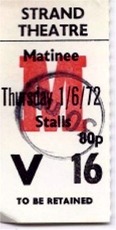
London theatre tickets at the time were different from what I was used to in the Colonies. As seen in this advert, the name of the show is not printed on the tickets, just the theatre name, date and time of performance, seat location and the price. I guess you just had to know what show you were seeing! These were the stubs from the two performances of Company I attended that week. 

(note: for Dietrich, it looks like the price increased from the printed 70p to a walloping 1 quid!!)


May, 1972.  I'm going to tell you a story and I swear on my parents' drawer it's true. Dietrich did NOT walk onstage. I don't how she got center stage, maybe she was flown down from the flies, maybe she just materialized, but the curtain was open, the lights were dim and I swear she was wheeled out on some sort of dolly. Don't roll your eyes. It's the truth! The woman did not move during the entire concert. Oh sure, she moved her hands, but she did not step one inch away from the microphone. Ever! (She held onto the mic during her bows.) I'm not sure how she left the stage. The curtain fell after what seemed like a million curtain calls, accompanied by much adoring screaming, and that was that. Dolly or not, she was freaking awesome! All glamour and all legend. Mesmerizing. She played at the Queen's Theatre…a most appropriate name for the venue, if you catch my drift. — at Queen's Theatre, London.


May, 1972. I have absolutely no recollection of this play at all. According to a web source, Alpha Beta is "about a marriage in terminal decline." Couldn't prove it by me. I'm certain the draw must have been the dual casting of Albert Finney, best known for playing the randy Tom Jones, and Rachel Roberts, a fine actress, but at the time probably most noted for being the most recent ex-Mrs. Rex Harrison. Finney continues to act to this day; Roberts tragically committed a rather gruesome suicide in 1980 at age 53. Playwright E.A. Whitehead was reasonably popular at the time and was the resident playwright at the Royal Court . This was his second play. There is no Wikipedia entry on him; and an Internet source indicates his most recent play was in 1977. Well, it was over forty years ago!  - at the Apollo Theatre, London


June, 1972. The British do love their sex farces and their saucy, but ultimately innocent, entertainments and No Sex, Please - We're British could safely be considered the quintessential British sex farce. The critics hated it, but it ran for a zillion years on the West End. (It was a big flop in a Broadway edition. I think it's safe to say the British sex farce doesn't cross the Pond very well.) The ridiculous plot had something to do with Scandinavian porn being sent to a young bride instead of Scandinavian glassware and the complications that ensued. It was silly, but modestly fun. The matinee audience at the Strand shrieked with laughter and a few gasps of titillated delight. I was somewhat less than enthusiastic. It was played with great gusto by a young Michael Crawford as the friend of the bridegroom whose muddles everything up and London theatre grand dame Evelyn Laye as the bridegroom's very proper mum. An agreeable enough way to spend the afternoon. - at the Strand Theatre, London
June, 1972. Taking a break from live theatre, I managed to see a couple of movies during my visit. To be truthful, I think it was primarily because I couldn't find a Friday matinee and the second film had a late showing. Whatever the case….
Film 1: The Music Lovers. Ken Russell's sumptuous and over-the-top film about Tchaikovsky was, and remains, a rather delicious bon-bon of sex, music, and really good scenery and costumes. Am I the only one, but did everyone in that film seem a bit (or more than just a bit) on the pervy side? The sequence with Glenda Jackson writhing naked on the floor of the train compartment and Richard Chamberlain's horrified reaction to it remains one of the most unforgettable and disturbing sequences on film. And the final visual of Glenda Jackson looking out from the barred window of the insane asylum is haunting. The theatre, a one-level house on Tottenham Court Road, was closed in 1976. - at the Berkeley Theatre, London
Film 2: Cabaret. What good is sitting alone in your room, indeed. In London, Cabaret was treated as a road-show film, with limited show times and reserved seating. The Prince Charles, located in Leicester Square, still exists, but it's now a repertory film house.  My seat in the Front Stalls was in the smoking section (an ashtray was conveniently provided in the seat back in front of me) and that picture was a perfect one to enjoy a cigarette or two. (I also had a G&T….civilized movie-going!). I digress. Back then, major motion pictures, like Cabaret, had souvenir programs with bios and pictures, just like their legit cousins. Now, I will say this only once. Cabaret the musical play and Cabaret the musical film are not the same show. They are first-cousins at best, but definitely not the same. The dramatic thrust is different, character treatments are very different, major characters from the play are deleted or relegated to bit status in the film and new characters added for the film, ditto with songs, etc. etc. It won a crapload of Oscars and it's a brilliant film; I just prefer the stage version. - at the Prince Charles Cinema, London


June, 1972. This musical version of Chaucer's classic didn't do well in New York, but was a 2000-odd performance smash in London. When I saw this, it was in its fifth year. Jessie Evans, the biggish name in the cast, was out that performance. I remember being unimpressed with the show to the point of boredom, but then, frankly, Chaucer's original didn't do it for me, either. Pretty much a miss. - at the Phoenix Theatre, London


June, 1972. A French Ravenal, an Illinois native as Magnolia ("and introducing Lorna Dallas as Magnolia"), a chorus of 38, 10 billed principals and a gorgeous physical design made this production of the Jerome Kern/Oscar Hammerstein II classic a sight to see and hear. It was quite the spectacle and just this side of being overproduced. Trust me on this…you haven't lived until you've heard a group of British chorus folk trying to wrap their tongues around a Southern drawl. I smiled a lot. Personally, I can take or leave Show Boat. The score is gorgeous and the story has something to say, but there's just something about it that seems, I don't know, flat. My reason for going was to see the late Kenneth Nelson, the fine actor who originated roles in The Fantasticks and The Boys in the Band. He became an London expat after his last New York show, Lovely Ladies, Kind Gentlemen failed rather spectacularly with lots of press and talk about the power of the critics, specifically the New York Times critic, a debate that continues to this day. He would have a successful career in the UK.  He died in 1993. - at the Adelphi Theatre, London


June, 1972. My debut week in London concluded with this tasty little thriller written by novelist/screenwriter/playwright Francis Durbridge and starring Gerald Harper, then a major UK telly star. Other names included Veronica Strong (another TV name), Terrence Longdon, and a young Penelope Keith, who would become a Commander of the Order of the British Empire in 2007. But look who's also listed…."international stage and TV star" Rula Lenska of VO5 fame! In 1971, she was just another working actress. She wouldn't become a United States TV personality until the late 70s. A quick read of her Wikipedia entry indicates she's worked constantly, often in "B" stuff, but, really, Rula, Celebrity Big Brother? Back to the play itself. While the details escape me, I do remember this being a suspenseful, involving play and enjoying it quite a lot. A suitable conclusion to a memorable visit. - at the Fortune Theatre, London

Cheers for now. See a play or musical this week. As always, comments welcome!


Sunday, April 7, 2013

THESE ARE A FEW OF MY FAVORITE ... PLAYS (the top 10) - PART 1

THESE ARE A FEW OF MY FAVORITE ... PLAYS (the top 10)
PART 1

Unlike my top twenty-five musicals, I haven't seen professional productions of all of my top twenty-five plays.  Most of them, yes, but there are a few exceptions. So how, you ask, can a play be among my top 25 if I've not seen a production of it? Simple answer: the script itself. Musicals have cast albums and an outstanding cast recording can make even an average musical sound good. Very often that's what makes the first impression rather than the book of a musical. But a play is almost always just words and if the words aren't compelling, the play doesn't work no matter how brilliant the cast. Now let me state flat out that my favorites are not going to necessarily be your favorites. You might look at a title and say, "Really? You like that play?" You'll notice there's not a Shakespeare or a Stoppard or a Mamet or a Williams in the bunch and an absence of many of the so-called Bests. (Okay, I admit it. I don't give a crap about "Our Town.") And the list, like any "Bests" list, is a fluid thing. This list is not set in stone. I'm positive there will be plays in the future that will get top ten status and rankings will change.

So, then, how does a play make my list. That's easy to answer. The play has to, for lack of a better word, speak to me. It's more of an intuitive thing rather than a quantitative one. What does my gut tell me? How did I react to it? Many of the plays on my list have gay themes, plots or sub-plots. I'm a gay man and rightly or wrongly, I am drawn to plays with gay themes, plots or sub-plots. Sue me.

So…without further ado, the Top 10-Part 1

# 10 - THE HISTORY BOYS by Alan Bennett


January, 2008. This play about adolescence, sex, the role of education, the teaching of history and what history teaches us, and how young promise does not always translate into adult success is literate, funny, touching and moving. We saw the excellent film version first and this National Theatre production, with an impeccable replacement cast, surpassed the film. Seeing it live…well, there's just no substitute. Terrific performances by everyone. I loved every minute of it. Truly remarkable. - at Wyndham's Theatre, London


June, 2009. We were so looking forward to this production. TimeLine Theatre Company is one of the finest in Chicago and one of the actors from Bob's production of The Sum of Us was playing Dakin, the resident student stud. We figured TimeLine would do justice to this wonderful play. The critics certainly thought so and it ran and ran and ran for a total of six months or so and became TimeLine's biggest success. Sadly, however, we were less than impressed. The alley staging and the scenic design didn't do the show any favors as it scattered the focus too much. There was no joy in the production, no camaraderie between Hector and the boys or among the boys themselves and except for a nice job by the actor playing Posner, no one was even remotely interesting, including Donald Brearley's Hector, which just left me cold. Why was Hector so popular? There was absolutely no indication in Brearley's lackluster performance. Perhaps it was an off night. Perhaps we were spoiled by the flawless West End production. Whatever the case, we left at the interval. A rare misfire for TimeLine. - at TimeLine Theatre, Chicago


#9 - THE LARAMIE PROJECT by MoisÄ—s Kaufman and the Members of the Tectonic Theater Project
December, 2004. This is one play I must see performed by professional actors, but I rather doubt it would have the same emotional impact that this wonderfully acted high school production had.  Some background. In the spring of 2004, Bob and I were reading plays and searching for the perfect one for Bob to direct as his last directorial project as a high school teacher. (He retired at the end of the 2004-2005 school year.) I was reading this just to be reading it, but the minute I finished it, I handed it to Bob and said, "You must do this." Like me, he read it in one sitting and he was hooked. It took a bit of convincing, but the powers-that-be signed off on it and with a cast of 22 (!!), this was a fitting finale to Bob's teaching career and a tribute to his skill both as a director and as a theatre educator.  What makes this play so extraordinary? Let me quote what Bob wrote in his director's notes: "I chose The Laramie Project as my final production because it speaks to the very core of who we are - of the heights to which we can soar and the depths to which we can descend. The plays is a testament of the enduring human spirit." This is a remarkable piece of work. Remarkable because it creates something beautiful out of something so horrific it is almost beyond comprehension. Bravo, Mr. Kaufman. Bravo. (Note: we were honored to get permission from photographer Nanette Martin to use her moving photograph for our program cover.) - at the McGee Theatre, New Trier High School, Winnetka, IL 

#8 - WHO'S AFRAID OF VIRGINIA WOOLF? by Edward Albee


February, 2005. "We've played Humiliate the Host…we've gone through that one…what shall we do now? … How about…how about…Hump the Hostess?" By the time the curtain came down on this Broadway-bound revival of this legendary contemporary American theatre masterpiece, I was simultaneously exhausted and exhilarated.  Exhausted because, well, let's face it, spending time with George and Martha is exhausting. Exhilarated because, instead of being just braying, showboating, over-the-top characters, as portrayed by Kathleen Turner, Bill Irwin, Mireille Enos and David Harbour, they were infused with a humanity and a vulnerability that ultimately made the play sad, yet oddly hopeful and rather touching. A simply sensational performance by Bill Irwin earned him a well-deserved Tony Award. And while no one can really quibble with Cherry Jones' win for Doubt, I think the better choice would have been Kathleen Turner's phenomenal turn as Martha. I was impressed with the local production I saw decades earlier at the Ivanhoe with Eileen Herlie. This production simply blew me away. Curiously, the Playbill calls this "Edward Albee's Who's Afraid of Virginia Woolf?" Well, duh! Whose else would it be? This is a trend. Stop it. - at the Wilbur Theatre, Boston


#7 - MY NIGHT WITH REG/THE DAY I STOOD STILL/MOUTH TO MOUTH by Kevin Elyot
Three exceptional plays by the relatively unknown here in the States Kevin Elyot.  Each of them confronts loneliness, loss, love, unrequited love and the struggles of people just trying to live their lives.


aka Hugh Bonneville, aka the Earl of Grantham.  Looking pretty hot there, your Lordship!


August, 1995. Written and first produced during the height of the AIDS plague in the early-mid 1990s, I saw this during a time of great emotional upheaval, loss and sorrow and felt the pain these characters felt with an heightened awareness that made Elyot's fine comedy-drama seem personal. Crisp dialogue and acting together with an appropriate physical production and invisible direction made for a memorable, sad/funny evening. (Sidebar: before he started being Master of the House in the divine "Downton Abbey," Hugh Bonneville, then billed as Richard Bonneville, played Daniel in this production. Richard is his middle name.)- at the Playhouse Theatre, London


Spring, 1998. As performed in the National Theatre's intimate Cottesloe Theatre, this play lyrically moved between present and past with a fluidity that made this both an exceptional memory play as well as a exceptional modern play. The loneliness and the memory of unrequited love was almost palpable. As performed by its talented cast, this haunting evening ranks very high on my "best" list. - at the Cottesloe Theatre, London


Fall, 2008. When I first read Mouth to Mouth, I was blown away by it. I still am. It's a devastating work that slaps you when you least expect it, usually when you're laughing at one of Elyot's very funny lines. That's what I love about Elyot: his ability to make you laugh and then make you gasp in a beat. I love the play and thought I'd feel the same about this performance. I didn't. Oh, the acting was fine, especially David Cale and Lisa Emery, but there appeared to be a chilly efficiency to the whole affair that robbed the play of both its legitimate humor and its legitimately slimy creepiness. I felt I was watching really good actors play at characters rather than inhabit them. Really glad I saw it, but a bit disappointed. The play itself, however, is a winner. - at the Acorn Theatre (The New Group), New York

#6 - TAKE ME OUT by Richard Greenberg

August, 2003. This Tony Award-winning play for 2003 was a stunning, brilliantly acted play about baseball, life, prejudices and hope.  Daniel Sunjata, Neil Huff, Frederick Weller and Nat DeWolf (subbing for Denis O'Hare) delivered performances of nuance and great humanity, even when you didn't necessarily like the character (Mr. Weller played the show's bad guy.) Top-notch direction and superb production values were the icing on this cake. And, I would be remiss as a gay man if I didn't at least mention the nude shower scene. Prurient perviness aside, the scene was crucial to the plot, but it was an added bonus. Why is this in the top ten? Because it's an amazing play, a true home run! - at the Walter Kerr Theatre, New York.

That's it for now. What show are YOU seeing this week? Ciao!


CONCERTS AND TUNERS AND PLAYS…OH, MY! - vol. 1

  CONCERTS AND TUNERS AND PLAYS…OH, MY! vol. 1 Spring is finally here. And what better way to celebrate than by strolling down theatrical ...