ALPHABET SOUP (13):
FEATURING A RANDOM LETTER OF THE ALPHABET AND
SOME SHOWS THAT BEGIN WITH THAT LETTER
B
Today, the blue London mug gave me the letter "B"
… a classic Inge, a hit revue featuring music of the Harlem Renaissance era
(1920-1940) written by African-American song masters, a one-woman show starring
the dazzling Caroline O'Connor, a Lerner and Loewe masterpiece, a Sondheim show
that has never really landed, a quintessential Ayckbourn farce, and Peter
Allen's life, Broadway style, that featured one of the most breathtaking
performances I've seen.
BUS STOP – Ivanhoe
Theatre, Chicago

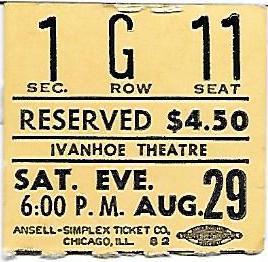


August, 1970. Even though only fifteen years had passed
since Bus Stop opened on Broadway,
Chicago reviewers praised the actors, but found the play itself to be coy, a
little too twee. A lot happened in those fifteen years: three gut-wrenching
assassinations, the escalation of an unpopular and doomed war resulting in
riots and protests, Stonewall, Hair
on Broadway featuring a glimpse of full-frontal nudity, Oh, Calcutta! on Broadway, a musical revue featuring sketches by
some leading talent of the time, that featured lots of nudity, the
Sharon Tate/Manson murders, the rise of the counterculture and the younger
generation questioning the status quo and the politics of power, the Democratic
convention in Chicago in 1968, the moon landing. Given all that, it's
not surprising that a gentle, unprepossessing show about a group of people
stranded in a Kansas diner in a blizzard would seem a bit dated and quaint. But
this production, expertly directed by the remarkable George Keathley, had a
cast, including Chicago vets George Womack, Marrian Walters, and Bob Thompson, that enchanted the audience. No matter how good the supporting players, if the
leading roles of would-be chanteuse Cherie and her cowboy would-be mate Bo
Decker aren't played well, the play sinks. This production was blessed with the
handsome and versatile Ben Piazza as Bo and the quirky, always fascinating
Sandy Dennis as Cherie. Piazza would soon play the macho Nick in Ivanhoe's Who's Afraid of Virginia Woolf? and
Dennis made a career out of playing wounded, flawed characters in both comedies
and dramas, as witnessed in Ivanhoe's A
Streetcar Named Desire in which she played Blanche (!!) and the national
tour of And Miss Reardon Drinks a Little
at the Civic. Both Piazza and Dennis played their characters with affection and
conviction and, as a result, the play had an unshakeable charm that almost hid
the just-under-the-surface creakiness. A fine production all around. I
thoroughly enjoyed it. – at the Ivanhoe Theatre, Chicago
Sidebar:
In Bus Stop's Broadway production,
Elaine Stritch originated the part of Grace, the diner proprietress, and Kim
Stanley originated the role of Cherie.
William
Inge Sidebar: Repressed sexuality plays an important part in William Inge's
four plays that are considered American classics: Come Back, Little Sheba, Picnic, Bus Stop, and The Dark at the Top of the Stairs. A closeted homosexual from very
conservative Kansas, Inge only overtly referenced gay characters in a couple of
works, but it's been suggested that Inge's conflicted sexuality infused the
sexual conflicts in his plays. A 2015 Chicago production of Picnic with gender-bending casting was
more admired than liked and, for some reviewers, brought Inge's sexual
insecurities to the forefront. Inge committed suicide in 1973, ending a
lifelong struggle with alcoholism and his sense of failure. While perhaps a bit
racy in the 1950s with their sexual energy, Inge's plays are tame by today's
standards.
BUBBLING BROWN SUGAR
– Blackstone Theatre, Chicago


November, 1975. My research on the show tells me that there
was a plot, of sorts, a sort of stroll down Harlem's memory lane with show biz
old-timers sharing stories and songs with some youngsters as they walk through mid-1970s Harlem. If you say so. I vaguely remember "back in my day"
moments, so I guess there was a storyline. What I do remember, however, is how this show sizzled with drop-dead
outstanding performers, dazzling choreography and musical staging by Billy
Wilson, a simply sensational onstage orchestra, and terrific songs, both
especially written for the show and songs from the heyday of Harlem (1920-1940).
Old pros Avon Long, Joseph Attles, and Thelma Carpenter were in fine form, but
for me, the highlight of the show was Vivian Reed, a sultry seductress with a
voice that simply caressed you. Any doubts, there's a clip of her from the 1976
Tony Awards on YouTube. There wasn't a weak link in the show and when the show
arrived on Broadway a few months later, it would enjoy a profitable run of 766
performances. This musical revue did more than simply "bubble." It
boiled over with talent and entertainment. – at the Blackstone Theatre, Chicago
Sidebar:
Avon Long originated the role of Sportin' Life in several revivals of Porgy and Bess in the 1940s. Joseph
Attles' career began in 1928, that's right, 1928,
as a performer in Blackbirds of 1928.
Vivian Reed, a Julliard graduate, would appear on Broadway only sporadically,
but had a successful career as a singer and nightclub performer. (I think I may
still have her 1976 album Brown Sugar.)
Thelma Carpenter was a familiar name to me from her stint as Pearl Bailey's
standby in Hello, Dolly!, going on as
Dolly at least 100 times, and later becoming the publicized and fully-billed
matinee star. She had a roller-coaster career and was replaced before the
Broadway opening with Josephine Premice. Carpenter played Miss One in the
god-awful film version of The Wiz.
Filling
in for Pearlie Mae: As mentioned above, Thelma Carpenter filled in for
Pearl Bailey at least 100 hundred times before being named the matinee Dolly. At
eight performances per week, that means Carpenter replaced Pearlie Mae for, at
minimum, 12 ½ weeks, or roughly 3 ½ months. That's a lot of filling in!
BOMBSHELLS – Quadracci Playhouse (Milwaukee Rep), Milwaukee


December, 2010. Dizzying, dazzling, dynamic portrayals of
six completely different women all performed by the indomitable Caroline
O'Connor made for a singular theatrical treat. In its U.S. premiere, and
written for O'Connor, this was a one-woman show on steroids. Director Mark
Clements wisely knew that all he had to do was give his star the framework and
she would flawlessly fill in the details. Effective scenic, costume, and
lighting designs put the icing on this multi-faceted cake. In rapid two hours,
O'Connor played an Australian suburban housewife, an English abandoned wife, an
Irish teenager, an Australian bride-to-be, an English widow, and a faded
American diva. Each was individual, totally unique. The Milwaukee Journal Sentinel put it this way:
"O'Connor consistently remakes the deliberately bare stage in the image of
each woman's careening fears and desires." In my book, O'Connor can pretty
much do no wrong. This was simply astounding. – at the Quadracci Playhouse
(Milwaukee Rep), Milwaukee
BRIGADOON – Majestic Theatre, New York


October, 1980. Brigadoon
holds a special place in my heart. When I was eleven or twelve, my grandmother
took me to see a performance of Brigadoon
produced by Waukegan Community Players in association with the Waukegan
Symphony Orchestra. It was my very first stage production, and I was enraptured
with the orchestra, the music, the actors, and the story of a village which
appears once every hundred years. It has remained a favorite ever since.
This production was the first major New York revival of the Lerner and Loewe
classic, not counting limited run City Center productions. Featuring the original iconic Agnes deMille
choreography, still divine, the show starred a radiant Meg Bussert as Fiona and
a virile Martin Vidnovic as Tommy, a role completely opposite of his gripping
performance as the brooding Jud in the previous season's Oklahoma! Together and individually, they were magic. UK Olympic
figure skating gold medal winner John Curry and dancer Marina Eglevsky played
the doomed Harry and Maggie, and were the principals in Brigadoon's two deMille masterpieces, "Sword Dance" and
"Funeral Dance," respectively. Broadway vets Frank Hamilton, Jack
Dabdoub, and Casper Roos played the older folks, Stephen Lehew, seen as Henrik
in the tour of A Little Night Music, played
the lovestruck Charlie, Mollie Smith played the thankless role of Jean, and
Elaine Hausman did what she could with the annoying role of Meg. Brigadoon is a quintessential 40s
musical, and as such, sometimes creaks a little. Personally, I'd eliminate most
of Meg's part and especially her two songs, which are nothing but endless list
songs that contribute absolutely nothing to the plot, and what may have been
seen as slightly naughty and risqué in 1947, in 1980 was cloying. But, director
Vivian Matalon knew if he treated the show honestly and with respect, the
glories of it would shine through and make the occasional clunkiness
irrelevant. I, and the audience of jaded New Yorkers who filled the Majestic
Theatre, were enchanted. It was a thrill to see Brigadoon so magnificently produced, sung, and danced. I may have
even gotten a little weepy at the end. – at the Majestic Theatre, New York
Fun
Fact: Martin Vidnovic is Laura Benanti's father!
Sad
Fact: Brigadoon would be John
Curry's only Broadway musical and his second and last appearance on Broadway.
(His first was a special limited engagement booking called Icedancing.) Curry would die in 1994 at the age of 44, a victim of
AIDS, like far too many of my generation.
Sidebar:
While I loved this production, I pretty much hated a 2014
"reimagined" production at Chicago's Goodman Theatre.
Director/choreographer Rachel Rockwell just destroyed this lovely, gentle show.
Not one of Goodman's finer moments. (See SUMMER SNAPSHOTS: NYC, WASHINGTON, MINNEAPOLIS, STORRS (WHERE?)
AND CHICAGO - Summer, 2014 - Part 2 post.)
BOUNCE – Goodman Theatre, Chicago


August, 2003. Poor Bounce. It's been bounced around more than
any well-intentioned musical should, pun definitely intended, with multiple
name changes, revisions, songs added, songs dropped. And even with all that,
the show, now called Road Show, has
never received the type of critical love and/or respect usually given to a show
by Stephen Sondheim. When Bounce began
its world premiere run at the Goodman, the press gave it a rousing thumbs-down,
with grudging respect for the score. But, instead of being the disaster I
expected, the evening turned out to be entertaining, often somewhat of a hot
mess, but entertaining. The story of the Mizner brothers, one a con artist and
one the architect who put Boca Raton, Florida, on the rich and famous map, was
told in big, broad strokes, so we never really got to know the brothers. The
dramatic arc of the story was literally all over the place, and sometimes it
was hard to follow what was going on. The cast tried mightily to put their
flawed material over. Film legend Jane Powell played Mama Mizner with a film
legend authority, though, and this is really unfair to Ms. Powell, it kind of
seemed like box-office casting, rather than character-driven casting. No
matter, she did well in an underwritten part, and when she wasn't onstage for
Act Two, you didn't miss her. Tony-winner Michele Pawk brought strength to her
role as Wilson Mizner's wife. Gavin Creel was earnest as Addison Mizner's
lover. Howard McGillin played con man Wilson Mizner in fine voice, and Richard
Kind played the closeted Addison with a nebbishy loveableness. Kind fared best
of all the characters. It was directed by Harold Prince with a surprising lack of
focus. Is this a vaudeville? Is it a musical drama? No one seemed to know. John
Weidman's book was scattered, and Sondheim's score had a little bit of this, a
little bit of that, some good, some not so good, but, let's face it, imperfect
Sondheim is usually better than someone else's perfect. To date, it has never
made it to Broadway. I suspect it never will. Flawed, but noble, I'm definitely
glad I saw it. – at the Goodman Theatre, Chicago


What's
In a Name?: When Bounce workshopped
in 1999, it was called Wise Guys.
Then, briefly, it became Gold! Then Bounce for the Chicago premiere and a
subsequent engagement at the Kennedy Center. Revised and without an
intermission, and with a downgraded Michele Pawk character, Bounce became Road Show and that's how it's licensed today. Making the show
darker seemed to please the critics more, though that's relative, and this
version has enjoyed runs at the Public in New York, the Donmar Warehouse in
London, the Chicago Shakespeare, and regional theatres nationwide.
Fun
Fact: Irving Berlin, you know, Annie
Get Your Gun Irving Berlin, tried his hand at musicalizing the Mizner
brothers with a show called, wait for it, Wise
Guy. Wise Guy also had lots of
other names: The Last Resorts, Palm
Beach, The Mizner Story, and Sentimental Guy. The project never came to
fruition. Berlin was a friend of Addison Mizner and even invested in Mizner's
Boca Raton project, which ultimately tanked. Fascinating to think how different
a Berlin Mizner musical would sound as opposed to the Sondheim one.
BEDROOM FARCE – Brooks
Atkinson Theatre, New York


Judy Ivey? Judy? Look how young Lithgow, Ivey, Schramm and Cuervo look! Lithgow was a muffin in his younger days.
August, 1979. Playwright Alan Ayckbourn is one of Britain's
most prolific and successful playwrights. He achieved his greatest fame writing
about marriage and the British middle classes with such works as Absurd Person Singular, The Norman Conquests,
How the Other Half Loves, and Bedroom Farce. The reason I saw this was
to see Mildred Natwick, so indelibly unforgettable as the mother in Barefoot in the Park and who was
luminous on the cast recording of 70,
Girls, 70, a truly underrated Kander and Ebb musical. The play focuses on
themes of marriage and relationships, young and old, and the effect
adultery and lying have on relationships. The action, under the direction of
playwright Ayckbourn and Peter Hall, was fast and furious as it bounced from
bedroom to bedroom to bedroom. Although often quite funny, it wasn't the madcap
farce I was expecting, and I was a bit disappointed. I wasn't disappointed, however, by Mildred Natwick. She was every bit
as wonderful as I had hoped, with precision comic timing and a warmth that
enveloped the theatre. Every bit her equal was Robert Coote, the original
Colonel Pickering in My Fair Lady and
the original King Pellinore in Camelot.
Rounding out the cast were such talents as John Lithgow, Alma Cuervo, John
Horton, Lynn Milgrim, David Schramm (in the 90s, a regular on Wings), and, in her Broadway debut,
Judith Ivey. If, at the end of the evening, it all felt a bit flat, seeing
Mildred Natwick more than made up for any reservations I may have had. – at the
Brooks Atkinson Theatre, New York
Sidebar:
When the play debuted on Broadway in March, 1979, it featured its original
London cast. When this cast took over, the New
York Times remarked that the American cast worked better as an ensemble and
focused more on the funnier sitcom elements of the play. Bedroom Farce would close a financial failure after only 276
performances. Alan Ayckbourn is also the author of the nifty thriller Haunting Julia, which we saw in
Edinburgh a few years back (see HAVE
PASSPORT, WILL GO TO THEATRE - Part 2 post.)
THE BOY FROM OZ – Imperial Theatre


December, 2003. New Year's Eve, 2003. Police barricades
blocked off 45th Street between 7th and 8th, and bags and theatre tickets were checked by the NYPD to make sure you had a
reason to be on 45th Street. Uber security? Perhaps, but I felt safer on a New
York street than I ever had before or since, for that matter. What this all
meant, though, was that getting to the Imperial was slow-going, and as a
result, when the 7:00 PM curtain time rolled around, there were many empty
seats for the sold-out performance. Promptly at 7:00, the house lights went to
half, and then Hugh Jackman came out and announced that the curtain would be
held for twenty minutes to allow folks to get through the enhanced security so
everyone could see the show from the start. What a guy! And with that, we all
applauded like mad, and, well, could we possibly love him more? As it turned
out, we could. In fact, we loved Hugh Jackman so much we all were perfectly
willing to ignore the fact that his show was, well, rubbish. Entertaining
rubbish, very entertaining rubbish, but rubbish nonetheless. Certainly no one
could fault the terrific Peter Allen songs, but Martin Sherman's book, based on
the original book by the late Nick Enright, was a series of bits rather than an
actual story where we got to know The Boy from Oz, Peter Allen. There were
early Peter bits, Mom Marion bits, Liza bits (Allen was Liza's first husband),
Judy bits (Allen was Judy's son-in-law), long-time lover bits, lover dying
bits, ghost bits, concert bits, but nothing with anything resembling depth or
nuance. Production-wise, it was often glitzy and flashy. Philip Wm. McKinley's
direction and Joey McKneely's choregraphy got the job done with neither
embarrassment nor distinction. Leslie Alexander filled in for Beth Fowler as
mom Marion as was appropriately warm and matronly and sang
the oddly-placed "Don't Cry Out Loud" with verve. P.J. Verhoest was
playing Young Peter that night and was appropriately endearing. Tony-winner (Damn Yankees) Jarrod Emick was
appropriately moving as long-time lover Greg Connell, and the "Love Don't
Need a Reason" duet with Jackson was especially touching. Isabel Keating
as Judy Garland was just eerily, almost creepily, like the late icon and for
the brief time she was onstage, gave the show a stunning verisimilitude. And
there was something pretty damn wonderful when Keating and Jackman sang
"Quiet Please. There's a Lady on Stage." I, frankly, hated Stephanie J. Block's Liza
Minnelli. Her Liza just seemed off, especially went placed side-by-side with
Keating's spot-on interp. She wasn't bad, mind you; I just wasn’t a fan. But
when all is said and done, The Boy from
Oz was all about Hugh Jackman. Jackman sang; Jackman danced; Jackman
flirted outrageously with the audience. Well before the final curtain fell, I
don't think there was a man or woman in the audience who didn't want to be
Jackman's friend, lover, or somewhere in-between. It all seemed effortless on
his part, and best of all, Jackman appeared to be having a blast. High energy
that never flagged, he gave his audience one hundred percent and then some. What
was onstage at the Imperial was perhaps more Hugh Jackman and less Peter Allen,
but Hugh Jackman's performance was, and remains, one of the most flat-out amazing performances that I've
seen. Single-handedly, he took a mediocre property and elevated it to show biz magic. And I loved practically every minute! – at the Imperial Theatre, New York
Sidebar:
I saw Peter Allen live once at a star-studded AIDS benefit at the Chicago
Theatre in the mid 1980s. I believe he opened the second half with a two or
three song set. Flamboyant, charismatic, and always eager to please, qualities
he shared with the man who would portray him in 2003, he was one-of-a-kind. His
death from AIDS in 1992 was a major loss.
Another
Sidebar: A major hit in its native Australia, The Boy from Oz was the first Australian musical to be presented on
Broadway. Hugh Jackman didn't miss a scheduled performance during its
396-performance run, including previews, and despite mediocre reviews for the
show, his presence would propel the show to profitability. He would also win
the 2004 Tony for Best Actor in a Musical for his sensational Broadway debut.
Yet
Another Sidebar: Trying to insert a song catalog into a book show is tricky
business. Sometimes it works; sometimes it's less successful. Jersey Boys probably did it best,
followed closely by Mamma Mia!'s
surprisingly successful shoehorning of ABBA's hit tunes into the silly plot.
Another Aussie import, Priscilla Queen of
the Desert, struggled with its score and that hurt the show overall. The Boy from Oz wasn't as good as the
ABBA and not as unsuccessful as Priscilla,
which could have hugely benefited from some original songs.
Final
Sidebar: Just how much The Boy from
Oz benefitted from Hugh Jackman's participation was evident when a local
Chicago production was mounted a few years back. The show's many flaws were on
full display and no matter how mightily the cast tried, they just couldn't
surmount them. A cheesy physical production and a lame ensemble didn't help
matters. Valiant effort, but without all
the bells and whistles and a charismatic star, it often just sort of sat there.
And with that…until later! TTFN!
© 2018 Jeffrey Geddes


